

Vectors 273
the horizontal component of the 20 m/s velocity is
20 cos90 ◦ = 0 m/s
and the horizontal component of the 15 m/s velocity is
15 cos195 ◦ = −14.489 m/s.
The total horizontal component of the three velocities,
H = 8.660 + 0 − 14.489 = −5.829 m/s
The vertical component of the 10 m/s velocity
= 10 sin 30 ◦ = 5 m/s,
the vertical component of the 20 m/s velocity is
20 sin 90 ◦ = 20 m/s
and the vertical component of the 15 m/s velocity is
15 sin 195
◦
= −3.882 m/s.
The total vertical component of the three forces,
V = 5 + 20 − 3.882 = 21.118 m/s
5.829
21.118
R
␣
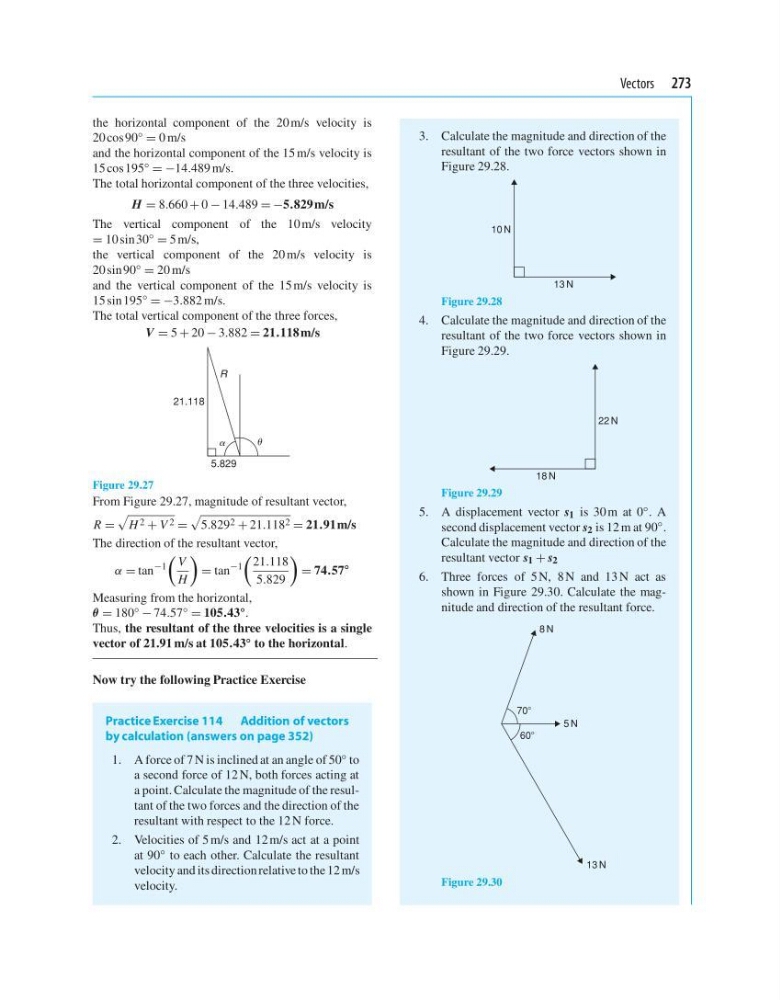
Figure 29.27
From Figure 29.27, magnitude of resultant vector,
R =
H 2 + V 2 =
5.829 2 + 21.118 2 = 21.91m/s
The direction of the resultant vector,
α = tan
−1
V
H
= tan
−1
21.118
5.829
= 74.57
◦
Measuring from the horizontal,
θ = 180 ◦ − 74.57 ◦ = 105.43 ◦ .
Thus, the resultant of the three velocities is a single
vector of 21.91 m/s at 105.43 ◦ to the horizontal.
Now try the following Practice Exercise
Practice Exercise 114 Addition of vectors
by calculation (answers on page 352)
1. A force of 7 N is inclined at an angle of 50 ◦ to
a second force of 12 N, both forces acting at
a point. Calculate the magnitude of the resultant of the two forces and the direction of the
resultant with respect to the 12 N force.
2. Velocities of 5 m/s and 12 m/s act at a point
at 90 ◦ to each other. Calculate the resultant
velocity and its direction relative to the 12 m/s
velocity.
3. Calculate the magnitude and direction of the
resultant of the two force vectors shown in
Figure 29.28.
10 N
13 N
Figure 29.28
4. Calculate the magnitude and direction of the
resultant of the two force vectors shown in
Figure 29.29.
22 N
18 N
Figure 29.29
5. A displacement vector s 1 is 30 m at 0 ◦ . A
second displacement vector s 2 is 12 m at 90
◦ .
Calculate the magnitude and direction of the
resultant vector s 1 + s 2
6. Three forces of 5 N, 8 N and 13 N act as
shown in Figure 29.30. Calculate the magnitude and direction of the resultant force.
5 N
13 N
8 N
708
608
Figure 29.30
the horizontal component of the 20 m/s velocity is
20 cos90 ◦ = 0 m/s
and the horizontal component of the 15 m/s velocity is
15 cos195 ◦ = −14.489 m/s.
The total horizontal component of the three velocities,
H = 8.660 + 0 − 14.489 = −5.829 m/s
The vertical component of the 10 m/s velocity
= 10 sin 30 ◦ = 5 m/s,
the vertical component of the 20 m/s velocity is
20 sin 90 ◦ = 20 m/s
and the vertical component of the 15 m/s velocity is
15 sin 195
◦
= −3.882 m/s.
The total vertical component of the three forces,
V = 5 + 20 − 3.882 = 21.118 m/s
5.829
21.118
R
␣
Figure 29.27
From Figure 29.27, magnitude of resultant vector,
R =
H 2 + V 2 =
5.829 2 + 21.118 2 = 21.91m/s
The direction of the resultant vector,
α = tan
−1
V
H
= tan
−1
21.118
5.829
= 74.57
◦
Measuring from the horizontal,
θ = 180 ◦ − 74.57 ◦ = 105.43 ◦ .
Thus, the resultant of the three velocities is a single
vector of 21.91 m/s at 105.43 ◦ to the horizontal.
Now try the following Practice Exercise
Practice Exercise 114 Addition of vectors
by calculation (answers on page 352)
1. A force of 7 N is inclined at an angle of 50 ◦ to
a second force of 12 N, both forces acting at
a point. Calculate the magnitude of the resultant of the two forces and the direction of the
resultant with respect to the 12 N force.
2. Velocities of 5 m/s and 12 m/s act at a point
at 90 ◦ to each other. Calculate the resultant
velocity and its direction relative to the 12 m/s
velocity.
3. Calculate the magnitude and direction of the
resultant of the two force vectors shown in
Figure 29.28.
10 N
13 N
Figure 29.28
4. Calculate the magnitude and direction of the
resultant of the two force vectors shown in
Figure 29.29.
22 N
18 N
Figure 29.29
5. A displacement vector s 1 is 30 m at 0 ◦ . A
second displacement vector s 2 is 12 m at 90
◦ .
Calculate the magnitude and direction of the
resultant vector s 1 + s 2
6. Three forces of 5 N, 8 N and 13 N act as
shown in Figure 29.30. Calculate the magnitude and direction of the resultant force.
5 N
13 N
8 N
708
608
Figure 29.30