

Vectors 269
(iii) The resultant force is shown as R and is measured
as 18 N and angle θ is measured as 34 ◦ .
Thus, the resultant of the two force vectors is 18 N at
34 ◦ to the 15 N force.
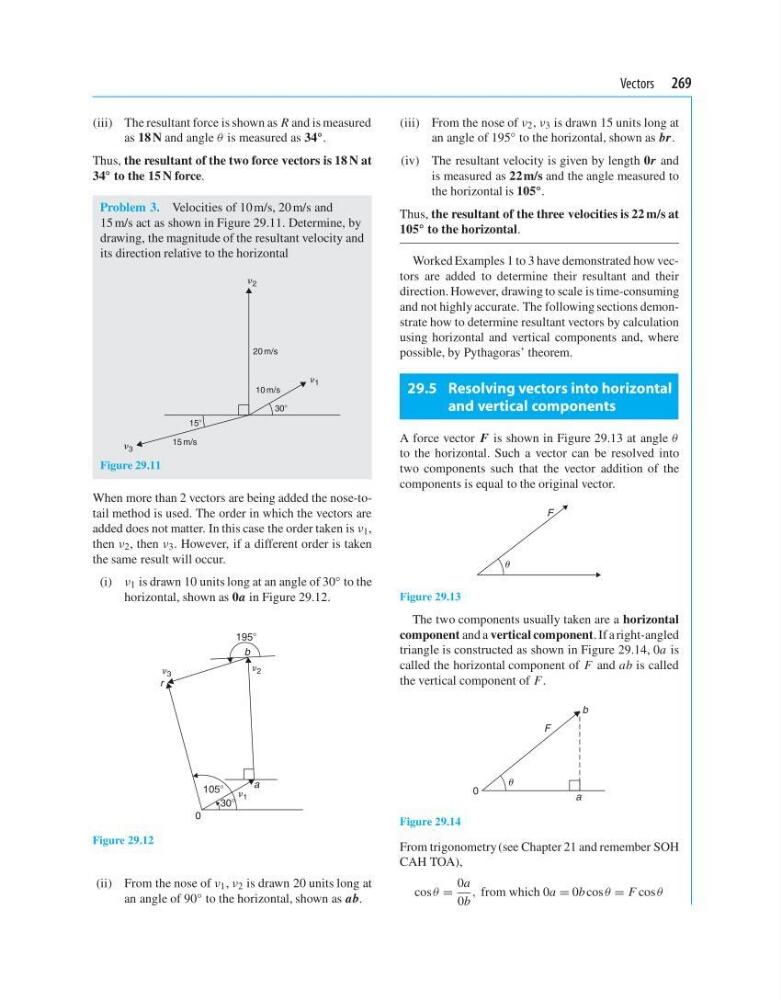
Problem 3. Velocities of 10 m/s, 20 m/s and
15 m/s act as shown in Figure 29.11. Determine, by
drawing, the magnitude of the resultant velocity and
its direction relative to the horizontal
15Њ
3
2
1
30Њ
10 m/s
20 m/s
15 m/s
Figure 29.11
When more than 2 vectors are being added the nose-totail method is used. The order in which the vectors are
added does not matter. In this case the order taken is ν 1 ,
then ν 2 , then ν 3 . However, if a different order is taken
the same result will occur.
(i) ν 1 is drawn 10 units long at an angle of 30 ◦ to the
horizontal, shown as 0a in Figure 29.12.
b
195Њ
105Њ
0
30Њ
1
3
2
r
a
Figure 29.12
(ii) From the nose of ν 1 , ν 2 is drawn 20 units long at
an angle of 90 ◦ to the horizontal, shown as ab.
(iii) From the nose of ν 2 , ν 3 is drawn 15 units long at
an angle of 195 ◦ to the horizontal, shown as br.
(iv) The resultant velocity is given by length 0r and
is measured as 22 m/s and the angle measured to
the horizontal is 105 ◦ .
Thus, the resultant of the three velocities is 22 m/s at
105 ◦ to the horizontal.
Worked Examples 1 to 3 have demonstrated how vectors are added to determine their resultant and their
direction. However, drawing to scale is time-consuming
and not highly accurate. The following sections demonstrate how to determine resultant vectors by calculation
using horizontal and vertical components and, where
possible, by Pythagoras’ theorem.
29.5 Resolving vectors into horizontal
and vertical components
A force vector F is shown in Figure 29.13 at angle θ
to the horizontal. Such a vector can be resolved into
two components such that the vector addition of the
components is equal to the original vector.
F
Figure 29.13
The two components usually taken are a horizontal
component and a vertical component. If a right-angled
triangle is constructed as shown in Figure 29.14, 0a is
called the horizontal component of F and ab is called
the vertical component of F.
0
a
F
b
Figure 29.14
From trigonometry (see Chapter 21 and remember SOH
CAH TOA),
cos θ =
0a
0b
, from which 0a = 0b cos θ = F cos θ
(iii) The resultant force is shown as R and is measured
as 18 N and angle θ is measured as 34 ◦ .
Thus, the resultant of the two force vectors is 18 N at
34 ◦ to the 15 N force.
Problem 3. Velocities of 10 m/s, 20 m/s and
15 m/s act as shown in Figure 29.11. Determine, by
drawing, the magnitude of the resultant velocity and
its direction relative to the horizontal
15Њ
3
2
1
30Њ
10 m/s
20 m/s
15 m/s
Figure 29.11
When more than 2 vectors are being added the nose-totail method is used. The order in which the vectors are
added does not matter. In this case the order taken is ν 1 ,
then ν 2 , then ν 3 . However, if a different order is taken
the same result will occur.
(i) ν 1 is drawn 10 units long at an angle of 30 ◦ to the
horizontal, shown as 0a in Figure 29.12.
b
195Њ
105Њ
0
30Њ
1
3
2
r
a
Figure 29.12
(ii) From the nose of ν 1 , ν 2 is drawn 20 units long at
an angle of 90 ◦ to the horizontal, shown as ab.
(iii) From the nose of ν 2 , ν 3 is drawn 15 units long at
an angle of 195 ◦ to the horizontal, shown as br.
(iv) The resultant velocity is given by length 0r and
is measured as 22 m/s and the angle measured to
the horizontal is 105 ◦ .
Thus, the resultant of the three velocities is 22 m/s at
105 ◦ to the horizontal.
Worked Examples 1 to 3 have demonstrated how vectors are added to determine their resultant and their
direction. However, drawing to scale is time-consuming
and not highly accurate. The following sections demonstrate how to determine resultant vectors by calculation
using horizontal and vertical components and, where
possible, by Pythagoras’ theorem.
29.5 Resolving vectors into horizontal
and vertical components
A force vector F is shown in Figure 29.13 at angle θ
to the horizontal. Such a vector can be resolved into
two components such that the vector addition of the
components is equal to the original vector.
F
Figure 29.13
The two components usually taken are a horizontal
component and a vertical component. If a right-angled
triangle is constructed as shown in Figure 29.14, 0a is
called the horizontal component of F and ab is called
the vertical component of F.
0
a
F
b
Figure 29.14
From trigonometry (see Chapter 21 and remember SOH
CAH TOA),
cos θ =
0a
0b
, from which 0a = 0b cos θ = F cos θ