

236 Basic Engineering Mathematics
19. Determine the length of steel strip required
to make the clip shown in Figure 26.13.
125 mm
rad
130Њ
100 mm
100 mm
Figure 26.13
20. A 50 ◦ tapered hole is checked with a 40 mm
diameter ball as shown in Figure 26.14.
Determine the length shown as x.
70 mm
x
50Њ
4 0 m m
Figure 26.14
26.5 The equation of a circle
The simplest equation of a circle, centre at the origin
and radius r, is given by
x
2
+ y
2
= r
2
For example, Figure 26.15 shows a circle x 2 + y 2 = 9.
3
3
2
x
2 ϩy
2 ϭ 9
x
y
2
1
1
0
Ϫ1
Ϫ1
Ϫ2
Ϫ2
Ϫ3
Ϫ3
Figure 26.15
More generally, the equation of a circle, centre (a, b)
and radius r, is given by
(x − a)
2
+ (y − b)
2
= r
2
(1)
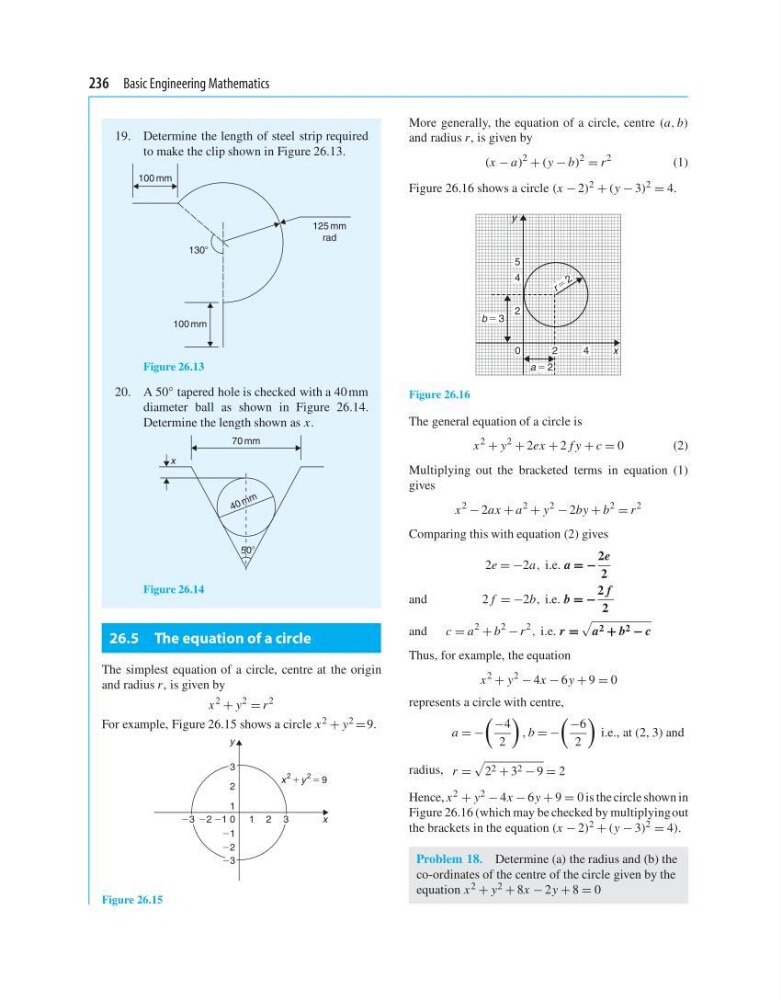
Figure 26.16 shows a circle (x − 2) 2 + (y − 3) 2 = 4.
r 5
2
y
5
4
2
0
2
4
x
b 5 3
a 5 2
Figure 26.16
The general equation of a circle is
x
2
+ y
2
+ 2ex + 2 f y + c = 0
( 2 )
Multiplying out the bracketed terms in equation (1)
gives
x
2
− 2ax + a
2
+ y
2
− 2by + b
2
= r
2
Comparing this with equation (2) gives
2e = −2a, i.e. a = −
2e
2
and
2 f = −2b, i.e. b = −
2f
2
and c = a
2
+ b
2
− r
2
, i.e. r =
a 2 + b 2 − c
Thus, for example, the equation
x
2
+ y
2
− 4x − 6y + 9 = 0
represents a circle with centre,
a = −
−4
2
, b = −
−6
2
i.e., at (2, 3) and
radius, r =
2 2 + 3 2 − 9 = 2
Hence, x 2 + y 2 − 4x − 6y + 9 = 0 is the circle shown in
Figure 26.16 (which may be checked by multiplying out
the brackets in the equation (x − 2) 2 + (y − 3) 2 = 4).
Problem 18. Determine (a) the radius and (b) the
co-ordinates of the centre of the circle given by the
equation x 2 + y 2 + 8x − 2y + 8 = 0
19. Determine the length of steel strip required
to make the clip shown in Figure 26.13.
125 mm
rad
130Њ
100 mm
100 mm
Figure 26.13
20. A 50 ◦ tapered hole is checked with a 40 mm
diameter ball as shown in Figure 26.14.
Determine the length shown as x.
70 mm
x
50Њ
4 0 m m
Figure 26.14
26.5 The equation of a circle
The simplest equation of a circle, centre at the origin
and radius r, is given by
x
2
+ y
2
= r
2
For example, Figure 26.15 shows a circle x 2 + y 2 = 9.
3
3
2
x
2 ϩy
2 ϭ 9
x
y
2
1
1
0
Ϫ1
Ϫ1
Ϫ2
Ϫ2
Ϫ3
Ϫ3
Figure 26.15
More generally, the equation of a circle, centre (a, b)
and radius r, is given by
(x − a)
2
+ (y − b)
2
= r
2
(1)
Figure 26.16 shows a circle (x − 2) 2 + (y − 3) 2 = 4.
r 5
2
y
5
4
2
0
2
4
x
b 5 3
a 5 2
Figure 26.16
The general equation of a circle is
x
2
+ y
2
+ 2ex + 2 f y + c = 0
( 2 )
Multiplying out the bracketed terms in equation (1)
gives
x
2
− 2ax + a
2
+ y
2
− 2by + b
2
= r
2
Comparing this with equation (2) gives
2e = −2a, i.e. a = −
2e
2
and
2 f = −2b, i.e. b = −
2f
2
and c = a
2
+ b
2
− r
2
, i.e. r =
a 2 + b 2 − c
Thus, for example, the equation
x
2
+ y
2
− 4x − 6y + 9 = 0
represents a circle with centre,
a = −
−4
2
, b = −
−6
2
i.e., at (2, 3) and
radius, r =
2 2 + 3 2 − 9 = 2
Hence, x 2 + y 2 − 4x − 6y + 9 = 0 is the circle shown in
Figure 26.16 (which may be checked by multiplying out
the brackets in the equation (x − 2) 2 + (y − 3) 2 = 4).
Problem 18. Determine (a) the radius and (b) the
co-ordinates of the centre of the circle given by the
equation x 2 + y 2 + 8x − 2y + 8 = 0