

234 Basic Engineering Mathematics
(b) Length of major arc = (circumference − minor
arc) = 2π(8.4) − 18.3 = 34.5 cm, correct to 3
significant figures.
(Alternatively, major arc = rθ
= 8.4(360 − 125)
π
180
= 34.5 cm.)
Problem 14. Determine the angle, in degrees and
minutes, subtended at the centre of a circle of
diameter 42 mm by an arc of length 36 mm.
Calculate also the area of the minor sector formed
Since length of arc, s = rθ then θ =
s
r
Radius,
r =
diameter
2
=
42
2
= 21 mm,
hence
θ =
s
r
=
36
21
= 1.7143 radians.
1.7143 rad = 1.7143 ×
180
π
◦
= 98.22 ◦ = 98 ◦ 13 =
angle subtended at centre of circle.
From equation (2),
area of sector =
1
2
r
2
θ =
1
2
(21)
2
(1.7143)
= 378 mm
2
.
Problem 15. A football stadium floodlight can
spread its illumination over an angle of 45 ◦ to a
distance of 55 m. Determine the maximum area that
is floodlit.
Floodlit area = area of sector =
1
2
r
2
θ
=
1
2
(55)
2
45 ×
π
180
= 1188 m
2
Problem 16. An automatic garden sprayer
produces spray to a distance of 1.8 m and revolves
through an angle α which may be varied. If the
desired spray catchment area is to be 2.5 m 2 , to what
should angle α be set, correct to the nearest degree?
Area of sector =
1
2
r 2 θ, hence 2.5 =
1
2
(1.8)
2
α
from which, α =
2.5 × 2
1.8 2 = 1.5432 radians
1.5432 rad =
1.5432 ×
180
π
◦
= 88.42
◦
Hence, angle α = 88 ◦ , correct to the nearest degree.
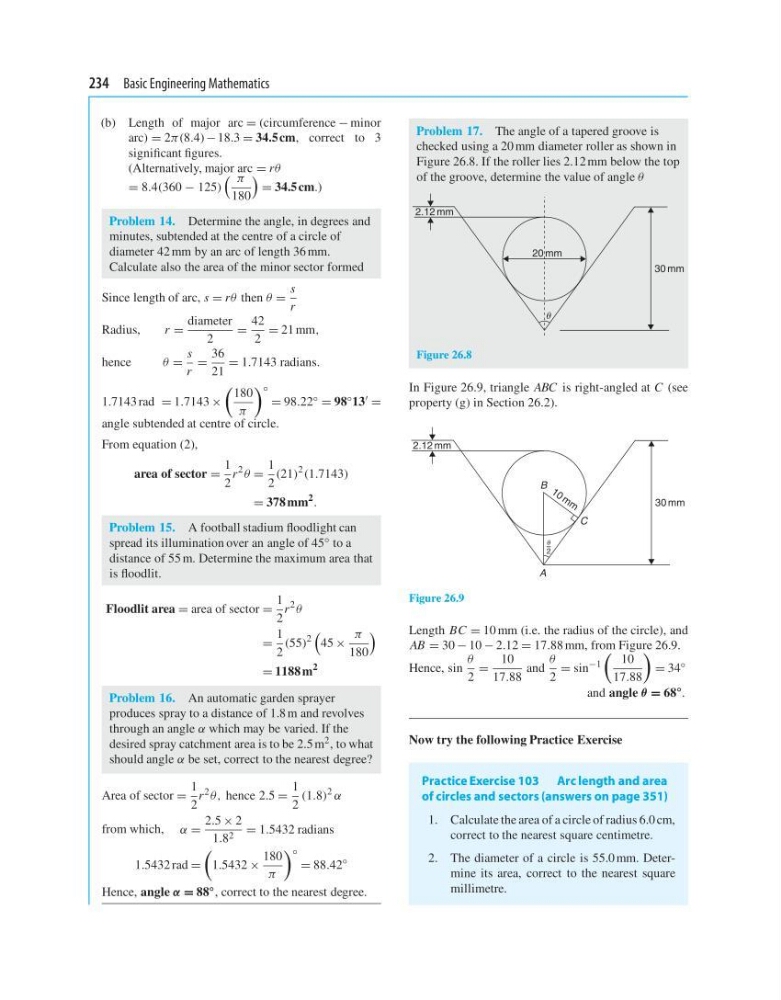
Problem 17. The angle of a tapered groove is
checked using a 20 mm diameter roller as shown in
Figure 26.8. If the roller lies 2.12 mm below the top
of the groove, determine the value of angle θ
2.12 mm
20 mm
30 mm
Figure 26.8
In Figure 26.9, triangle ABC is right-angled at C (see
property (g) in Section 26.2).
2.12 mm
2
1 0 m m
B
A
C
30 mm
Figure 26.9
Length BC = 10 mm (i.e. the radius of the circle), and
AB = 30 − 10 − 2.12 = 17.88 mm, from Figure 26.9.
Hence, sin
θ
2
=
10
17.88
and
θ
2
= sin
−1
10
17.88
= 34 ◦
and angle θ = 68
◦ .
Now try the following Practice Exercise
Practice Exercise 103 Arc length and area
of circles and sectors (answers on page 351)
1. Calculate the area of a circle of radius 6.0 cm,
correct to the nearest square centimetre.
2. The diameter of a circle is 55.0 mm. Determine its area, correct to the nearest square
millimetre.
(b) Length of major arc = (circumference − minor
arc) = 2π(8.4) − 18.3 = 34.5 cm, correct to 3
significant figures.
(Alternatively, major arc = rθ
= 8.4(360 − 125)
π
180
= 34.5 cm.)
Problem 14. Determine the angle, in degrees and
minutes, subtended at the centre of a circle of
diameter 42 mm by an arc of length 36 mm.
Calculate also the area of the minor sector formed
Since length of arc, s = rθ then θ =
s
r
Radius,
r =
diameter
2
=
42
2
= 21 mm,
hence
θ =
s
r
=
36
21
= 1.7143 radians.
1.7143 rad = 1.7143 ×
180
π
◦
= 98.22 ◦ = 98 ◦ 13 =
angle subtended at centre of circle.
From equation (2),
area of sector =
1
2
r
2
θ =
1
2
(21)
2
(1.7143)
= 378 mm
2
.
Problem 15. A football stadium floodlight can
spread its illumination over an angle of 45 ◦ to a
distance of 55 m. Determine the maximum area that
is floodlit.
Floodlit area = area of sector =
1
2
r
2
θ
=
1
2
(55)
2
45 ×
π
180
= 1188 m
2
Problem 16. An automatic garden sprayer
produces spray to a distance of 1.8 m and revolves
through an angle α which may be varied. If the
desired spray catchment area is to be 2.5 m 2 , to what
should angle α be set, correct to the nearest degree?
Area of sector =
1
2
r 2 θ, hence 2.5 =
1
2
(1.8)
2
α
from which, α =
2.5 × 2
1.8 2 = 1.5432 radians
1.5432 rad =
1.5432 ×
180
π
◦
= 88.42
◦
Hence, angle α = 88 ◦ , correct to the nearest degree.
Problem 17. The angle of a tapered groove is
checked using a 20 mm diameter roller as shown in
Figure 26.8. If the roller lies 2.12 mm below the top
of the groove, determine the value of angle θ
2.12 mm
20 mm
30 mm
Figure 26.8
In Figure 26.9, triangle ABC is right-angled at C (see
property (g) in Section 26.2).
2.12 mm
2
1 0 m m
B
A
C
30 mm
Figure 26.9
Length BC = 10 mm (i.e. the radius of the circle), and
AB = 30 − 10 − 2.12 = 17.88 mm, from Figure 26.9.
Hence, sin
θ
2
=
10
17.88
and
θ
2
= sin
−1
10
17.88
= 34 ◦
and angle θ = 68
◦ .
Now try the following Practice Exercise
Practice Exercise 103 Arc length and area
of circles and sectors (answers on page 351)
1. Calculate the area of a circle of radius 6.0 cm,
correct to the nearest square centimetre.
2. The diameter of a circle is 55.0 mm. Determine its area, correct to the nearest square
millimetre.