

Areas of common shapes 227
in the middle of the garden. Find, correct to the
nearest square metre, the area remaining.
2. Determine the area of circles having (a) a
radius of 4 cm (b) a diameter of 30 mm (c) a
circumference of 200 mm.
3. An annulus has an outside diameter of 60 mm
and an inside diameter of 20 mm. Determine
its area.
4. If the area of a circle is 320 mm 2 , find (a) its
diameter and (b) its circumference.
5. Calculate the areas of the following sectors of
circles.
(a) radius 9 cm, angle subtended at centre
75 ◦ .
(b) diameter 35 mm, angle subtended at
centre 48 ◦ 37 .
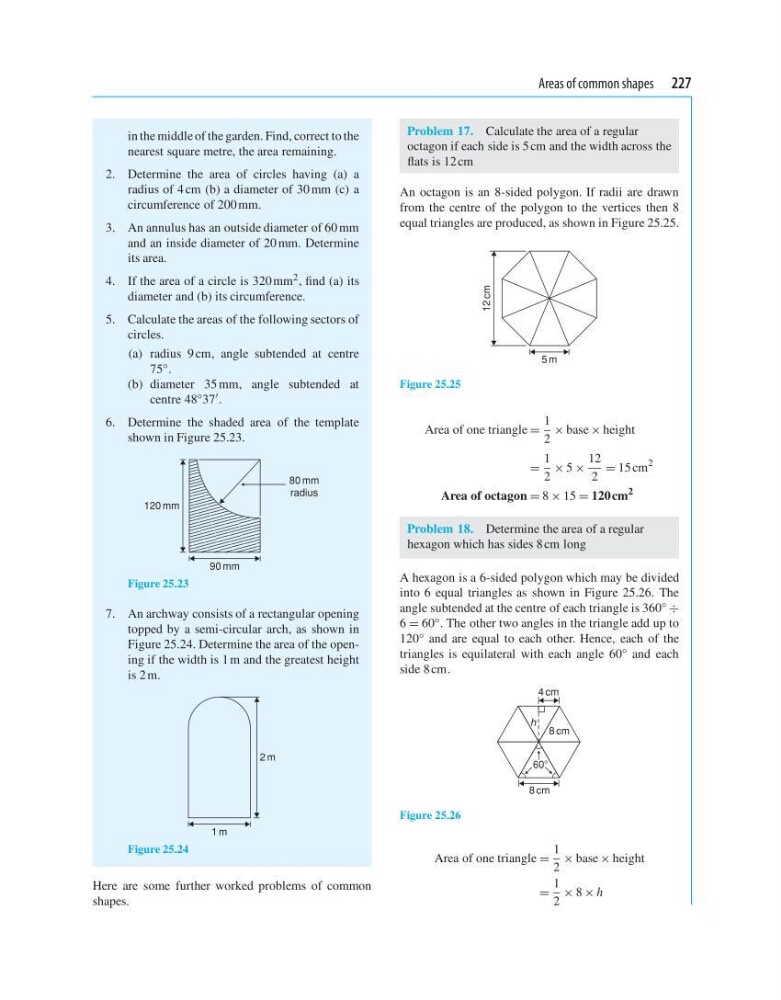
6. Determine the shaded area of the template
shown in Figure 25.23.
120 mm
90 mm
80 mm
radius
Figure 25.23
7. An archway consists of a rectangular opening
topped by a semi-circular arch, as shown in
Figure 25.24. Determine the area of the opening if the width is 1 m and the greatest height
is 2 m.
1 m
2 m
Figure 25.24
Here are some further worked problems of common
shapes.
Problem 17. Calculate the area of a regular
octagon if each side is 5 cm and the width across the
flats is 12 cm
An octagon is an 8-sided polygon. If radii are drawn
from the centre of the polygon to the vertices then 8
equal triangles are produced, as shown in Figure 25.25.
12 cm
5 m
Figure 25.25
Area of one triangle =
1
2
× base × height
=
1
2
× 5 ×
12
2
= 15 cm
2
Area of octagon = 8 × 15 = 120 cm
2
Problem 18. Determine the area of a regular
hexagon which has sides 8 cm long
A hexagon is a 6-sided polygon which may be divided
into 6 equal triangles as shown in Figure 25.26. The
angle subtended at the centre of each triangle is 360 ◦ ÷
6 = 60 ◦ . The other two angles in the triangle add up to
120 ◦ and are equal to each other. Hence, each of the
triangles is equilateral with each angle 60 ◦ and each
side 8 cm.
4 cm
8 cm
8 cm
608
h
Figure 25.26
Area of one triangle =
1
2
× base × height
=
1
2
× 8 × h
in the middle of the garden. Find, correct to the
nearest square metre, the area remaining.
2. Determine the area of circles having (a) a
radius of 4 cm (b) a diameter of 30 mm (c) a
circumference of 200 mm.
3. An annulus has an outside diameter of 60 mm
and an inside diameter of 20 mm. Determine
its area.
4. If the area of a circle is 320 mm 2 , find (a) its
diameter and (b) its circumference.
5. Calculate the areas of the following sectors of
circles.
(a) radius 9 cm, angle subtended at centre
75 ◦ .
(b) diameter 35 mm, angle subtended at
centre 48 ◦ 37 .
6. Determine the shaded area of the template
shown in Figure 25.23.
120 mm
90 mm
80 mm
radius
Figure 25.23
7. An archway consists of a rectangular opening
topped by a semi-circular arch, as shown in
Figure 25.24. Determine the area of the opening if the width is 1 m and the greatest height
is 2 m.
1 m
2 m
Figure 25.24
Here are some further worked problems of common
shapes.
Problem 17. Calculate the area of a regular
octagon if each side is 5 cm and the width across the
flats is 12 cm
An octagon is an 8-sided polygon. If radii are drawn
from the centre of the polygon to the vertices then 8
equal triangles are produced, as shown in Figure 25.25.
12 cm
5 m
Figure 25.25
Area of one triangle =
1
2
× base × height
=
1
2
× 5 ×
12
2
= 15 cm
2
Area of octagon = 8 × 15 = 120 cm
2
Problem 18. Determine the area of a regular
hexagon which has sides 8 cm long
A hexagon is a 6-sided polygon which may be divided
into 6 equal triangles as shown in Figure 25.26. The
angle subtended at the centre of each triangle is 360 ◦ ÷
6 = 60 ◦ . The other two angles in the triangle add up to
120 ◦ and are equal to each other. Hence, each of the
triangles is equilateral with each angle 60 ◦ and each
side 8 cm.
4 cm
8 cm
8 cm
608
h
Figure 25.26
Area of one triangle =
1
2
× base × height
=
1
2
× 8 × h