

Areas of common shapes 221
In triangle FGH, 40
◦
+ 90
◦
+ b = 180
◦ , since the
angles in a triangle add up to 180 ◦ , from which
b = 50 ◦ . Also, c = 40 ◦ (alternate angles between
parallel lines EF and HG). (Alternatively, b and c
are complementary; i.e., add up to 90 ◦ .)
d = 90 ◦ + c (external angle of a triangle equals
the sum of the interior opposite angles), hence
d = 90 ◦ + 40 ◦ = 130 ◦ (or ∠EFH = 50 ◦ and
d = 180 ◦ − 50 ◦ = 130 ◦ ).
(c) JKLM is a rhombus
The diagonals of a rhombus bisect the interior
angles and the opposite internal angles are equal.
Thus, ∠JKM = ∠MKL = ∠JMK = ∠LMK = 30
◦ ,
hence, e = 30 ◦ .
In triangle KLM, 30 ◦ + ∠KLM + 30 ◦ = 180 ◦
(the angles in a triangle add up to 180 ◦ ), hence,
∠KLM = 120 ◦ . The diagonal JL bisects ∠KLM,
hence, f =
120 ◦
2
= 60 ◦ .
(d) NOPQ is a parallelogram
g = 52 ◦ since the opposite interior angles of a
parallelogram are equal.
In triangle NOQ, g + h + 65 ◦ = 180 ◦ (the angles
in a triangle add up to 180 ◦ ), from which
h = 180 ◦ − 65 ◦ − 52 ◦ = 63 ◦ .
i = 65 ◦ (alternate angles between parallel lines
NQ and OP).
j = 52 ◦ + i = 52 ◦ + 65 ◦ = 117 ◦ (the external
angle of a triangle equals the sum of the interior
opposite angles). (Alternatively, ∠PQO = h =
63 ◦ ; hence, j = 180 ◦ − 63 ◦ = 117 ◦ .)
(e) RSTU is a trapezium
35 ◦ + k = 75 ◦ (external angle of a triangle equals
the sum of the interior opposite angles), hence,
k = 40 ◦ .
∠STR = 35
◦ (alternate angles between parallel
lines RU and ST). l + 35 ◦ = 115 ◦ (external angle
of a triangle equals the sum of the interior opposite
angles), hence, l = 115 ◦ − 35 ◦ = 80 ◦ .
Now try the following Practice Exercise
Practice Exercise 96 Common shapes
(answers on page 351)
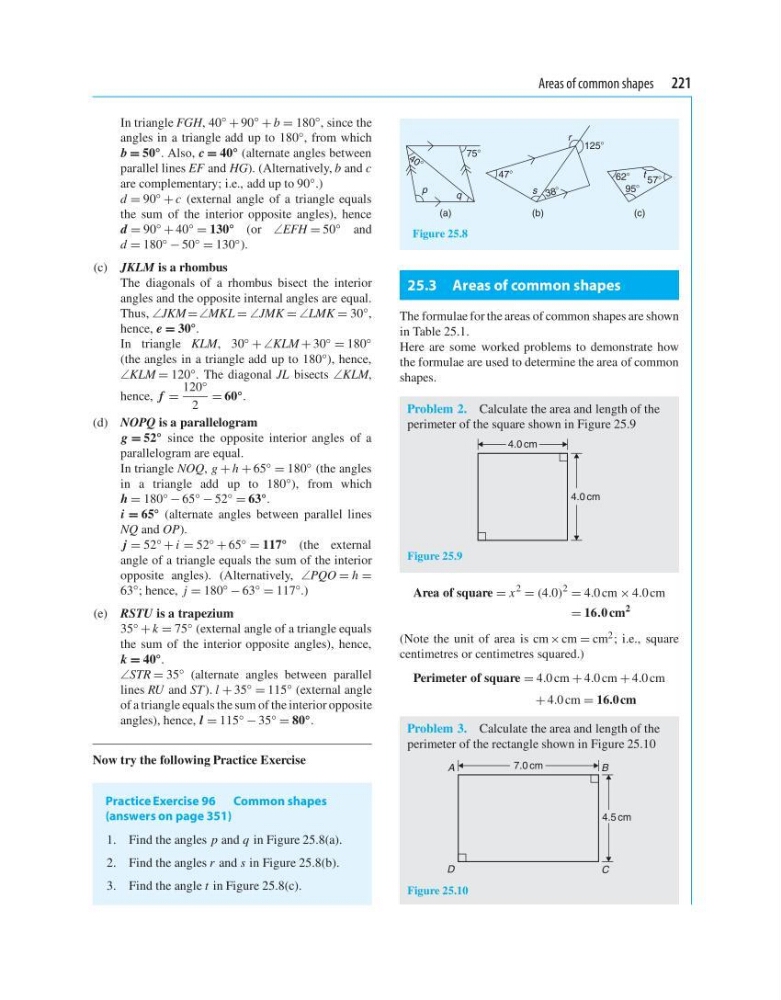
1. Find the angles p and q in Figure 25.8(a).
2. Find the angles r and s in Figure 25.8(b).
3. Find the angle t in Figure 25.8(c).
758
38 8
1258
628
958
578
478
4 0 8
p
q
s
r
t
(a)
(b)
(c)
Figure 25.8
25.3 Areas of common shapes
The formulae for the areas of common shapes are shown
in Table 25.1.
Here are some worked problems to demonstrate how
the formulae are used to determine the area of common
shapes.
Problem 2. Calculate the area and length of the
perimeter of the square shown in Figure 25.9
4.0 cm
4.0 cm
Figure 25.9
Area of square = x
2
= (4.0)
2
= 4.0 cm × 4.0 cm
= 16.0 cm
2
(Note the unit of area is cm × cm = cm 2 ; i.e., square
centimetres or centimetres squared.)
Perimeter of square = 4.0 cm + 4.0 cm + 4.0 cm
+ 4.0 cm = 16.0 cm
Problem 3. Calculate the area and length of the
perimeter of the rectangle shown in Figure 25.10
7.0 cm
4.5 cm
A
D
C
B
Figure 25.10
In triangle FGH, 40
◦
+ 90
◦
+ b = 180
◦ , since the
angles in a triangle add up to 180 ◦ , from which
b = 50 ◦ . Also, c = 40 ◦ (alternate angles between
parallel lines EF and HG). (Alternatively, b and c
are complementary; i.e., add up to 90 ◦ .)
d = 90 ◦ + c (external angle of a triangle equals
the sum of the interior opposite angles), hence
d = 90 ◦ + 40 ◦ = 130 ◦ (or ∠EFH = 50 ◦ and
d = 180 ◦ − 50 ◦ = 130 ◦ ).
(c) JKLM is a rhombus
The diagonals of a rhombus bisect the interior
angles and the opposite internal angles are equal.
Thus, ∠JKM = ∠MKL = ∠JMK = ∠LMK = 30
◦ ,
hence, e = 30 ◦ .
In triangle KLM, 30 ◦ + ∠KLM + 30 ◦ = 180 ◦
(the angles in a triangle add up to 180 ◦ ), hence,
∠KLM = 120 ◦ . The diagonal JL bisects ∠KLM,
hence, f =
120 ◦
2
= 60 ◦ .
(d) NOPQ is a parallelogram
g = 52 ◦ since the opposite interior angles of a
parallelogram are equal.
In triangle NOQ, g + h + 65 ◦ = 180 ◦ (the angles
in a triangle add up to 180 ◦ ), from which
h = 180 ◦ − 65 ◦ − 52 ◦ = 63 ◦ .
i = 65 ◦ (alternate angles between parallel lines
NQ and OP).
j = 52 ◦ + i = 52 ◦ + 65 ◦ = 117 ◦ (the external
angle of a triangle equals the sum of the interior
opposite angles). (Alternatively, ∠PQO = h =
63 ◦ ; hence, j = 180 ◦ − 63 ◦ = 117 ◦ .)
(e) RSTU is a trapezium
35 ◦ + k = 75 ◦ (external angle of a triangle equals
the sum of the interior opposite angles), hence,
k = 40 ◦ .
∠STR = 35
◦ (alternate angles between parallel
lines RU and ST). l + 35 ◦ = 115 ◦ (external angle
of a triangle equals the sum of the interior opposite
angles), hence, l = 115 ◦ − 35 ◦ = 80 ◦ .
Now try the following Practice Exercise
Practice Exercise 96 Common shapes
(answers on page 351)
1. Find the angles p and q in Figure 25.8(a).
2. Find the angles r and s in Figure 25.8(b).
3. Find the angle t in Figure 25.8(c).
758
38 8
1258
628
958
578
478
4 0 8
p
q
s
r
t
(a)
(b)
(c)
Figure 25.8
25.3 Areas of common shapes
The formulae for the areas of common shapes are shown
in Table 25.1.
Here are some worked problems to demonstrate how
the formulae are used to determine the area of common
shapes.
Problem 2. Calculate the area and length of the
perimeter of the square shown in Figure 25.9
4.0 cm
4.0 cm
Figure 25.9
Area of square = x
2
= (4.0)
2
= 4.0 cm × 4.0 cm
= 16.0 cm
2
(Note the unit of area is cm × cm = cm 2 ; i.e., square
centimetres or centimetres squared.)
Perimeter of square = 4.0 cm + 4.0 cm + 4.0 cm
+ 4.0 cm = 16.0 cm
Problem 3. Calculate the area and length of the
perimeter of the rectangle shown in Figure 25.10
7.0 cm
4.5 cm
A
D
C
B
Figure 25.10