

Revision Test 9 : Trigonometric waveforms and practical trigonometry
This assignment covers the material contained in Chapters 22–24. The marks available are shown in brackets at the
end of each question.
1. A sine wave is given by y = 8 sin4x. State its peak
value and its period, in degrees.
(2)
2. A periodic function is given by y = 15 tan 2x.
State its period in degrees.
(2)
3. The frequency of a sine wave is 800 Hz. Calculate
the periodic time in milliseconds.
(2)
4. Calculate the frequency of a sine wave that has a
periodic time of 40 μs.
(2)
5. Calculate the periodic time for a sine wave having
a frequency of 20 kHz.
(2)
6. An alternating current completes 12 cycles in
16 ms. What is its frequency?
(3)
7. A
sinusoidal
voltage
is
given
by
e = 150 sin(500πt − 0.25) volts. Determine the
(a) amplitude,
(b) frequency,
(c) periodic time,
(d) phase angle (stating whether it is leading or
lagging 150 sin 500πt ).
(4)
8. Determine the acute angles in degrees, degrees and
minutes, and radians.
(a) sin −1 0.4721
(b) cos −1 0.8457
(c) tan −1 1.3472
(9)
9. Sketch the following curves, labelling relevant
points.
(a) y = 4 cos(θ + 45 ◦ ) (b) y = 5 sin(2t − 60 ◦ )
(8)
10. The current in an alternating current circuit at any time t seconds is given by
i = 120 sin(100πt + 0.274) amperes. Determine
(a) the amplitude, frequency, periodic time and
phase angle (with reference to 120 sin100πt ),
(b) the value of current when t = 0,
(c) the value of current when t = 6 ms.
Sketch one cycle of the oscillation.
(16)
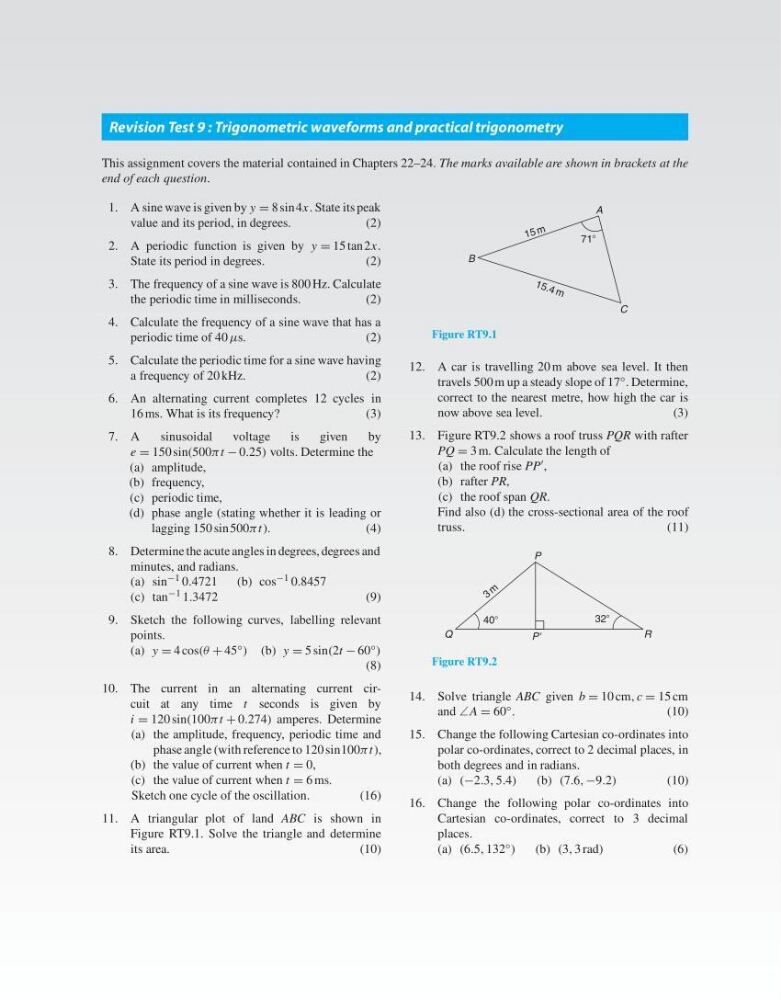
11. A triangular plot of land ABC is shown in
Figure RT9.1. Solve the triangle and determine
its area.
(10)
A
B
C
1 5 m
1 5 .4 m
718
Figure RT9.1
12. A car is travelling 20 m above sea level. It then
travels 500 m up a steady slope of 17 ◦ . Determine,
correct to the nearest metre, how high the car is
now above sea level.
(3)
13. Figure RT9.2 shows a roof truss PQR with rafter
PQ = 3 m. Calculate the length of
(a) the roof rise PP ,
(b) rafter PR,
(c) the roof span QR.
Find also (d) the cross-sectional area of the roof
truss.
(11)
P
Q
R
P9
3 m
408
328
Figure RT9.2
14. Solve triangle ABC given b = 10 cm, c = 15 cm
and ∠A = 60 ◦ .
(10)
15. Change the following Cartesian co-ordinates into
polar co-ordinates, correct to 2 decimal places, in
both degrees and in radians.
(a) (−2.3, 5.4)
(b) (7.6, −9.2)
(10)
16. Change the following polar co-ordinates into
Cartesian co-ordinates, correct to 3 decimal
places.
(a) (6.5, 132 ◦ )
(b) (3, 3 rad)
(6)
This assignment covers the material contained in Chapters 22–24. The marks available are shown in brackets at the
end of each question.
1. A sine wave is given by y = 8 sin4x. State its peak
value and its period, in degrees.
(2)
2. A periodic function is given by y = 15 tan 2x.
State its period in degrees.
(2)
3. The frequency of a sine wave is 800 Hz. Calculate
the periodic time in milliseconds.
(2)
4. Calculate the frequency of a sine wave that has a
periodic time of 40 μs.
(2)
5. Calculate the periodic time for a sine wave having
a frequency of 20 kHz.
(2)
6. An alternating current completes 12 cycles in
16 ms. What is its frequency?
(3)
7. A
sinusoidal
voltage
is
given
by
e = 150 sin(500πt − 0.25) volts. Determine the
(a) amplitude,
(b) frequency,
(c) periodic time,
(d) phase angle (stating whether it is leading or
lagging 150 sin 500πt ).
(4)
8. Determine the acute angles in degrees, degrees and
minutes, and radians.
(a) sin −1 0.4721
(b) cos −1 0.8457
(c) tan −1 1.3472
(9)
9. Sketch the following curves, labelling relevant
points.
(a) y = 4 cos(θ + 45 ◦ ) (b) y = 5 sin(2t − 60 ◦ )
(8)
10. The current in an alternating current circuit at any time t seconds is given by
i = 120 sin(100πt + 0.274) amperes. Determine
(a) the amplitude, frequency, periodic time and
phase angle (with reference to 120 sin100πt ),
(b) the value of current when t = 0,
(c) the value of current when t = 6 ms.
Sketch one cycle of the oscillation.
(16)
11. A triangular plot of land ABC is shown in
Figure RT9.1. Solve the triangle and determine
its area.
(10)
A
B
C
1 5 m
1 5 .4 m
718
Figure RT9.1
12. A car is travelling 20 m above sea level. It then
travels 500 m up a steady slope of 17 ◦ . Determine,
correct to the nearest metre, how high the car is
now above sea level.
(3)
13. Figure RT9.2 shows a roof truss PQR with rafter
PQ = 3 m. Calculate the length of
(a) the roof rise PP ,
(b) rafter PR,
(c) the roof span QR.
Find also (d) the cross-sectional area of the roof
truss.
(11)
P
Q
R
P9
3 m
408
328
Figure RT9.2
14. Solve triangle ABC given b = 10 cm, c = 15 cm
and ∠A = 60 ◦ .
(10)
15. Change the following Cartesian co-ordinates into
polar co-ordinates, correct to 2 decimal places, in
both degrees and in radians.
(a) (−2.3, 5.4)
(b) (7.6, −9.2)
(10)
16. Change the following polar co-ordinates into
Cartesian co-ordinates, correct to 3 decimal
places.
(a) (6.5, 132 ◦ )
(b) (3, 3 rad)
(6)