

216 Basic Engineering Mathematics
24.3 Changing from polar to Cartesian
co-ordinates
y
y
Q
x
x
O
P
r
Figure 24.6
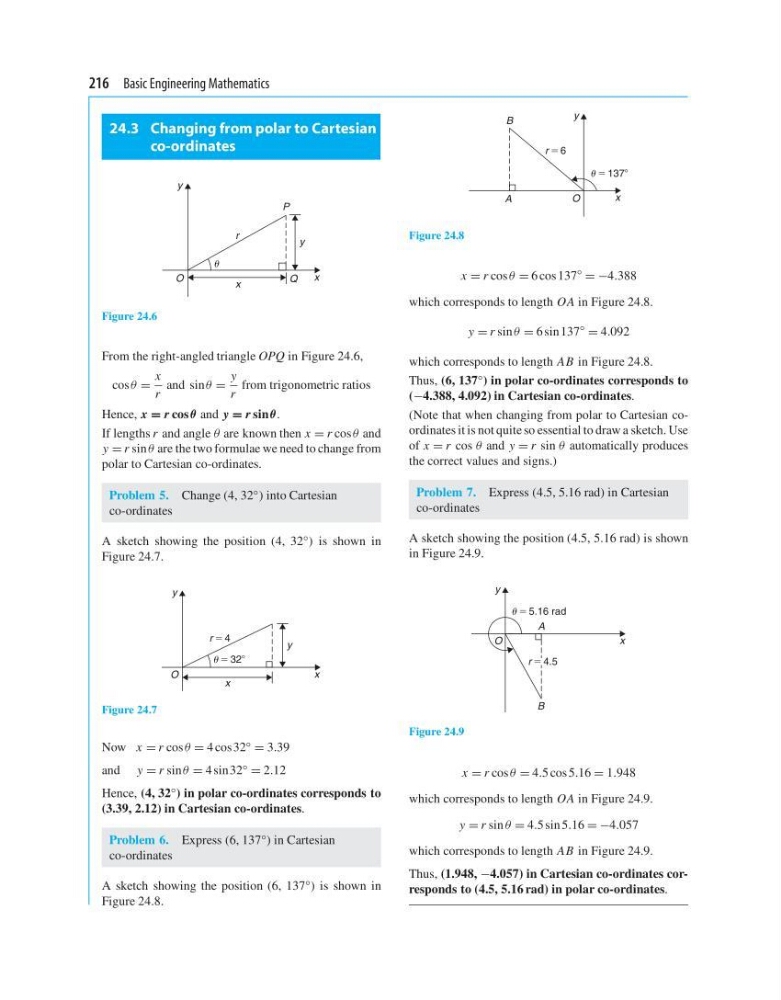
From the right-angled triangle OPQ in Figure 24.6,
cos θ =
x
r
and sin θ =
y
r
from trigonometric ratios
Hence, x = r cos θ and y = r sinθ .
If lengths r and angle θ are known then x = r cos θ and
y = r sin θ are the two formulae we need to change from
polar to Cartesian co-ordinates.
Problem 5. Change (4, 32 ◦ ) into Cartesian
co-ordinates
A sketch showing the position (4, 32 ◦ ) is shown in
Figure 24.7.
y
y
O
x
x
r ϭ 4
ϭ 32Њ
Figure 24.7
Now x = r cos θ = 4 cos32 ◦ = 3.39
and y = r sin θ = 4 sin32 ◦ = 2.12
Hence, (4, 32 ◦ ) in polar co-ordinates corresponds to
(3.39, 2.12) in Cartesian co-ordinates.
Problem 6. Express (6, 137 ◦ ) in Cartesian
co-ordinates
A sketch showing the position (6, 137 ◦ ) is shown in
Figure 24.8.
B
O
A
y
x
r ϭ 6
ϭ 137Њ
Figure 24.8
x = r cos θ = 6 cos 137
◦
= −4.388
which corresponds to length OA in Figure 24.8.
y = r sin θ = 6 sin 137
◦
= 4.092
which corresponds to length AB in Figure 24.8.
Thus, (6, 137 ◦ ) in polar co-ordinates corresponds to
(−4.388, 4.092) in Cartesian co-ordinates.
(Note that when changing from polar to Cartesian coordinates it is not quite so essential to draw a sketch. Use
of x = r cos θ and y = r sin θ automatically produces
the correct values and signs.)
Problem 7. Express (4.5, 5.16 rad) in Cartesian
co-ordinates
A sketch showing the position (4.5, 5.16 rad) is shown
in Figure 24.9.
y
A
B
O
x
5 5.16 rad
r 5 4.5
Figure 24.9
x = r cos θ = 4.5 cos 5.16 = 1.948
which corresponds to length OA in Figure 24.9.
y = r sin θ = 4.5 sin 5.16 = −4.057
which corresponds to length AB in Figure 24.9.
Thus, (1.948, −4.057) in Cartesian co-ordinates corresponds to (4.5, 5.16 rad) in polar co-ordinates.
24.3 Changing from polar to Cartesian
co-ordinates
y
y
Q
x
x
O
P
r
Figure 24.6
From the right-angled triangle OPQ in Figure 24.6,
cos θ =
x
r
and sin θ =
y
r
from trigonometric ratios
Hence, x = r cos θ and y = r sinθ .
If lengths r and angle θ are known then x = r cos θ and
y = r sin θ are the two formulae we need to change from
polar to Cartesian co-ordinates.
Problem 5. Change (4, 32 ◦ ) into Cartesian
co-ordinates
A sketch showing the position (4, 32 ◦ ) is shown in
Figure 24.7.
y
y
O
x
x
r ϭ 4
ϭ 32Њ
Figure 24.7
Now x = r cos θ = 4 cos32 ◦ = 3.39
and y = r sin θ = 4 sin32 ◦ = 2.12
Hence, (4, 32 ◦ ) in polar co-ordinates corresponds to
(3.39, 2.12) in Cartesian co-ordinates.
Problem 6. Express (6, 137 ◦ ) in Cartesian
co-ordinates
A sketch showing the position (6, 137 ◦ ) is shown in
Figure 24.8.
B
O
A
y
x
r ϭ 6
ϭ 137Њ
Figure 24.8
x = r cos θ = 6 cos 137
◦
= −4.388
which corresponds to length OA in Figure 24.8.
y = r sin θ = 6 sin 137
◦
= 4.092
which corresponds to length AB in Figure 24.8.
Thus, (6, 137 ◦ ) in polar co-ordinates corresponds to
(−4.388, 4.092) in Cartesian co-ordinates.
(Note that when changing from polar to Cartesian coordinates it is not quite so essential to draw a sketch. Use
of x = r cos θ and y = r sin θ automatically produces
the correct values and signs.)
Problem 7. Express (4.5, 5.16 rad) in Cartesian
co-ordinates
A sketch showing the position (4.5, 5.16 rad) is shown
in Figure 24.9.
y
A
B
O
x
5 5.16 rad
r 5 4.5
Figure 24.9
x = r cos θ = 4.5 cos 5.16 = 1.948
which corresponds to length OA in Figure 24.9.
y = r sin θ = 4.5 sin 5.16 = −4.057
which corresponds to length AB in Figure 24.9.
Thus, (1.948, −4.057) in Cartesian co-ordinates corresponds to (4.5, 5.16 rad) in polar co-ordinates.