

Angles and triangles 171
20.3 Triangles
A triangle is a figure enclosed by three straight lines.
The sum of the three angles of a triangle is equal
to 180 ◦ .
20.3.1 Types of triangle
An acute-angled triangle is one in which all the angles
are acute; i.e., all the angles are less than 90 ◦ . An
example is shown in triangle ABC in Figure 20.15(a).
A right-angled triangle is one which contains a right
angle; i.e., one in which one of the angles is 90 ◦ . An
example is shown in triangle DEF in Figure 20.15(b).
678
598
508
408
548
A
B
C
(a)
(b)
D
E
F
Figure 20.15
An obtuse-angled triangle is one which contains an
obtuse angle; i.e., one angle which lies between 90 ◦
and 180 ◦ . An example is shown in triangle PQR in
Figure 20.16(a).
An equilateral triangle is one in which all the sides and
all the angles are equal; i.e., each is 60 ◦ . An example is
shown in triangle ABC in Figure 20.16(b).
P
Q
R
1318
278
2 2 8
(a)
608
608
608
A
B
C
(b)
Figure 20.16
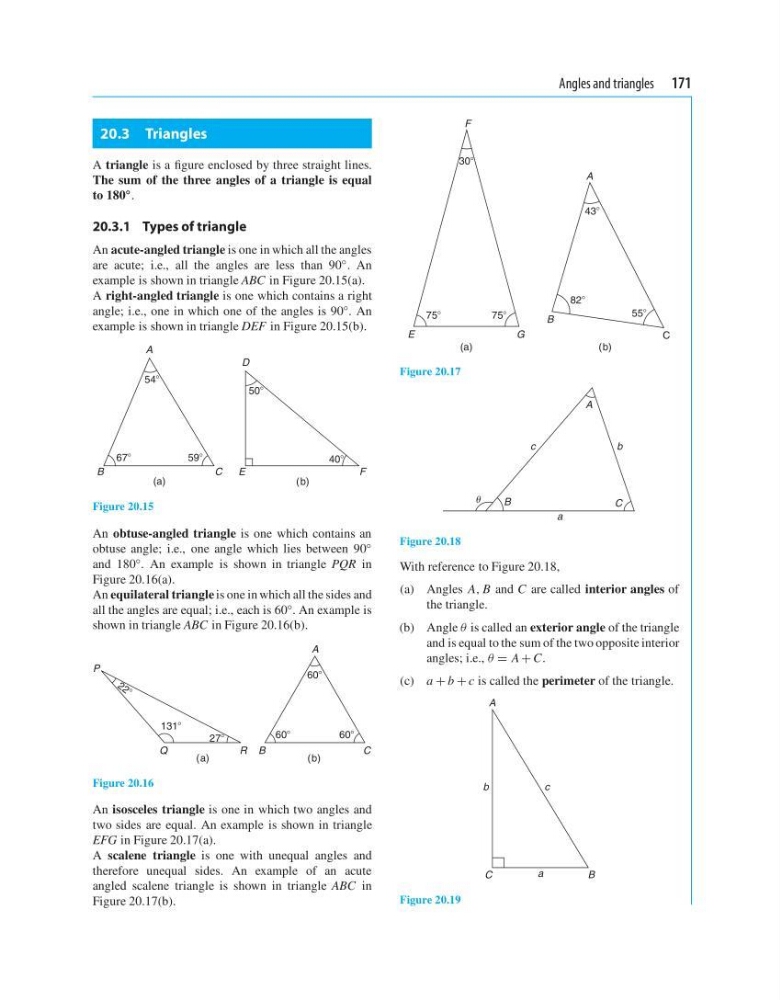
An isosceles triangle is one in which two angles and
two sides are equal. An example is shown in triangle
EFG in Figure 20.17(a).
A scalene triangle is one with unequal angles and
therefore unequal sides. An example of an acute
angled scalene triangle is shown in triangle ABC in
Figure 20.17(b).
(a)
(b)
A
B
C
438
828
558
F
E
G
308
758
758
Figure 20.17
B
A
C
c
b
a
Figure 20.18
With reference to Figure 20.18,
(a) Angles A, B and C are called interior angles of
the triangle.
(b) Angle θ is called an exterior angle of the triangle
and is equal to the sum of the two opposite interior
angles; i.e., θ = A + C.
(c) a + b + c is called the perimeter of the triangle.
A
C
B
b
a
c
Figure 20.19
20.3 Triangles
A triangle is a figure enclosed by three straight lines.
The sum of the three angles of a triangle is equal
to 180 ◦ .
20.3.1 Types of triangle
An acute-angled triangle is one in which all the angles
are acute; i.e., all the angles are less than 90 ◦ . An
example is shown in triangle ABC in Figure 20.15(a).
A right-angled triangle is one which contains a right
angle; i.e., one in which one of the angles is 90 ◦ . An
example is shown in triangle DEF in Figure 20.15(b).
678
598
508
408
548
A
B
C
(a)
(b)
D
E
F
Figure 20.15
An obtuse-angled triangle is one which contains an
obtuse angle; i.e., one angle which lies between 90 ◦
and 180 ◦ . An example is shown in triangle PQR in
Figure 20.16(a).
An equilateral triangle is one in which all the sides and
all the angles are equal; i.e., each is 60 ◦ . An example is
shown in triangle ABC in Figure 20.16(b).
P
Q
R
1318
278
2 2 8
(a)
608
608
608
A
B
C
(b)
Figure 20.16
An isosceles triangle is one in which two angles and
two sides are equal. An example is shown in triangle
EFG in Figure 20.17(a).
A scalene triangle is one with unequal angles and
therefore unequal sides. An example of an acute
angled scalene triangle is shown in triangle ABC in
Figure 20.17(b).
(a)
(b)
A
B
C
438
828
558
F
E
G
308
758
758
Figure 20.17
B
A
C
c
b
a
Figure 20.18
With reference to Figure 20.18,
(a) Angles A, B and C are called interior angles of
the triangle.
(b) Angle θ is called an exterior angle of the triangle
and is equal to the sum of the two opposite interior
angles; i.e., θ = A + C.
(c) a + b + c is called the perimeter of the triangle.
A
C
B
b
a
c
Figure 20.19