

168 Basic Engineering Mathematics
Thus, 49
◦ is an acute angle.
(c) An angle equal to 90 ◦ is called a right angle.
(d) Any angle greater than 180 ◦ and less than 360 ◦ is
called a reflex angle.
Thus, 245
◦ is a reflex angle.
Problem 8. Find the angle complementary to
48 ◦ 39
If two angles add up to 90 ◦ they are called complementary angles. Hence, the angle complementary to
48
◦ 39 is
90
◦
− 48
◦ 39
= 41
◦ 21
Problem 9. Find the angle supplementary to
74 ◦ 25
If two angles add up to 180 ◦ they are called supplementary angles. Hence, the angle supplementary to
74
◦ 25 is
180
◦
− 74
◦ 25
= 105
◦ 35
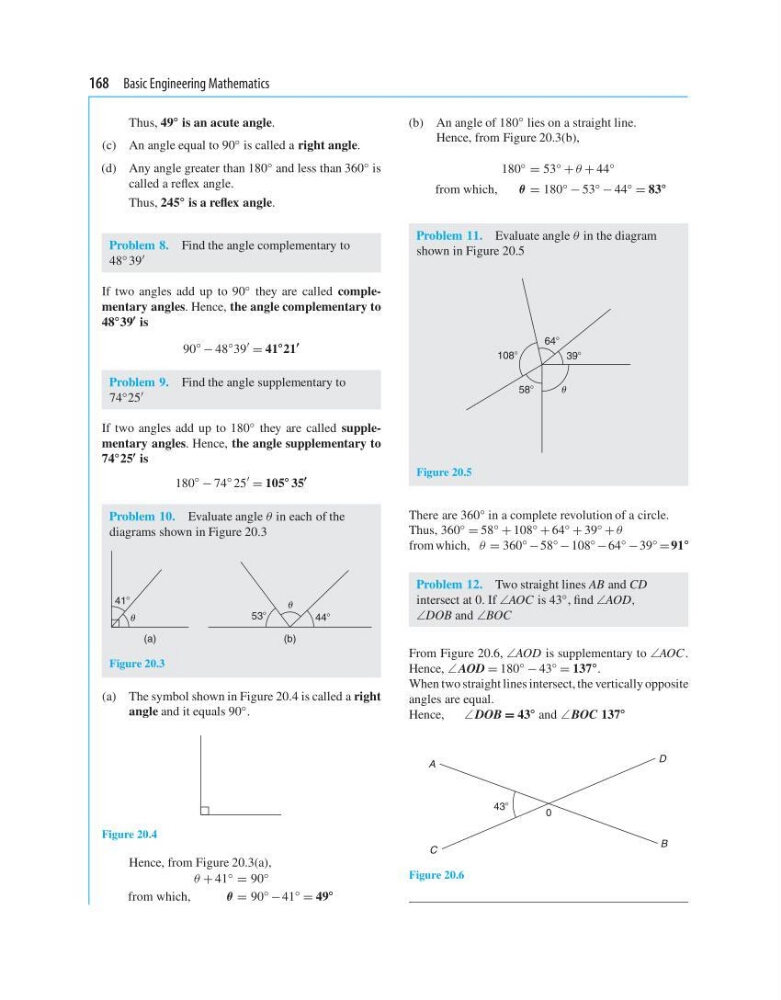
Problem 10. Evaluate angle θ in each of the
diagrams shown in Figure 20.3
(a)
(b)
418
538
448
Figure 20.3
(a) The symbol shown in Figure 20.4 is called a right
angle and it equals 90 ◦ .
Figure 20.4
Hence, from Figure 20.3(a),
θ + 41 ◦ = 90 ◦
from which,
θ = 90 ◦ − 41 ◦ = 49
◦
(b) An angle of 180
◦ lies on a straight line.
Hence, from Figure 20.3(b),
180 ◦ = 53 ◦ + θ + 44 ◦
from which,
θ = 180 ◦ − 53 ◦ − 44 ◦ = 83
◦
Problem 11. Evaluate angle θ in the diagram
shown in Figure 20.5
39Њ
58Њ
64Њ
108Њ
Figure 20.5
There are 360 ◦ in a complete revolution of a circle.
Thus, 360 ◦ = 58 ◦ + 108 ◦ + 64 ◦ + 39 ◦ + θ
from which, θ = 360 ◦ − 58 ◦ − 108 ◦ − 64 ◦ − 39 ◦ = 91
◦
Problem 12. Two straight lines AB and CD
intersect at 0. If ∠AOC is 43 ◦ , find ∠AOD,
∠DOB and ∠BOC
From Figure 20.6, ∠AOD is supplementary to ∠AOC.
Hence, ∠ AOD = 180 ◦ − 43 ◦ = 137
◦ .
When two straight lines intersect, the vertically opposite
angles are equal.
Hence,
∠ DOB = 43
◦ and ∠BOC 137
◦
A
D
B
C
438
0
Figure 20.6
Thus, 49
◦ is an acute angle.
(c) An angle equal to 90 ◦ is called a right angle.
(d) Any angle greater than 180 ◦ and less than 360 ◦ is
called a reflex angle.
Thus, 245
◦ is a reflex angle.
Problem 8. Find the angle complementary to
48 ◦ 39
If two angles add up to 90 ◦ they are called complementary angles. Hence, the angle complementary to
48
◦ 39 is
90
◦
− 48
◦ 39
= 41
◦ 21
Problem 9. Find the angle supplementary to
74 ◦ 25
If two angles add up to 180 ◦ they are called supplementary angles. Hence, the angle supplementary to
74
◦ 25 is
180
◦
− 74
◦ 25
= 105
◦ 35
Problem 10. Evaluate angle θ in each of the
diagrams shown in Figure 20.3
(a)
(b)
418
538
448
Figure 20.3
(a) The symbol shown in Figure 20.4 is called a right
angle and it equals 90 ◦ .
Figure 20.4
Hence, from Figure 20.3(a),
θ + 41 ◦ = 90 ◦
from which,
θ = 90 ◦ − 41 ◦ = 49
◦
(b) An angle of 180
◦ lies on a straight line.
Hence, from Figure 20.3(b),
180 ◦ = 53 ◦ + θ + 44 ◦
from which,
θ = 180 ◦ − 53 ◦ − 44 ◦ = 83
◦
Problem 11. Evaluate angle θ in the diagram
shown in Figure 20.5
39Њ
58Њ
64Њ
108Њ
Figure 20.5
There are 360 ◦ in a complete revolution of a circle.
Thus, 360 ◦ = 58 ◦ + 108 ◦ + 64 ◦ + 39 ◦ + θ
from which, θ = 360 ◦ − 58 ◦ − 108 ◦ − 64 ◦ − 39 ◦ = 91
◦
Problem 12. Two straight lines AB and CD
intersect at 0. If ∠AOC is 43 ◦ , find ∠AOD,
∠DOB and ∠BOC
From Figure 20.6, ∠AOD is supplementary to ∠AOC.
Hence, ∠ AOD = 180 ◦ − 43 ◦ = 137
◦ .
When two straight lines intersect, the vertically opposite
angles are equal.
Hence,
∠ DOB = 43
◦ and ∠BOC 137
◦
A
D
B
C
438
0
Figure 20.6