

Graphical solution of equations 161
Ϫ4
0
Ϫ1
Ϫ2
1
B
A
y ϭ 2 Ϫ 4x
y ϭ 2x 2 Ϫ 3x Ϫ 4
2
3
x
2
4
6
8
10
y
Ϫ2
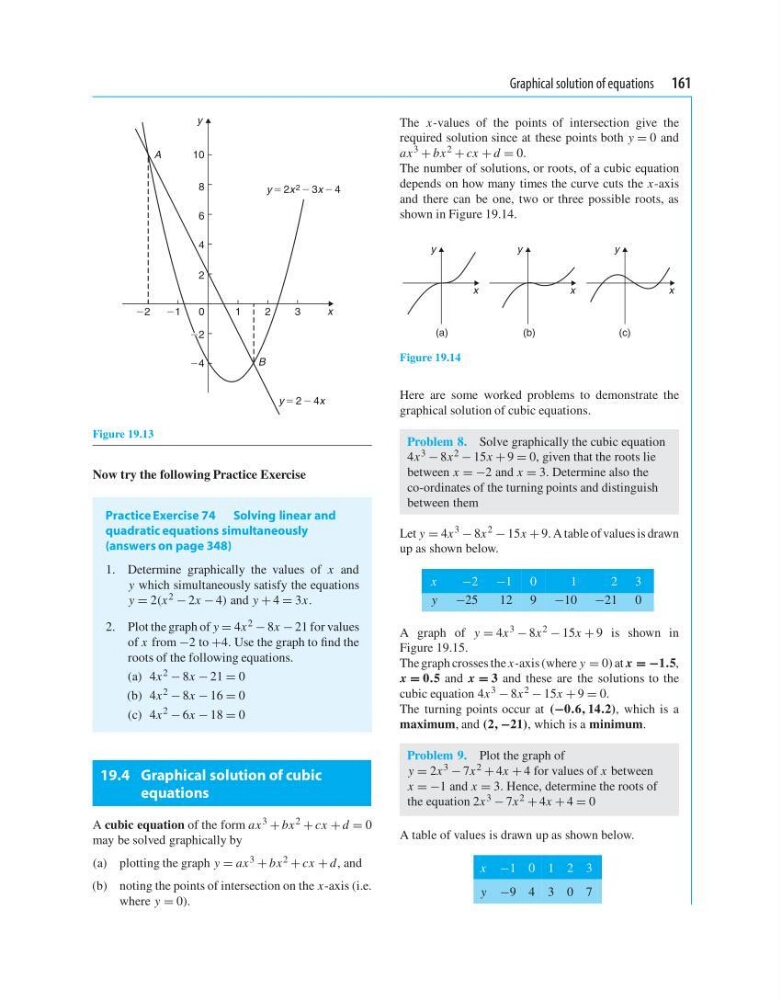
Figure 19.13
Now try the following Practice Exercise
Practice Exercise 74 Solving linear and
quadratic equations simultaneously
(answers on page 348)
1. Determine graphically the values of x and
y which simultaneously satisfy the equations
y = 2(x 2 − 2x − 4) and y + 4 = 3x.
2. Plot the graph of y = 4x 2 − 8x − 21 for values
of x from −2 to +4. Use the graph to find the
roots of the following equations.
(a) 4x 2 − 8x − 21 = 0
(b) 4x 2 − 8x − 16 = 0
(c) 4x
2
− 6x − 18 = 0
19.4 Graphical solution of cubic
equations
A cubic equation of the form ax 3 + bx 2 + cx + d = 0
may be solved graphically by
(a) plotting the graph y = ax 3 + bx 2 + cx + d, and
(b) noting the points of intersection on the x-axis (i.e.
where y = 0).
The x-values of the points of intersection give the
required solution since at these points both y = 0 and
ax 3 + bx 2 + cx + d = 0.
The number of solutions, or roots, of a cubic equation
depends on how many times the curve cuts the x-axis
and there can be one, two or three possible roots, as
shown in Figure 19.14.
(a)
y
x
(b)
y
x
(c)
y
x
Figure 19.14
Here are some worked problems to demonstrate the
graphical solution of cubic equations.
Problem 8. Solve graphically the cubic equation
4x 3 − 8x 2 − 15x + 9 = 0, given that the roots lie
between x = −2 and x = 3. Determine also the
co-ordinates of the turning points and distinguish
between them
Let y = 4x
3
− 8x
2
− 15x + 9. A table of values is drawn
up as shown below.
x
−2 −1 0
1
2 3
y −25
12 9 −10 −21 0
A graph of y = 4x 3 − 8x 2 − 15x + 9 is shown in
Figure 19.15.
The graph crosses the x-axis (where y = 0) at x = −1.5,
x = 0.5 and x = 3 and these are the solutions to the
cubic equation 4x 3 − 8x 2 − 15x + 9 = 0.
The turning points occur at (−0.6, 14.2), which is a
maximum, and (2, −21), which is a minimum.
Problem 9. Plot the graph of
y = 2x 3 − 7x 2 + 4x + 4 for values of x between
x = −1 and x = 3. Hence, determine the roots of
the equation 2x 3 − 7x 2 + 4x + 4 = 0
A table of values is drawn up as shown below.
x −1 0 1 2 3
y −9 4 3 0 7
Ϫ4
0
Ϫ1
Ϫ2
1
B
A
y ϭ 2 Ϫ 4x
y ϭ 2x 2 Ϫ 3x Ϫ 4
2
3
x
2
4
6
8
10
y
Ϫ2
Figure 19.13
Now try the following Practice Exercise
Practice Exercise 74 Solving linear and
quadratic equations simultaneously
(answers on page 348)
1. Determine graphically the values of x and
y which simultaneously satisfy the equations
y = 2(x 2 − 2x − 4) and y + 4 = 3x.
2. Plot the graph of y = 4x 2 − 8x − 21 for values
of x from −2 to +4. Use the graph to find the
roots of the following equations.
(a) 4x 2 − 8x − 21 = 0
(b) 4x 2 − 8x − 16 = 0
(c) 4x
2
− 6x − 18 = 0
19.4 Graphical solution of cubic
equations
A cubic equation of the form ax 3 + bx 2 + cx + d = 0
may be solved graphically by
(a) plotting the graph y = ax 3 + bx 2 + cx + d, and
(b) noting the points of intersection on the x-axis (i.e.
where y = 0).
The x-values of the points of intersection give the
required solution since at these points both y = 0 and
ax 3 + bx 2 + cx + d = 0.
The number of solutions, or roots, of a cubic equation
depends on how many times the curve cuts the x-axis
and there can be one, two or three possible roots, as
shown in Figure 19.14.
(a)
y
x
(b)
y
x
(c)
y
x
Figure 19.14
Here are some worked problems to demonstrate the
graphical solution of cubic equations.
Problem 8. Solve graphically the cubic equation
4x 3 − 8x 2 − 15x + 9 = 0, given that the roots lie
between x = −2 and x = 3. Determine also the
co-ordinates of the turning points and distinguish
between them
Let y = 4x
3
− 8x
2
− 15x + 9. A table of values is drawn
up as shown below.
x
−2 −1 0
1
2 3
y −25
12 9 −10 −21 0
A graph of y = 4x 3 − 8x 2 − 15x + 9 is shown in
Figure 19.15.
The graph crosses the x-axis (where y = 0) at x = −1.5,
x = 0.5 and x = 3 and these are the solutions to the
cubic equation 4x 3 − 8x 2 − 15x + 9 = 0.
The turning points occur at (−0.6, 14.2), which is a
maximum, and (2, −21), which is a minimum.
Problem 9. Plot the graph of
y = 2x 3 − 7x 2 + 4x + 4 for values of x between
x = −1 and x = 3. Hence, determine the roots of
the equation 2x 3 − 7x 2 + 4x + 4 = 0
A table of values is drawn up as shown below.
x −1 0 1 2 3
y −9 4 3 0 7