

140 Basic Engineering Mathematics
is v = mt + c. But, from above, gradient, m = 2.5 and
v-axis intercept, c = 5.5.
Hence, the equation of the graph is v = 2.5 t + 5.5
Problem 11. Determine the gradient of the
straight line graph passing through the co-ordinates
(a) (−2, 5) and (3, 4), and (b) (−2, −3) and (−1, 3)
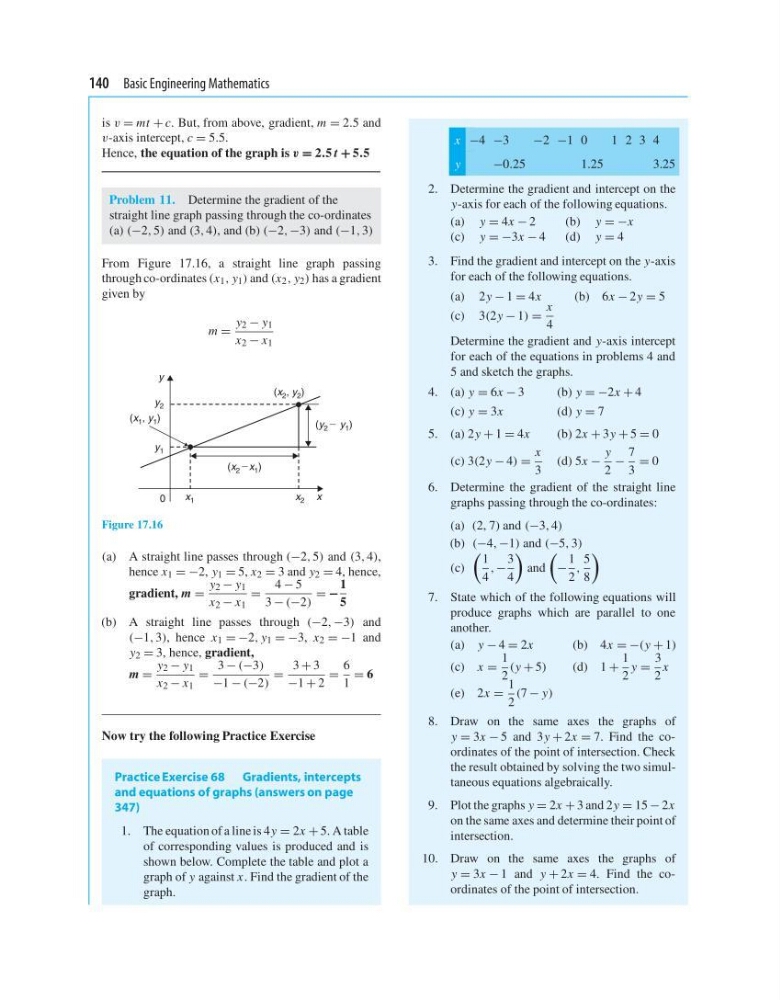
From Figure 17.16, a straight line graph passing
through co-ordinates (x 1 , y 1 ) and (x 2 , y 2 ) has a gradient
given by
m =
y 2 − y 1
x 2 − x 1
(x 1 , y 1 )
(x 2 , y 2 )
(x 2 Ϫx 1 )
(y 2 Ϫ y 1 )
0
y
y 2
y 1
x 1
x 2 x
Figure 17.16
(a) A straight line passes through (−2, 5) and (3, 4),
hence x 1 = −2, y 1 = 5, x 2 = 3 and y 2 = 4, hence,
gradient, m =
y 2 − y 1
x 2 − x 1
=
4 − 5
3 − (−2)
= −
1
5
(b) A straight line passes through (−2, −3) and
(−1, 3), hence x 1 = −2, y 1 = −3, x 2 = −1 and
y 2 = 3, hence, gradient,
m =
y 2 − y 1
x 2 − x 1
=
3 − (−3)
−1 − (−2)
=
3 + 3
−1 + 2
=
6
1
= 6
Now try the following Practice Exercise
Practice Exercise 68 Gradients, intercepts
and equations of graphs (answers on page
347)
1. The equation of a line is 4y = 2x + 5. A table
of corresponding values is produced and is
shown below. Complete the table and plot a
graph of y against x. Find the gradient of the
graph.
x −4 −3
−2 −1 0
1 2 3 4
y
−0.25
1.25
3.25
2. Determine the gradient and intercept on the
y-axis for each of the following equations.
(a) y = 4x − 2
(b) y = −x
(c) y = −3x − 4
(d) y = 4
3. Find the gradient and intercept on the y-axis
for each of the following equations.
(a) 2y − 1 = 4x
(b) 6x − 2y = 5
(c) 3(2y − 1) =
x
4
Determine the gradient and y-axis intercept
for each of the equations in problems 4 and
5 and sketch the graphs.
4. (a) y = 6x − 3
(b)y = −2x + 4
(c) y = 3x
(d) y = 7
5. (a) 2y + 1 = 4x
(b) 2x + 3y + 5 = 0
(c) 3(2y − 4) =
x
3
(d) 5x −
y
2
−
7
3
= 0
6. Determine the gradient of the straight line
graphs passing through the co-ordinates:
(a) (2, 7) and (−3, 4)
(b) (−4, −1) and (−5, 3)
(c)
1
4
, −
3
4
and
−
1
2
,
5
8
7. State which of the following equations will
produce graphs which are parallel to one
another.
(a) y − 4 = 2x
(b) 4x = −(y + 1)
(c) x =
1
2
(y + 5)
(d) 1 +
1
2
y =
3
2
x
(e) 2x =
1
2
(7 − y)
8. Draw on the same axes the graphs of
y = 3x − 5 and 3y + 2x = 7. Find the coordinates of the point of intersection. Check
the result obtained by solving the two simultaneous equations algebraically.
9. Plot the graphs y = 2x + 3 and 2y = 15 − 2x
on the same axes and determine their point of
intersection.
10. Draw on the same axes the graphs of
y = 3x − 1 and y + 2x = 4. Find the coordinates of the point of intersection.
is v = mt + c. But, from above, gradient, m = 2.5 and
v-axis intercept, c = 5.5.
Hence, the equation of the graph is v = 2.5 t + 5.5
Problem 11. Determine the gradient of the
straight line graph passing through the co-ordinates
(a) (−2, 5) and (3, 4), and (b) (−2, −3) and (−1, 3)
From Figure 17.16, a straight line graph passing
through co-ordinates (x 1 , y 1 ) and (x 2 , y 2 ) has a gradient
given by
m =
y 2 − y 1
x 2 − x 1
(x 1 , y 1 )
(x 2 , y 2 )
(x 2 Ϫx 1 )
(y 2 Ϫ y 1 )
0
y
y 2
y 1
x 1
x 2 x
Figure 17.16
(a) A straight line passes through (−2, 5) and (3, 4),
hence x 1 = −2, y 1 = 5, x 2 = 3 and y 2 = 4, hence,
gradient, m =
y 2 − y 1
x 2 − x 1
=
4 − 5
3 − (−2)
= −
1
5
(b) A straight line passes through (−2, −3) and
(−1, 3), hence x 1 = −2, y 1 = −3, x 2 = −1 and
y 2 = 3, hence, gradient,
m =
y 2 − y 1
x 2 − x 1
=
3 − (−3)
−1 − (−2)
=
3 + 3
−1 + 2
=
6
1
= 6
Now try the following Practice Exercise
Practice Exercise 68 Gradients, intercepts
and equations of graphs (answers on page
347)
1. The equation of a line is 4y = 2x + 5. A table
of corresponding values is produced and is
shown below. Complete the table and plot a
graph of y against x. Find the gradient of the
graph.
x −4 −3
−2 −1 0
1 2 3 4
y
−0.25
1.25
3.25
2. Determine the gradient and intercept on the
y-axis for each of the following equations.
(a) y = 4x − 2
(b) y = −x
(c) y = −3x − 4
(d) y = 4
3. Find the gradient and intercept on the y-axis
for each of the following equations.
(a) 2y − 1 = 4x
(b) 6x − 2y = 5
(c) 3(2y − 1) =
x
4
Determine the gradient and y-axis intercept
for each of the equations in problems 4 and
5 and sketch the graphs.
4. (a) y = 6x − 3
(b)y = −2x + 4
(c) y = 3x
(d) y = 7
5. (a) 2y + 1 = 4x
(b) 2x + 3y + 5 = 0
(c) 3(2y − 4) =
x
3
(d) 5x −
y
2
−
7
3
= 0
6. Determine the gradient of the straight line
graphs passing through the co-ordinates:
(a) (2, 7) and (−3, 4)
(b) (−4, −1) and (−5, 3)
(c)
1
4
, −
3
4
and
−
1
2
,
5
8
7. State which of the following equations will
produce graphs which are parallel to one
another.
(a) y − 4 = 2x
(b) 4x = −(y + 1)
(c) x =
1
2
(y + 5)
(d) 1 +
1
2
y =
3
2
x
(e) 2x =
1
2
(7 − y)
8. Draw on the same axes the graphs of
y = 3x − 5 and 3y + 2x = 7. Find the coordinates of the point of intersection. Check
the result obtained by solving the two simultaneous equations algebraically.
9. Plot the graphs y = 2x + 3 and 2y = 15 − 2x
on the same axes and determine their point of
intersection.
10. Draw on the same axes the graphs of
y = 3x − 1 and y + 2x = 4. Find the coordinates of the point of intersection.