

Solving quadratic equations 105
14.3 Solution of quadratic equations
by ‘completing the square’
An expression such as x 2 or (x + 2) 2 or (x − 3) 2 is
called a perfect square.
If x 2 = 3 then x = ±
√
3
If (x + 2) 2 = 5 then x + 2 = ±
√
5 and x = −2 ±
√
5
If (x − 3) 2 = 8 then x − 3 = ±
√
8 and x = 3 ±
√
8
Hence, if a quadratic equation can be rearranged so that
one side of the equation is a perfect square and the other
side of the equation is a number, then the solution of
the equation is readily obtained by taking the square
roots of each side as in the above examples. The process
of rearranging one side of a quadratic equation into a
perfect square before solving is called ‘completing the
square’.
(x + a)
2
= x
2
+ 2ax + a
2
Thus, in order to make the quadratic expression x 2 + 2ax
into a perfect square, it is necessary to add (half the
coefficient of x) 2 , i.e.
2a
2
2
or a 2
For example, x 2 + 3x becomes a perfect square by
adding
3
2
2
, i.e.
x
2
+ 3x +
3
2
2
=
x +
3
2
2
The method of completing the square is demonstrated
in the following worked problems.
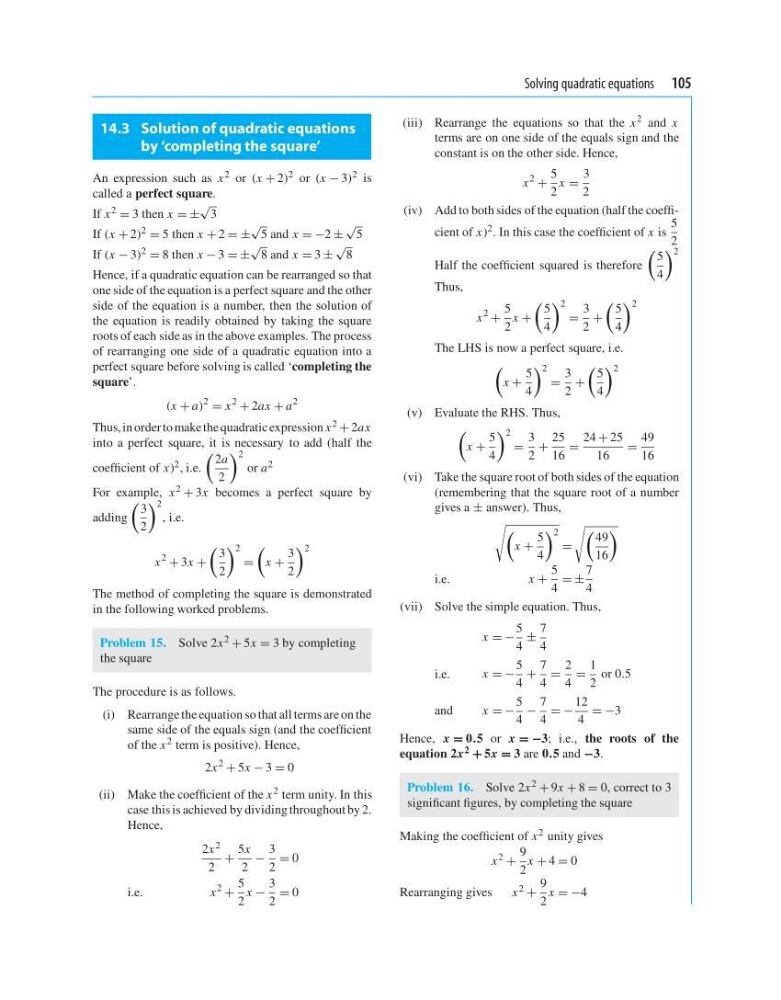
Problem 15. Solve 2x 2 + 5x = 3 by completing
the square
The procedure is as follows.
(i) Rearrange the equation so that all terms are on the
same side of the equals sign (and the coefficient
of the x 2 term is positive). Hence,
2x
2
+ 5x − 3 = 0
(ii) Make the coefficient of the x 2 term unity. In this
case this is achieved by dividing throughout by 2.
Hence,
2x 2
2
+
5x
2
−
3
2
= 0
i.e.
x
2
+
5
2
x −
3
2
= 0
(iii) Rearrange the equations so that the x
2 and x
terms are on one side of the equals sign and the
constant is on the other side. Hence,
x
2
+
5
2
x =
3
2
(iv) Add to both sides of the equation (half the coefficient of x) 2 . In this case the coefficient of x is
5
2
Half the coefficient squared is therefore
5
4
2
Thus,
x
2
+
5
2
x +
5
4
2
=
3
2
+
5
4
2
The LHS is now a perfect square, i.e.
x +
5
4
2
=
3
2
+
5
4
2
(v) Evaluate the RHS. Thus,
x +
5
4
2
=
3
2
+
25
16
=
24 + 25
16
=
49
16
(vi) Take the square root of both sides of the equation
(remembering that the square root of a number
gives a ± answer). Thus,
x +
5
4
2
=
49
16
i.e.
x +
5
4
= ±
7
4
(vii) Solve the simple equation. Thus,
x = −
5
4
±
7
4
i.e.
x = −
5
4
+
7
4
=
2
4
=
1
2
or 0.5
and
x = −
5
4
−
7
4
= −
12
4
= −3
Hence, x = 0.5 or x = −3; i.e., the roots of the
equation 2x 2 + 5x = 3 are 0.5 and −3.
Problem 16. Solve 2x 2 + 9x + 8 = 0, correct to 3
significant figures, by completing the square
Making the coefficient of x 2 unity gives
x 2 +
9
2
x + 4 = 0
Rearranging gives
x 2 +
9
2
x = −4
14.3 Solution of quadratic equations
by ‘completing the square’
An expression such as x 2 or (x + 2) 2 or (x − 3) 2 is
called a perfect square.
If x 2 = 3 then x = ±
√
3
If (x + 2) 2 = 5 then x + 2 = ±
√
5 and x = −2 ±
√
5
If (x − 3) 2 = 8 then x − 3 = ±
√
8 and x = 3 ±
√
8
Hence, if a quadratic equation can be rearranged so that
one side of the equation is a perfect square and the other
side of the equation is a number, then the solution of
the equation is readily obtained by taking the square
roots of each side as in the above examples. The process
of rearranging one side of a quadratic equation into a
perfect square before solving is called ‘completing the
square’.
(x + a)
2
= x
2
+ 2ax + a
2
Thus, in order to make the quadratic expression x 2 + 2ax
into a perfect square, it is necessary to add (half the
coefficient of x) 2 , i.e.
2a
2
2
or a 2
For example, x 2 + 3x becomes a perfect square by
adding
3
2
2
, i.e.
x
2
+ 3x +
3
2
2
=
x +
3
2
2
The method of completing the square is demonstrated
in the following worked problems.
Problem 15. Solve 2x 2 + 5x = 3 by completing
the square
The procedure is as follows.
(i) Rearrange the equation so that all terms are on the
same side of the equals sign (and the coefficient
of the x 2 term is positive). Hence,
2x
2
+ 5x − 3 = 0
(ii) Make the coefficient of the x 2 term unity. In this
case this is achieved by dividing throughout by 2.
Hence,
2x 2
2
+
5x
2
−
3
2
= 0
i.e.
x
2
+
5
2
x −
3
2
= 0
(iii) Rearrange the equations so that the x
2 and x
terms are on one side of the equals sign and the
constant is on the other side. Hence,
x
2
+
5
2
x =
3
2
(iv) Add to both sides of the equation (half the coefficient of x) 2 . In this case the coefficient of x is
5
2
Half the coefficient squared is therefore
5
4
2
Thus,
x
2
+
5
2
x +
5
4
2
=
3
2
+
5
4
2
The LHS is now a perfect square, i.e.
x +
5
4
2
=
3
2
+
5
4
2
(v) Evaluate the RHS. Thus,
x +
5
4
2
=
3
2
+
25
16
=
24 + 25
16
=
49
16
(vi) Take the square root of both sides of the equation
(remembering that the square root of a number
gives a ± answer). Thus,
x +
5
4
2
=
49
16
i.e.
x +
5
4
= ±
7
4
(vii) Solve the simple equation. Thus,
x = −
5
4
±
7
4
i.e.
x = −
5
4
+
7
4
=
2
4
=
1
2
or 0.5
and
x = −
5
4
−
7
4
= −
12
4
= −3
Hence, x = 0.5 or x = −3; i.e., the roots of the
equation 2x 2 + 5x = 3 are 0.5 and −3.
Problem 16. Solve 2x 2 + 9x + 8 = 0, correct to 3
significant figures, by completing the square
Making the coefficient of x 2 unity gives
x 2 +
9
2
x + 4 = 0
Rearranging gives
x 2 +
9
2
x = −4