

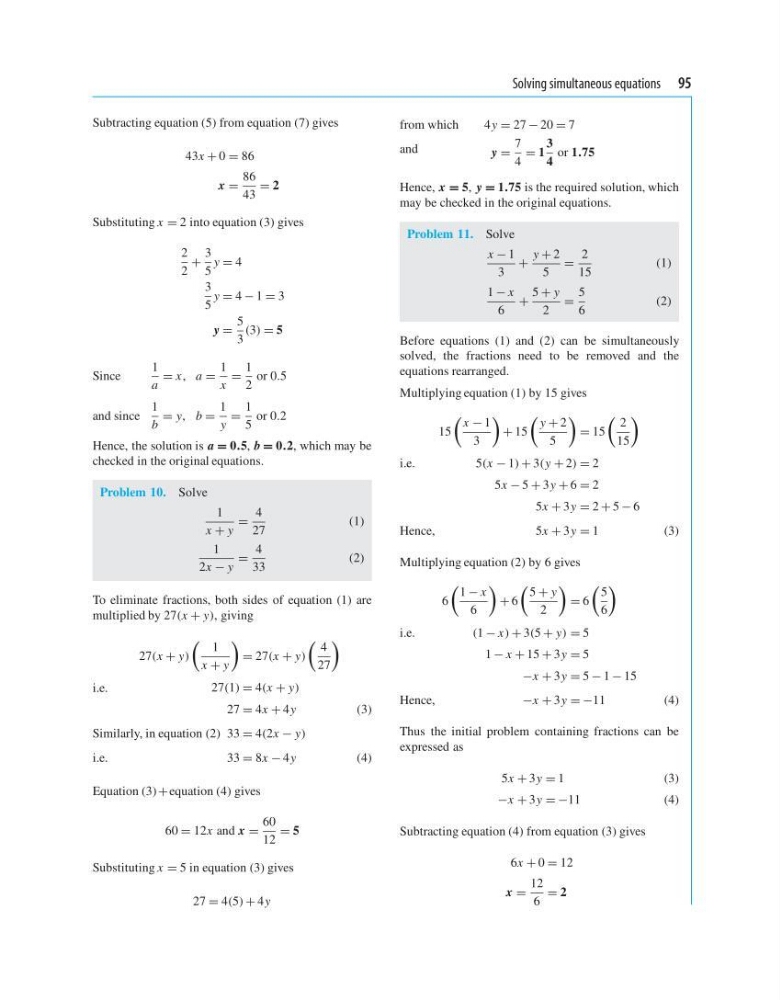
Solving simultaneous equations 95
Subtracting equation (5) from equation (7) gives
43x + 0 = 86
x =
86
43
= 2
Substituting x = 2 into equation (3) gives
2
2
+
3
5
y = 4
3
5
y = 4 − 1 = 3
y =
5
3
(3) = 5
Since
1
a
= x, a =
1
x
=
1
2
or 0.5
and since
1
b
= y, b =
1
y
=
1
5
or 0.2
Hence, the solution is a = 0.5, b = 0.2, which may be
checked in the original equations.
Problem 10. Solve
1
x + y
=
4
27
(1)
1
2x − y
=
4
33
(2)
To eliminate fractions, both sides of equation (1) are
multiplied by 27(x + y), giving
27(x + y)
1
x + y
= 27(x + y)
4
27
i.e.
27(1) = 4(x + y)
27 = 4x + 4y
(3)
Similarly, in equation (2) 33 = 4(2x − y)
i.e.
33 = 8x − 4y
(4)
Equation (3) + equation (4) gives
60 = 12x and x =
60
12
= 5
Substituting x = 5 in equation (3) gives
27 = 4(5) + 4y
from which
4y = 27 − 20 = 7
and
y =
7
4
= 1
3
4
or 1.75
Hence, x = 5, y = 1.75 is the required solution, which
may be checked in the original equations.
Problem 11. Solve
x − 1
3
+
y + 2
5
=
2
15
(1)
1 − x
6
+
5 + y
2
=
5
6
(2)
Before equations (1) and (2) can be simultaneously
solved, the fractions need to be removed and the
equations rearranged.
Multiplying equation (1) by 15 gives
15
x − 1
3
+ 15
y + 2
5
= 15
2
15
i.e.
5(x − 1) + 3(y + 2) = 2
5x − 5 + 3y + 6 = 2
5x + 3y = 2 + 5 − 6
Hence,
5x + 3y = 1
( 3 )
Multiplying equation (2) by 6 gives
6
1 − x
6
+ 6
5 + y
2
= 6
5
6
i.e.
(1 − x) + 3(5 + y) = 5
1 − x + 15 + 3y = 5
−x + 3y = 5 − 1 − 15
Hence,
−x + 3y = −11
(4)
Thus the initial problem containing fractions can be
expressed as
5x + 3y = 1
( 3 )
−x + 3y = −11
(4)
Subtracting equation (4) from equation (3) gives
6x + 0 = 12
x =
12
6
= 2
Subtracting equation (5) from equation (7) gives
43x + 0 = 86
x =
86
43
= 2
Substituting x = 2 into equation (3) gives
2
2
+
3
5
y = 4
3
5
y = 4 − 1 = 3
y =
5
3
(3) = 5
Since
1
a
= x, a =
1
x
=
1
2
or 0.5
and since
1
b
= y, b =
1
y
=
1
5
or 0.2
Hence, the solution is a = 0.5, b = 0.2, which may be
checked in the original equations.
Problem 10. Solve
1
x + y
=
4
27
(1)
1
2x − y
=
4
33
(2)
To eliminate fractions, both sides of equation (1) are
multiplied by 27(x + y), giving
27(x + y)
1
x + y
= 27(x + y)
4
27
i.e.
27(1) = 4(x + y)
27 = 4x + 4y
(3)
Similarly, in equation (2) 33 = 4(2x − y)
i.e.
33 = 8x − 4y
(4)
Equation (3) + equation (4) gives
60 = 12x and x =
60
12
= 5
Substituting x = 5 in equation (3) gives
27 = 4(5) + 4y
from which
4y = 27 − 20 = 7
and
y =
7
4
= 1
3
4
or 1.75
Hence, x = 5, y = 1.75 is the required solution, which
may be checked in the original equations.
Problem 11. Solve
x − 1
3
+
y + 2
5
=
2
15
(1)
1 − x
6
+
5 + y
2
=
5
6
(2)
Before equations (1) and (2) can be simultaneously
solved, the fractions need to be removed and the
equations rearranged.
Multiplying equation (1) by 15 gives
15
x − 1
3
+ 15
y + 2
5
= 15
2
15
i.e.
5(x − 1) + 3(y + 2) = 2
5x − 5 + 3y + 6 = 2
5x + 3y = 2 + 5 − 6
Hence,
5x + 3y = 1
( 3 )
Multiplying equation (2) by 6 gives
6
1 − x
6
+ 6
5 + y
2
= 6
5
6
i.e.
(1 − x) + 3(5 + y) = 5
1 − x + 15 + 3y = 5
−x + 3y = 5 − 1 − 15
Hence,
−x + 3y = −11
(4)
Thus the initial problem containing fractions can be
expressed as
5x + 3y = 1
( 3 )
−x + 3y = −11
(4)
Subtracting equation (4) from equation (3) gives
6x + 0 = 12
x =
12
6
= 2