

Transposing formulae 89
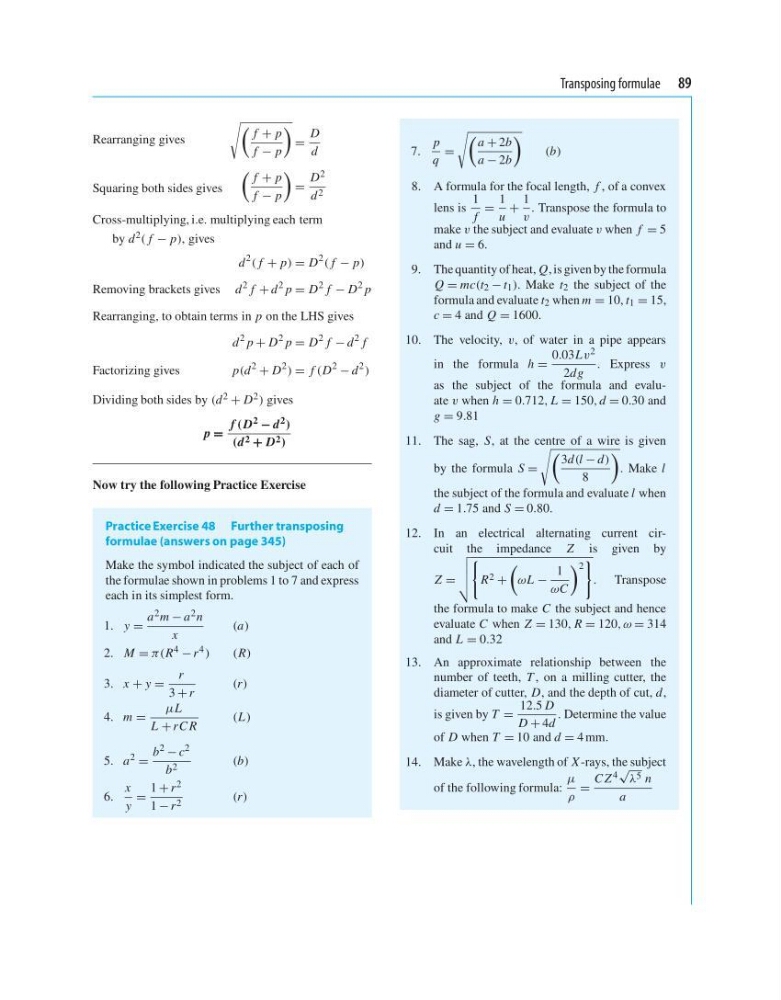
Rearranging gives
f + p
f − p
=
D
d
Squaring both sides gives
f + p
f − p
=
D 2
d 2
Cross-multiplying, i.e. multiplying each term
by d 2 ( f − p), gives
d
2
( f + p) = D
2
( f − p)
Removing brackets gives d
2 f + d
2 p = D
2 f − D
2 p
Rearranging, to obtain terms in p on the LHS gives
d
2 p + D
2 p = D
2 f − d
2 f
Factorizing gives
p(d
2
+ D
2
) = f (D
2
− d
2
)
Dividing both sides by (d 2 + D 2 ) gives
p =
f (D 2 − d 2 )
(d 2 + D 2 )
Now try the following Practice Exercise
Practice Exercise 48 Further transposing
formulae (answers on page 345)
Make the symbol indicated the subject of each of
the formulae shown in problems 1 to 7 and express
each in its simplest form.
1. y =
a 2 m − a 2 n
x
(a)
2. M = π(R 4 − r 4 )
(R)
3. x + y =
r
3 + r
(r)
4. m =
μL
L + rC R
(L)
5. a 2 =
b
2
− c
2
b 2
(b)
6.
x
y
=
1 + r 2
1 − r 2
(r)
7.
p
q
=
a + 2b
a − 2b
(b)
8. A formula for the focal length, f , of a convex
lens is
1
f
=
1
u
+
1
v
. Transpose the formula to
make v the subject and evaluate v when f = 5
and u = 6.
9. The quantity of heat, Q, is given by the formula
Q = mc(t 2 − t 1 ). Make t 2 the subject of the
formula and evaluate t 2 when m = 10, t 1 = 15,
c = 4 and Q = 1600.
10. The velocity, v, of water in a pipe appears
in the formula h =
0.03Lv 2
2dg
. Express v
as the subject of the formula and evaluate v when h = 0.712, L = 150, d = 0.30 and
g = 9.81
11. The sag, S, at the centre of a wire is given
by the formula S =
3d(l − d)
8
. Make l
the subject of the formula and evaluate l when
d = 1.75 and S = 0.80.
12. In an electrical alternating current circuit the impedance Z is given by
Z =
R 2 +
ωL −
1
ωC
2
. Transpose
the formula to make C the subject and hence
evaluate C when Z = 130, R = 120, ω = 314
and L = 0.32
13. An approximate relationship between the
number of teeth, T , on a milling cutter, the
diameter of cutter, D, and the depth of cut, d,
is given by T =
12.5 D
D + 4d
. Determine the value
of D when T = 10 and d = 4 mm.
14. Make λ, the wavelength of X -rays, the subject
of the following formula:
μ
ρ
=
C Z 4
√
λ 5 n
a
Rearranging gives
f + p
f − p
=
D
d
Squaring both sides gives
f + p
f − p
=
D 2
d 2
Cross-multiplying, i.e. multiplying each term
by d 2 ( f − p), gives
d
2
( f + p) = D
2
( f − p)
Removing brackets gives d
2 f + d
2 p = D
2 f − D
2 p
Rearranging, to obtain terms in p on the LHS gives
d
2 p + D
2 p = D
2 f − d
2 f
Factorizing gives
p(d
2
+ D
2
) = f (D
2
− d
2
)
Dividing both sides by (d 2 + D 2 ) gives
p =
f (D 2 − d 2 )
(d 2 + D 2 )
Now try the following Practice Exercise
Practice Exercise 48 Further transposing
formulae (answers on page 345)
Make the symbol indicated the subject of each of
the formulae shown in problems 1 to 7 and express
each in its simplest form.
1. y =
a 2 m − a 2 n
x
(a)
2. M = π(R 4 − r 4 )
(R)
3. x + y =
r
3 + r
(r)
4. m =
μL
L + rC R
(L)
5. a 2 =
b
2
− c
2
b 2
(b)
6.
x
y
=
1 + r 2
1 − r 2
(r)
7.
p
q
=
a + 2b
a − 2b
(b)
8. A formula for the focal length, f , of a convex
lens is
1
f
=
1
u
+
1
v
. Transpose the formula to
make v the subject and evaluate v when f = 5
and u = 6.
9. The quantity of heat, Q, is given by the formula
Q = mc(t 2 − t 1 ). Make t 2 the subject of the
formula and evaluate t 2 when m = 10, t 1 = 15,
c = 4 and Q = 1600.
10. The velocity, v, of water in a pipe appears
in the formula h =
0.03Lv 2
2dg
. Express v
as the subject of the formula and evaluate v when h = 0.712, L = 150, d = 0.30 and
g = 9.81
11. The sag, S, at the centre of a wire is given
by the formula S =
3d(l − d)
8
. Make l
the subject of the formula and evaluate l when
d = 1.75 and S = 0.80.
12. In an electrical alternating current circuit the impedance Z is given by
Z =
R 2 +
ωL −
1
ωC
2
. Transpose
the formula to make C the subject and hence
evaluate C when Z = 130, R = 120, ω = 314
and L = 0.32
13. An approximate relationship between the
number of teeth, T , on a milling cutter, the
diameter of cutter, D, and the depth of cut, d,
is given by T =
12.5 D
D + 4d
. Determine the value
of D when T = 10 and d = 4 mm.
14. Make λ, the wavelength of X -rays, the subject
of the following formula:
μ
ρ
=
C Z 4
√
λ 5 n
a