

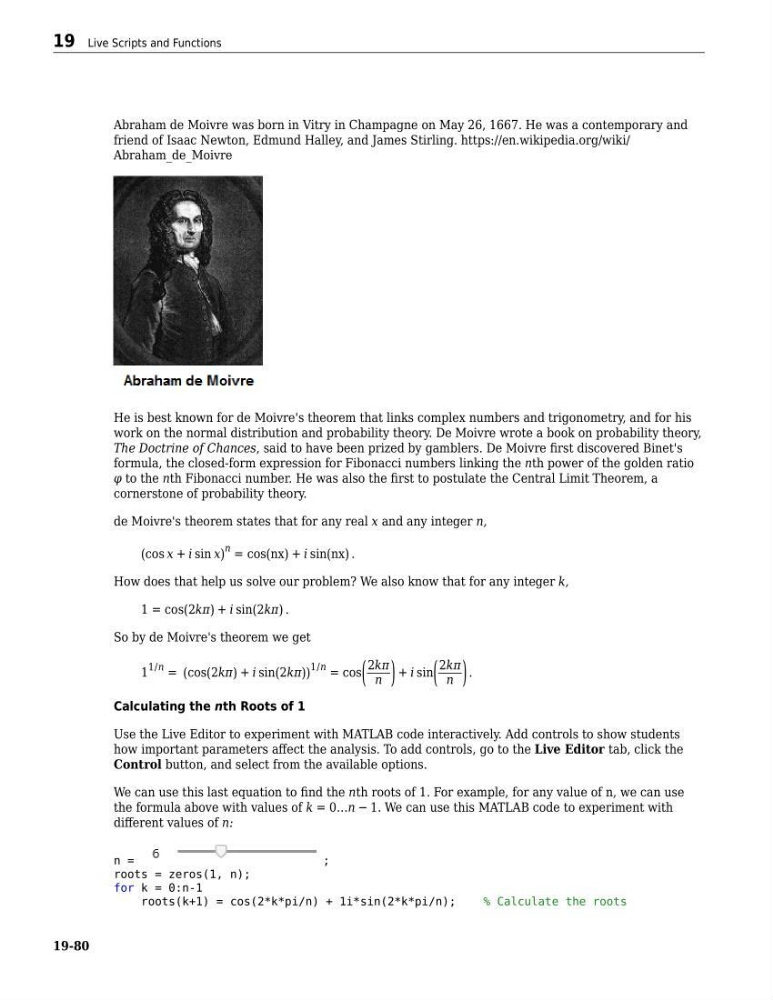
Abraham de Moivre was born in Vitry in Champagne on May 26, 1667. He was a contemporary and
friend of Isaac Newton, Edmund Halley, and James Stirling. https://en.wikipedia.org/wiki/
Abraham_de_Moivre
He is best known for de Moivre's theorem that links complex numbers and trigonometry, and for his
work on the normal distribution and probability theory. De Moivre wrote a book on probability theory,
The Doctrine of Chances, said to have been prized by gamblers. De Moivre first discovered Binet's
formula, the closed-form expression for Fibonacci numbers linking the nth power of the golden ratio
φ to the nth Fibonacci number. He was also the first to postulate the Central Limit Theorem, a
cornerstone of probability theory.
de Moivre's theorem states that for any real x and any integer n,
cos x + i sin x
n = cos nx + i sin nx .
How does that help us solve our problem? We also know that for any integer k,
1 = cos 2kπ + i sin 2kπ .
So by de Moivre's theorem we get
1
1/n = cos 2kπ + i sin 2kπ
1/n = cos
2kπ
n
+ i sin
2kπ
n
.
Calculating the nth Roots of 1
Use the Live Editor to experiment with MATLAB code interactively. Add controls to show students
how important parameters affect the analysis. To add controls, go to the Live Editor tab, click the
Control button, and select from the available options.
We can use this last equation to find the nth roots of 1. For example, for any value of n, we can use
the formula above with values of k = 0…n − 1. We can use this MATLAB code to experiment with
different values of n:
n =
;
roots = zeros(1, n);
for k = 0:n-1
roots(k+1) = cos(2*k*pi/n) + 1i*sin(2*k*pi/n);
% Calculate the roots
19 Live Scripts and Functions
19-80