

Solar Radiation on Fixed Panels
Use hyperlinks to reference supporting information from other sources. To add a hyperlink, go to the
Insert tab and click the Hyperlink button.
Panels installed with a solar tracker can move with the sun and receive 100% of the sun's radiation as
the sun moves across the sky. However, most solar cell installations have panels set at a fixed azimuth
and tilt. Therefore, the actual radiation reaching the panel also depends on the solar azimuth. The
solar azimuth (γ) is the compass direction of the sun's position in the sky. At solar noon in the
Northern hemisphere the solar azimuth is180
∘ corresponding to the direction south. Calculate the
solar azimuth using the equation
γ =
cos −1 sinδcosϕ − cosδsinϕcosω
cosα
for solar time ≤ 12
360
∘ − cos −1 sinδcosϕ − cosδsinϕcosω
cosα
for solar time > 12
gamma = acosd((sind(delta)*cosd(phi) - cosd(delta)*sind(phi)*cosd(omega))/cosd(alpha));
if (hour(solarTime) >= 12) && (omega >= 0)
gamma = 360 - gamma;
end
disp(['Solar Azimuth = ' num2str(gamma)])
Solar Azimuth = 191.7888
In the northern hemisphere, a typical solar panel installation has panels oriented toward the south
with a panel azimuth (β) of 180
∘ . At northern latitudes, a typical tilt angle (τ) is 35
∘ . Calculate the
panel radiation for fixed panels from the total solar radiation using the equation
pRad = sRad cos(α)sin(τ)cos(β − γ) + sin(α)cos(τ) .
beta = 180;
% Panel azimuth
tau = 35;
% Panel tilt
panelRad = solarRad*max(0,(cosd(alpha)*sind(tau)*cosd(beta-gamma) + sind(alpha)*cosd(tau)));
disp(['Panel Radiation = ' num2str(panelRad) ' kW/m^2'])
Panel Radiation = 0.89928 kW/m^2
Panel Radiation and Power Generation For a Single Day
Modify parameters using interactive controls. Display plots together with the code that produced
them.
Panel Radiation
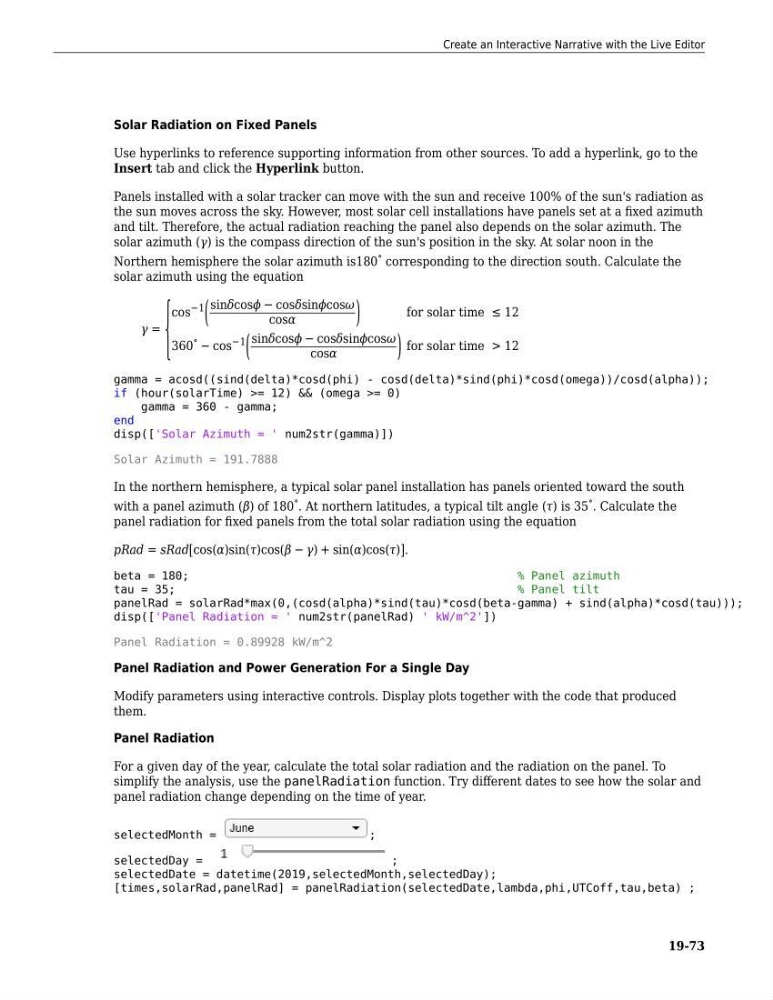
For a given day of the year, calculate the total solar radiation and the radiation on the panel. To
simplify the analysis, use the panelRadiation function. Try different dates to see how the solar and
panel radiation change depending on the time of year.
selectedMonth =
;
selectedDay =
;
selectedDate = datetime(2019,selectedMonth,selectedDay);
[times,solarRad,panelRad] = panelRadiation(selectedDate,lambda,phi,UTCoff,tau,beta) ;
Create an Interactive Narrative with the Live Editor
19-73