

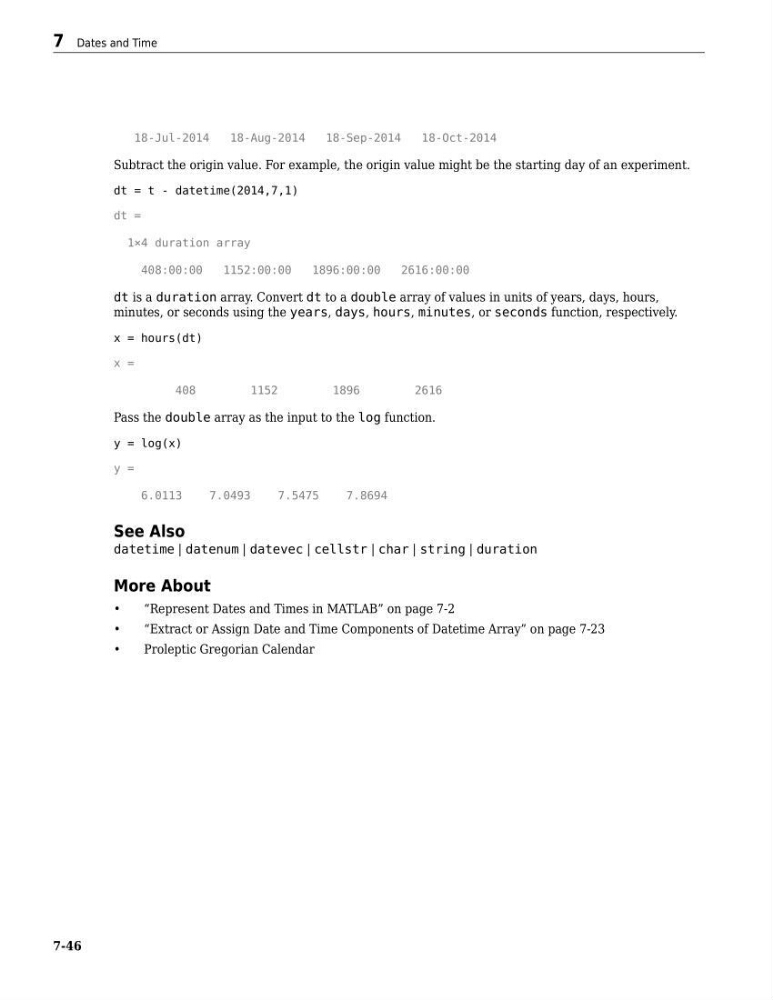
18-Jul-2014
18-Aug-2014
18-Sep-2014
18-Oct-2014
Subtract the origin value. For example, the origin value might be the starting day of an experiment.
dt = t - datetime(2014,7,1)
dt =
1×4 duration array
408:00:00
1152:00:00
1896:00:00
2616:00:00
dt is a duration array. Convert dt to a double array of values in units of years, days, hours,
minutes, or seconds using the years, days, hours, minutes, or seconds function, respectively.
x = hours(dt)
x =
408
1152
1896
2616
Pass the double array as the input to the log function.
y = log(x)
y =
6.0113
7.0493
7.5475
7.8694
See Also
datetime | datenum | datevec | cellstr | char | string | duration
More About
•
“Represent Dates and Times in MATLAB” on page 7-2
•
“Extract or Assign Date and Time Components of Datetime Array” on page 7-23
•
Proleptic Gregorian Calendar
7 Dates and Time
7-46
18-Aug-2014
18-Sep-2014
18-Oct-2014
Subtract the origin value. For example, the origin value might be the starting day of an experiment.
dt = t - datetime(2014,7,1)
dt =
1×4 duration array
408:00:00
1152:00:00
1896:00:00
2616:00:00
dt is a duration array. Convert dt to a double array of values in units of years, days, hours,
minutes, or seconds using the years, days, hours, minutes, or seconds function, respectively.
x = hours(dt)
x =
408
1152
1896
2616
Pass the double array as the input to the log function.
y = log(x)
y =
6.0113
7.0493
7.5475
7.8694
See Also
datetime | datenum | datevec | cellstr | char | string | duration
More About
•
“Represent Dates and Times in MATLAB” on page 7-2
•
“Extract or Assign Date and Time Components of Datetime Array” on page 7-23
•
Proleptic Gregorian Calendar
7 Dates and Time
7-46