

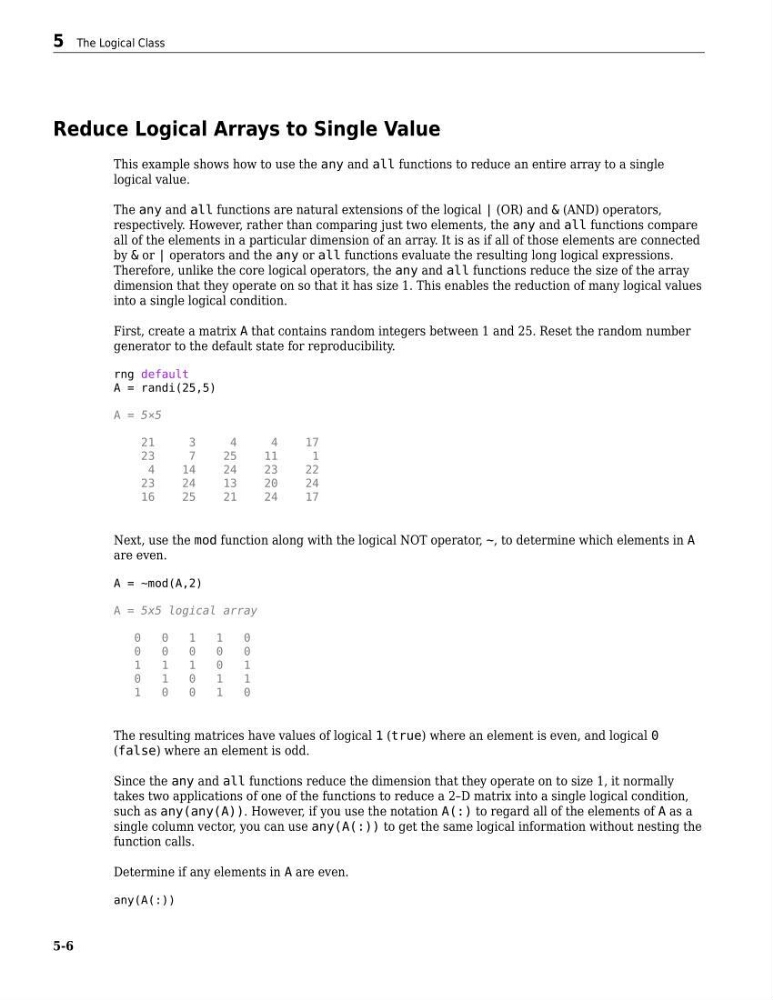
Reduce Logical Arrays to Single Value
This example shows how to use the any and all functions to reduce an entire array to a single
logical value.
The any and all functions are natural extensions of the logical | (OR) and & (AND) operators,
respectively. However, rather than comparing just two elements, the any and all functions compare
all of the elements in a particular dimension of an array. It is as if all of those elements are connected
by & or | operators and the any or all functions evaluate the resulting long logical expressions.
Therefore, unlike the core logical operators, the any and all functions reduce the size of the array
dimension that they operate on so that it has size 1. This enables the reduction of many logical values
into a single logical condition.
First, create a matrix A that contains random integers between 1 and 25. Reset the random number
generator to the default state for reproducibility.
rng default
A = randi(25,5)
A = 5×5
21
3
4
4
17
23
7
25
11
1
4
14
24
23
22
23
24
13
20
24
16
25
21
24
17
Next, use the mod function along with the logical NOT operator, ~, to determine which elements in A
are even.
A = ~mod(A,2)
A = 5x5 logical array
0
0
1
1
0
0
0
0
0
0
1
1
1
0
1
0
1
0
1
1
1
0
0
1
0
The resulting matrices have values of logical 1 (true) where an element is even, and logical 0
(false) where an element is odd.
Since the any and all functions reduce the dimension that they operate on to size 1, it normally
takes two applications of one of the functions to reduce a 2–D matrix into a single logical condition,
such as any(any(A)). However, if you use the notation A(:) to regard all of the elements of A as a
single column vector, you can use any(A(:)) to get the same logical information without nesting the
function calls.
Determine if any elements in A are even.
any(A(:))
5 The Logical Class
5-6
This example shows how to use the any and all functions to reduce an entire array to a single
logical value.
The any and all functions are natural extensions of the logical | (OR) and & (AND) operators,
respectively. However, rather than comparing just two elements, the any and all functions compare
all of the elements in a particular dimension of an array. It is as if all of those elements are connected
by & or | operators and the any or all functions evaluate the resulting long logical expressions.
Therefore, unlike the core logical operators, the any and all functions reduce the size of the array
dimension that they operate on so that it has size 1. This enables the reduction of many logical values
into a single logical condition.
First, create a matrix A that contains random integers between 1 and 25. Reset the random number
generator to the default state for reproducibility.
rng default
A = randi(25,5)
A = 5×5
21
3
4
4
17
23
7
25
11
1
4
14
24
23
22
23
24
13
20
24
16
25
21
24
17
Next, use the mod function along with the logical NOT operator, ~, to determine which elements in A
are even.
A = ~mod(A,2)
A = 5x5 logical array
0
0
1
1
0
0
0
0
0
0
1
1
1
0
1
0
1
0
1
1
1
0
0
1
0
The resulting matrices have values of logical 1 (true) where an element is even, and logical 0
(false) where an element is odd.
Since the any and all functions reduce the dimension that they operate on to size 1, it normally
takes two applications of one of the functions to reduce a 2–D matrix into a single logical condition,
such as any(any(A)). However, if you use the notation A(:) to regard all of the elements of A as a
single column vector, you can use any(A(:)) to get the same logical information without nesting the
function calls.
Determine if any elements in A are even.
any(A(:))
5 The Logical Class
5-6