

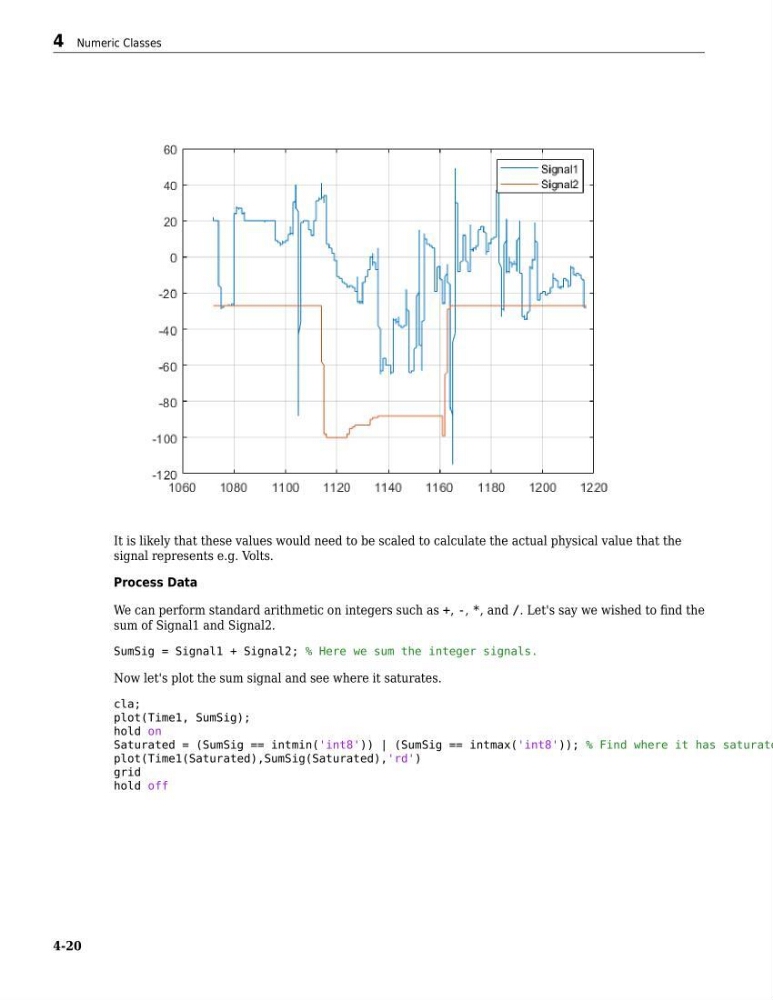
It is likely that these values would need to be scaled to calculate the actual physical value that the
signal represents e.g. Volts.
Process Data
We can perform standard arithmetic on integers such as +, -, *, and /. Let's say we wished to find the
sum of Signal1 and Signal2.
SumSig = Signal1 + Signal2; % Here we sum the integer signals.
Now let's plot the sum signal and see where it saturates.
cla;
plot(Time1, SumSig);
hold on
Saturated = (SumSig == intmin('int8')) | (SumSig == intmax('int8')); % Find where it has saturate
plot(Time1(Saturated),SumSig(Saturated),'rd')
grid
hold off
4 Numeric Classes
4-20
signal represents e.g. Volts.
Process Data
We can perform standard arithmetic on integers such as +, -, *, and /. Let's say we wished to find the
sum of Signal1 and Signal2.
SumSig = Signal1 + Signal2; % Here we sum the integer signals.
Now let's plot the sum signal and see where it saturates.
cla;
plot(Time1, SumSig);
hold on
Saturated = (SumSig == intmin('int8')) | (SumSig == intmax('int8')); % Find where it has saturate
plot(Time1(Saturated),SumSig(Saturated),'rd')
grid
hold off
4 Numeric Classes
4-20