

Chapter 9
Solving equations by
iterative methods
9.1 Introduction to iterative methods
Many equations can only be solved graphically or by
methods of successive approximations to the roots,
called iterative methods. Three methods of successive
approximations are (i) bisection method, introduced in
Section 9.2, (ii) an algebraic method, introduction in
Section 9.3, and (iii) by using the Newton-Raphson
formula, given in Section 9.4.
Each successive approximation method relies on a
reasonably good first estimate of the value of a root
being made. One way of determining this is to sketch a
graph of the function, say y = f (x), and determine the
approximate values of roots from the points where the
graph cuts the x-axis. Another way is by using a functional notation method. This method uses the property
that the value of the graph of f (x) = 0 changes sign for
values of x just before and just after the value of a root.
f(x)
8
4
0
Ϫ2
Ϫ4
2
4
x
f(x)ϭx 2 ϪxϪ6
Ϫ4
Ϫ6
Figure 9.1
For example, one root of the equation x 2 − x − 6 = 0 is
x = 3. Using functional notation:
f (x) = x
2
− x − 6
f (2) = 2
2
− 2 − 6 = −4
f (4) = 4
2
− 4 − 6 = +6
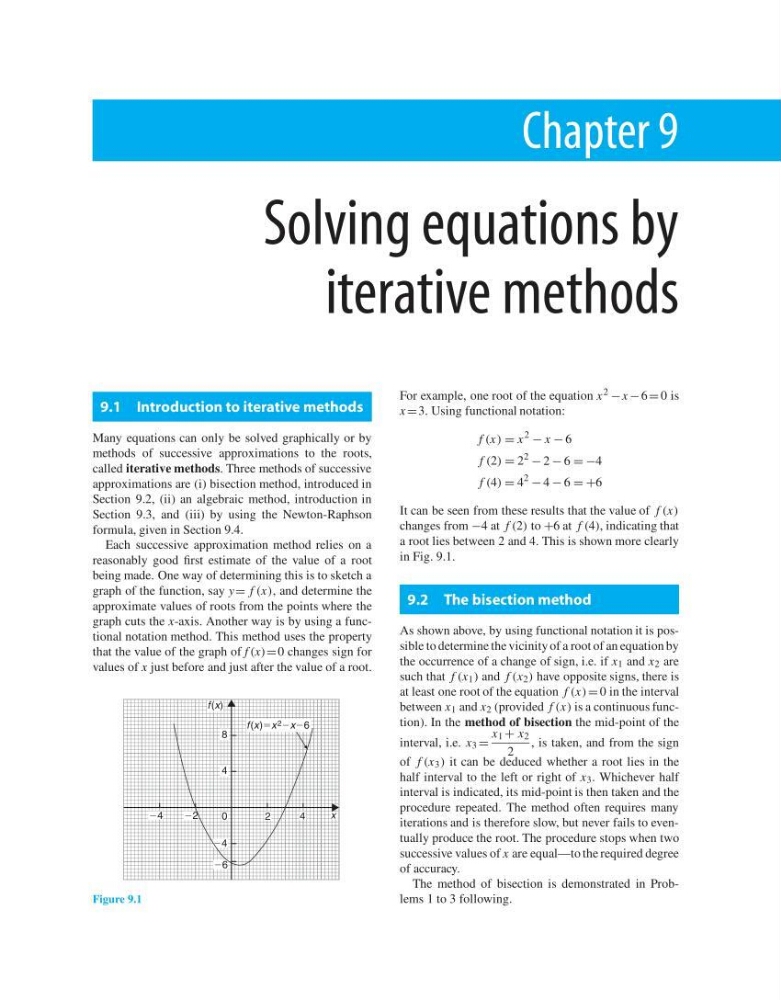
It can be seen from these results that the value of f (x)
changes from −4 at f (2) to +6 at f (4), indicating that
a root lies between 2 and 4. This is shown more clearly
in Fig. 9.1.
9.2 The bisection method
As shown above, by using functional notation it is possible to determine the vicinity of a root of an equation by
the occurrence of a change of sign, i.e. if x 1 and x 2 are
such that f (x 1 ) and f (x 2 ) have opposite signs, there is
at least one root of the equation f (x) = 0 in the interval
between x 1 and x 2 (provided f (x) is a continuous function). In the method of bisection the mid-point of the
interval, i.e. x 3 =
x 1 + x 2
2
, is taken, and from the sign
of f (x 3 ) it can be deduced whether a root lies in the
half interval to the left or right of x 3 . Whichever half
interval is indicated, its mid-point is then taken and the
procedure repeated. The method often requires many
iterations and is therefore slow, but never fails to eventually produce the root. The procedure stops when two
successive values of x are equal—to the required degree
of accuracy.
The method of bisection is demonstrated in Problems 1 to 3 following.
Solving equations by
iterative methods
9.1 Introduction to iterative methods
Many equations can only be solved graphically or by
methods of successive approximations to the roots,
called iterative methods. Three methods of successive
approximations are (i) bisection method, introduced in
Section 9.2, (ii) an algebraic method, introduction in
Section 9.3, and (iii) by using the Newton-Raphson
formula, given in Section 9.4.
Each successive approximation method relies on a
reasonably good first estimate of the value of a root
being made. One way of determining this is to sketch a
graph of the function, say y = f (x), and determine the
approximate values of roots from the points where the
graph cuts the x-axis. Another way is by using a functional notation method. This method uses the property
that the value of the graph of f (x) = 0 changes sign for
values of x just before and just after the value of a root.
f(x)
8
4
0
Ϫ2
Ϫ4
2
4
x
f(x)ϭx 2 ϪxϪ6
Ϫ4
Ϫ6
Figure 9.1
For example, one root of the equation x 2 − x − 6 = 0 is
x = 3. Using functional notation:
f (x) = x
2
− x − 6
f (2) = 2
2
− 2 − 6 = −4
f (4) = 4
2
− 4 − 6 = +6
It can be seen from these results that the value of f (x)
changes from −4 at f (2) to +6 at f (4), indicating that
a root lies between 2 and 4. This is shown more clearly
in Fig. 9.1.
9.2 The bisection method
As shown above, by using functional notation it is possible to determine the vicinity of a root of an equation by
the occurrence of a change of sign, i.e. if x 1 and x 2 are
such that f (x 1 ) and f (x 2 ) have opposite signs, there is
at least one root of the equation f (x) = 0 in the interval
between x 1 and x 2 (provided f (x) is a continuous function). In the method of bisection the mid-point of the
interval, i.e. x 3 =
x 1 + x 2
2
, is taken, and from the sign
of f (x 3 ) it can be deduced whether a root lies in the
half interval to the left or right of x 3 . Whichever half
interval is indicated, its mid-point is then taken and the
procedure repeated. The method often requires many
iterations and is therefore slow, but never fails to eventually produce the root. The procedure stops when two
successive values of x are equal—to the required degree
of accuracy.
The method of bisection is demonstrated in Problems 1 to 3 following.