

Maclaurin’ s series 71
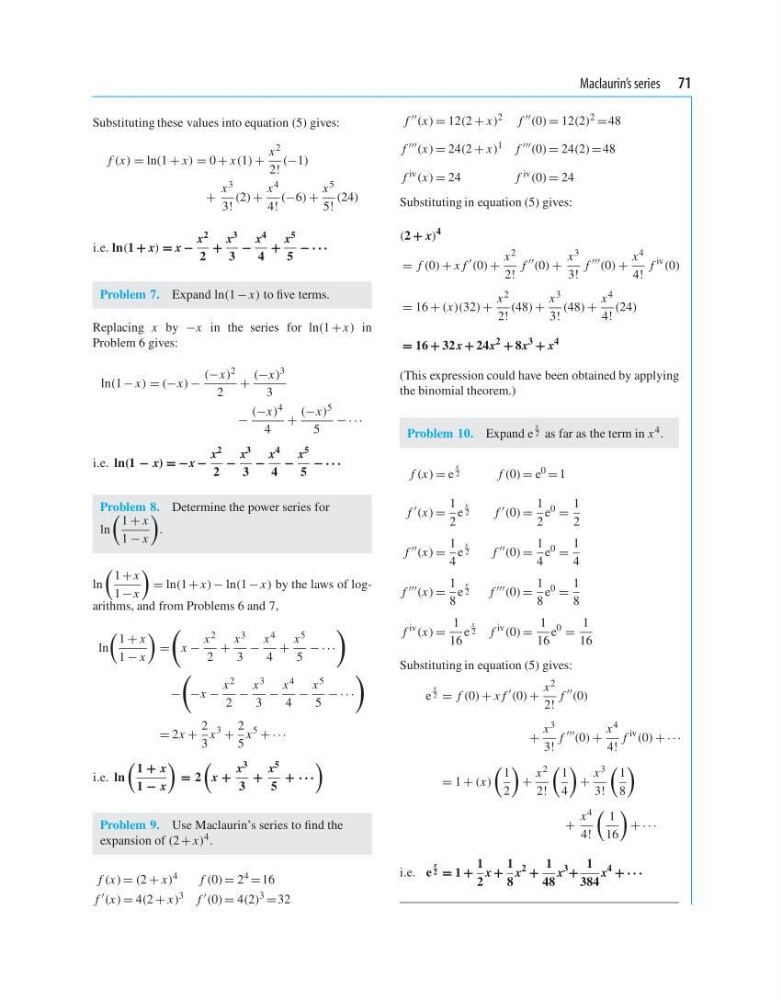
Substituting these values into equation (5) gives:
f (x) = ln(1 + x) = 0 + x(1) +
x 2
2!
(−1)
+
x 3
3!
(2) +
x 4
4!
(−6) +
x 5
5!
(24)
i.e. ln(1 + x) = x −
x 2
2
+
x 3
3
−
x 4
4
+
x 5
5
− · · ·
Problem 7. Expand ln(1 − x) to five terms.
Replacing x by −x in the series for ln(1 + x) in
Problem 6 gives:
ln(1 − x) = (−x) −
(−x) 2
2
+
(−x) 3
3
−
(−x) 4
4
+
(−x) 5
5
− · · ·
i.e. ln(1 − x) = −x −
x
2
2
−
x
3
3
−
x
4
4
−
x
5
5
− · · ·
Problem 8. Determine the power series for
ln
1 + x
1 − x
.
ln
1 + x
1 − x
= ln(1 + x) − ln(1 − x) by the laws of logarithms, and from Problems 6 and 7,
ln
1 + x
1 − x
=
x −
x 2
2
+
x 3
3
−
x 4
4
+
x 5
5
− · · ·
−
−x −
x 2
2
−
x 3
3
−
x 4
4
−
x 5
5
− · · ·
= 2x +
2
3
x
3
+
2
5
x
5
+ · · ·
i.e. ln
1 + x
1 − x
= 2
x +
x 3
3
+
x 5
5
+ · · ·
Problem 9. Use Maclaurin’s series to find the
expansion of (2 + x) 4 .
f (x) = (2 + x) 4
f (0) = 2 4 = 16
f (x) = 4(2 + x) 3 f (0) = 4(2) 3 = 32
f (x) = 12(2 + x) 2 f (0) = 12(2) 2 = 48
f (x) = 24(2 + x) 1 f (0) = 24(2) = 48
f iv (x) = 24
f iv (0) = 24
Substituting in equation (5) gives:
(2 + x)
4
= f (0) + x f
(0) +
x 2
2!
f
(0) +
x 3
3!
f
(0) +
x 4
4!
f
iv
(0)
= 16 + (x)(32) +
x 2
2!
(48) +
x 3
3!
(48) +
x 4
4!
(24)
= 16 + 32x + 24x
2
+ 8x
3
+ x
4
(This expression could have been obtained by applying
the binomial theorem.)
Problem 10. Expand e
x
2 as far as the term in x 4 .
f (x) = e
x
2
f (0) = e 0 = 1
f (x) =
1
2
e
x
2
f (0) =
1
2
e 0 =
1
2
f (x) =
1
4
e
x
2
f (0) =
1
4
e 0 =
1
4
f (x) =
1
8
e
x
2
f (0) =
1
8
e 0 =
1
8
f
iv
(x) =
1
16
e
x
2
f
iv
(0) =
1
16
e
0
=
1
16
Substituting in equation (5) gives:
e
x
2 = f (0) + x f
(0) +
x 2
2!
f
(0)
+
x 3
3!
f
(0) +
x 4
4!
f
iv
(0) + · · ·
= 1 + (x)
1
2
+
x 2
2!
1
4
+
x 3
3!
1
8
+
x 4
4!
1
16
+ · · ·
i.e. e
x
2 = 1 +
1
2
x +
1
8
x
2
+
1
48
x
3
+
1
384
x
4
+ · · ·
Substituting these values into equation (5) gives:
f (x) = ln(1 + x) = 0 + x(1) +
x 2
2!
(−1)
+
x 3
3!
(2) +
x 4
4!
(−6) +
x 5
5!
(24)
i.e. ln(1 + x) = x −
x 2
2
+
x 3
3
−
x 4
4
+
x 5
5
− · · ·
Problem 7. Expand ln(1 − x) to five terms.
Replacing x by −x in the series for ln(1 + x) in
Problem 6 gives:
ln(1 − x) = (−x) −
(−x) 2
2
+
(−x) 3
3
−
(−x) 4
4
+
(−x) 5
5
− · · ·
i.e. ln(1 − x) = −x −
x
2
2
−
x
3
3
−
x
4
4
−
x
5
5
− · · ·
Problem 8. Determine the power series for
ln
1 + x
1 − x
.
ln
1 + x
1 − x
= ln(1 + x) − ln(1 − x) by the laws of logarithms, and from Problems 6 and 7,
ln
1 + x
1 − x
=
x −
x 2
2
+
x 3
3
−
x 4
4
+
x 5
5
− · · ·
−
−x −
x 2
2
−
x 3
3
−
x 4
4
−
x 5
5
− · · ·
= 2x +
2
3
x
3
+
2
5
x
5
+ · · ·
i.e. ln
1 + x
1 − x
= 2
x +
x 3
3
+
x 5
5
+ · · ·
Problem 9. Use Maclaurin’s series to find the
expansion of (2 + x) 4 .
f (x) = (2 + x) 4
f (0) = 2 4 = 16
f (x) = 4(2 + x) 3 f (0) = 4(2) 3 = 32
f (x) = 12(2 + x) 2 f (0) = 12(2) 2 = 48
f (x) = 24(2 + x) 1 f (0) = 24(2) = 48
f iv (x) = 24
f iv (0) = 24
Substituting in equation (5) gives:
(2 + x)
4
= f (0) + x f
(0) +
x 2
2!
f
(0) +
x 3
3!
f
(0) +
x 4
4!
f
iv
(0)
= 16 + (x)(32) +
x 2
2!
(48) +
x 3
3!
(48) +
x 4
4!
(24)
= 16 + 32x + 24x
2
+ 8x
3
+ x
4
(This expression could have been obtained by applying
the binomial theorem.)
Problem 10. Expand e
x
2 as far as the term in x 4 .
f (x) = e
x
2
f (0) = e 0 = 1
f (x) =
1
2
e
x
2
f (0) =
1
2
e 0 =
1
2
f (x) =
1
4
e
x
2
f (0) =
1
4
e 0 =
1
4
f (x) =
1
8
e
x
2
f (0) =
1
8
e 0 =
1
8
f
iv
(x) =
1
16
e
x
2
f
iv
(0) =
1
16
e
0
=
1
16
Substituting in equation (5) gives:
e
x
2 = f (0) + x f
(0) +
x 2
2!
f
(0)
+
x 3
3!
f
(0) +
x 4
4!
f
iv
(0) + · · ·
= 1 + (x)
1
2
+
x 2
2!
1
4
+
x 3
3!
1
8
+
x 4
4!
1
16
+ · · ·
i.e. e
x
2 = 1 +
1
2
x +
1
8
x
2
+
1
48
x
3
+
1
384
x
4
+ · · ·