

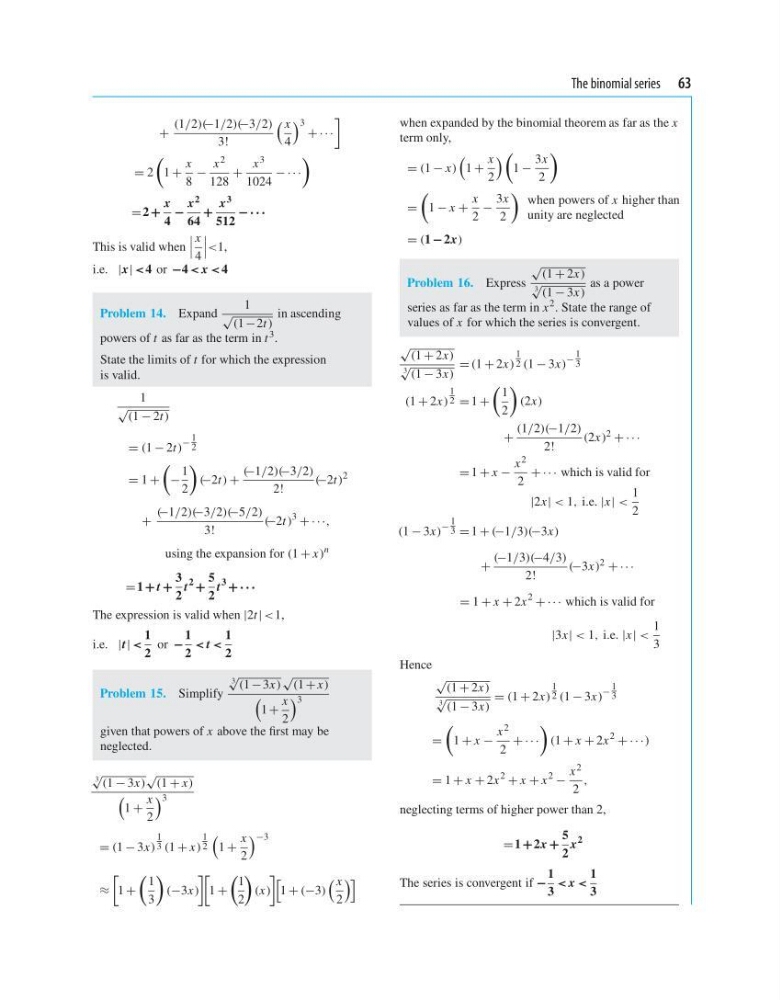
The binomial series 63
+
(1/2)(−1/2)(−3/2)
3!
x
4
3 + · · ·
= 2
1 +
x
8
−
x 2
128
+
x 3
1024
− · · ·
= 2 +
x
4
−
x 2
64
+
x 3
512
−· · ·
This is valid when
x
4
<1,
i.e. |x| <4 or −4
1
√ (1 −2t )
in ascending
powers of t as far as the term in t 3 .
State the limits of t for which the expression
is valid.
1
√
(1 − 2t )
= (1 − 2t )
−
1
2
= 1 +
−
1
2
(−2t ) +
(−1/2)(−3/2)
2!
(−2t )
2
+
(−1/2)(−3/2)(−5/2)
3!
(−2t )
3
+ · · ·,
using the expansion for (1 + x)
n
= 1 + t +
3
2
t
2
+
5
2
t
3
+· · ·
The expression is valid when |2t | <1,
i.e. |t| <
1
2
or −
1
2
2
Problem 15. Simplify
3
√
(1 − 3x)
√
(1 + x)
1 +
x
2
3
given that powers of x above the first may be
neglected.
3
√
(1 − 3x)
√
(1 + x)
1 +
x
2
3
= (1 − 3x)
1
3 (1 + x)
1
2
1 +
x
2
−3
≈
1 +
1
3
(−3x)
1 +
1
2
(x)
1 + (−3)
x
2
when expanded by the binomial theorem as far as the x
term only,
= (1 − x)
1 +
x
2
1 −
3x
2
=
1 − x +
x
2
−
3x
2
when powers of x higher than
unity are neglected
= (1 − 2x)
Problem 16. Express
√ (1 + 2x)
3
√
(1 − 3x)
as a power
series as far as the term in x
2 . State the range of
values of x for which the series is convergent.
√ (1 + 2x)
3
√
(1 − 3x)
= (1 + 2x)
1
2 (1 − 3x)
−
1
3
(1 + 2x)
1
2 = 1 +
1
2
(2x)
+
(1/2)(−1/2)
2!
(2x) 2 + · · ·
= 1 + x −
x 2
2
+ · · · which is valid for
|2x| < 1, i.e. |x| <
1
2
(1 − 3x)
−
1
3 = 1 + (−1/3)(−3x)
+
(−1/3)(−4/3)
2!
(−3x) 2 + · · ·
= 1 + x + 2x
2
+ · · · which is valid for
|3x| < 1, i.e. |x| <
1
3
Hence
√
(1 + 2x)
3
√
(1 − 3x)
= (1 + 2x)
1
2 (1 − 3x)
−
1
3
=
1 + x −
x 2
2
+ · · ·
(1 + x + 2x
2
+ · · ·)
= 1 + x + 2x
2
+ x + x
2
−
x 2
2
,
neglecting terms of higher power than 2,
= 1 +2x +
5
2
x
2
The series is convergent if −
1
3
3
+
(1/2)(−1/2)(−3/2)
3!
x
4
3 + · · ·
= 2
1 +
x
8
−
x 2
128
+
x 3
1024
− · · ·
= 2 +
x
4
−
x 2
64
+
x 3
512
−· · ·
This is valid when
x
4
<1,
i.e. |x| <4 or −4
1
√ (1 −2t )
in ascending
powers of t as far as the term in t 3 .
State the limits of t for which the expression
is valid.
1
√
(1 − 2t )
= (1 − 2t )
−
1
2
= 1 +
−
1
2
(−2t ) +
(−1/2)(−3/2)
2!
(−2t )
2
+
(−1/2)(−3/2)(−5/2)
3!
(−2t )
3
+ · · ·,
using the expansion for (1 + x)
n
= 1 + t +
3
2
t
2
+
5
2
t
3
+· · ·
The expression is valid when |2t | <1,
i.e. |t| <
1
2
or −
1
2
2
Problem 15. Simplify
3
√
(1 − 3x)
√
(1 + x)
1 +
x
2
3
given that powers of x above the first may be
neglected.
3
√
(1 − 3x)
√
(1 + x)
1 +
x
2
3
= (1 − 3x)
1
3 (1 + x)
1
2
1 +
x
2
−3
≈
1 +
1
3
(−3x)
1 +
1
2
(x)
1 + (−3)
x
2
when expanded by the binomial theorem as far as the x
term only,
= (1 − x)
1 +
x
2
1 −
3x
2
=
1 − x +
x
2
−
3x
2
when powers of x higher than
unity are neglected
= (1 − 2x)
Problem 16. Express
√ (1 + 2x)
3
√
(1 − 3x)
as a power
series as far as the term in x
2 . State the range of
values of x for which the series is convergent.
√ (1 + 2x)
3
√
(1 − 3x)
= (1 + 2x)
1
2 (1 − 3x)
−
1
3
(1 + 2x)
1
2 = 1 +
1
2
(2x)
+
(1/2)(−1/2)
2!
(2x) 2 + · · ·
= 1 + x −
x 2
2
+ · · · which is valid for
|2x| < 1, i.e. |x| <
1
2
(1 − 3x)
−
1
3 = 1 + (−1/3)(−3x)
+
(−1/3)(−4/3)
2!
(−3x) 2 + · · ·
= 1 + x + 2x
2
+ · · · which is valid for
|3x| < 1, i.e. |x| <
1
3
Hence
√
(1 + 2x)
3
√
(1 − 3x)
= (1 + 2x)
1
2 (1 − 3x)
−
1
3
=
1 + x −
x 2
2
+ · · ·
(1 + x + 2x
2
+ · · ·)
= 1 + x + 2x
2
+ x + x
2
−
x 2
2
,
neglecting terms of higher power than 2,
= 1 +2x +
5
2
x
2
The series is convergent if −
1
3
3