

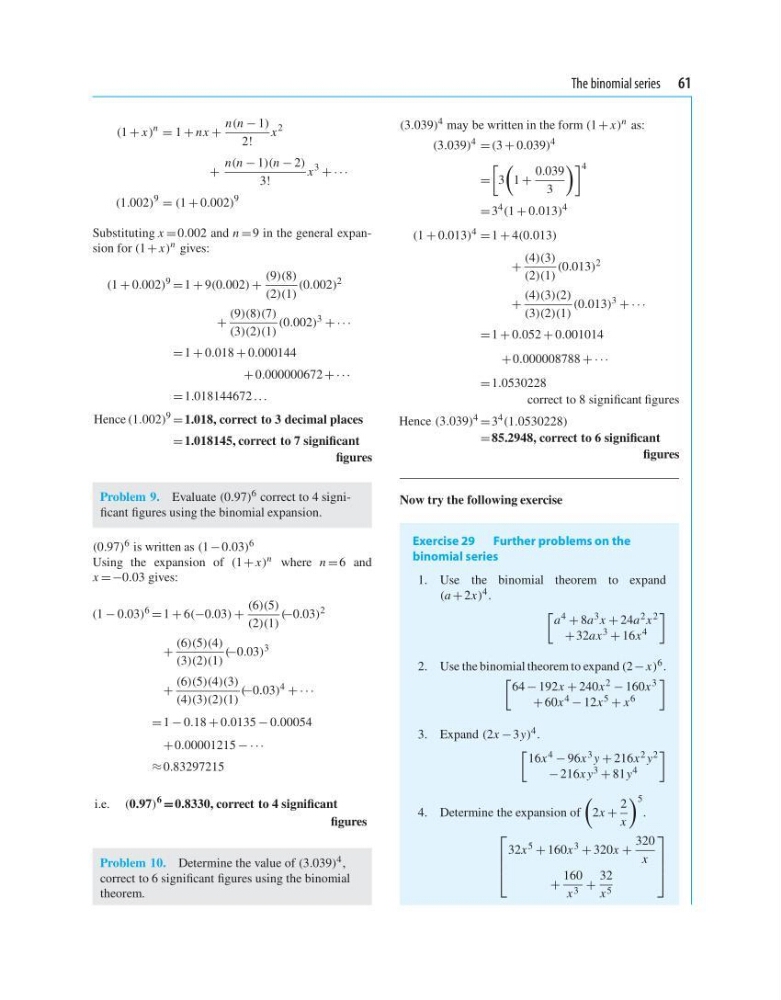
The binomial series 61
(1 + x)
n
= 1 + nx +
n(n − 1)
2!
x
2
+
n(n − 1)(n − 2)
3!
x
3
+ · · ·
(1.002)
9
= (1 + 0.002)
9
Substituting x = 0.002 and n = 9 in the general expansion for (1 + x)
n gives:
(1 + 0.002) 9 = 1 + 9(0.002) +
(9)(8)
(2)(1)
(0.002) 2
+
(9)(8)(7)
(3)(2)(1)
(0.002) 3 + · · ·
= 1 + 0.018 + 0.000144
+ 0.000000672 + · · ·
= 1.018144672 ...
Hence (1.002)
9
= 1.018, correct to 3 decimal places
= 1.018145, correct to 7 significant
figures
Problem 9. Evaluate (0.97) 6 correct to 4 significant figures using the binomial expansion.
(0.97) 6 is written as (1 − 0.03) 6
Using the expansion of (1 + x) n where n = 6 and
x =−0.03 gives:
(1 − 0.03) 6 = 1 + 6(−0.03) +
(6)(5)
(2)(1)
(−0.03) 2
+
(6)(5)(4)
(3)(2)(1)
(−0.03) 3
+
(6)(5)(4)(3)
(4)(3)(2)(1)
(−0.03) 4 + · · ·
= 1 − 0.18 + 0.0135 − 0.00054
+ 0.00001215 − · · ·
≈ 0.83297215
i.e. (0.97)
6
= 0.8330, correct to 4 significant
figures
Problem 10. Determine the value of (3.039) 4 ,
correct to 6 significant figures using the binomial
theorem.
(3.039) 4 may be written in the form (1 + x) n as:
(3.039) 4 = (3 + 0.039) 4
=
3
1 +
0.039
3
4
= 3 4 (1 + 0.013) 4
(1 + 0.013) 4 = 1 + 4(0.013)
+
(4)(3)
(2)(1)
(0.013) 2
+
(4)(3)(2)
(3)(2)(1)
(0.013) 3 + · · ·
= 1 + 0.052 + 0.001014
+ 0.000008788 + · · ·
= 1.0530228
correct to 8 significant figures
Hence (3.039) 4 = 3 4 (1.0530228)
= 85.2948, correct to 6 significant
figures
Now try the following exercise
Exercise 29 Further problems on the
binomial series
1. Use the binomial theorem to expand
(a + 2x) 4 .
a 4 + 8a 3 x + 24a 2 x 2
+ 32ax 3 + 16x 4
2. Use the binomial theorem to expand (2 − x) 6 .
64 − 192x + 240x 2 − 160x 3
+ 60x 4 − 12x 5 + x 6
3. Expand (2x − 3y) 4 .
16x 4 − 96x 3 y + 216x 2 y 2
− 216x y 3 + 81y 4
4. Determine the expansion of
2x +
2
x
5
.
⎡
⎢
⎢
⎣
32x 5 + 160x 3 + 320x +
320
x
+
160
x 3 +
32
x 5
⎤
⎥
⎥
⎦
(1 + x)
n
= 1 + nx +
n(n − 1)
2!
x
2
+
n(n − 1)(n − 2)
3!
x
3
+ · · ·
(1.002)
9
= (1 + 0.002)
9
Substituting x = 0.002 and n = 9 in the general expansion for (1 + x)
n gives:
(1 + 0.002) 9 = 1 + 9(0.002) +
(9)(8)
(2)(1)
(0.002) 2
+
(9)(8)(7)
(3)(2)(1)
(0.002) 3 + · · ·
= 1 + 0.018 + 0.000144
+ 0.000000672 + · · ·
= 1.018144672 ...
Hence (1.002)
9
= 1.018, correct to 3 decimal places
= 1.018145, correct to 7 significant
figures
Problem 9. Evaluate (0.97) 6 correct to 4 significant figures using the binomial expansion.
(0.97) 6 is written as (1 − 0.03) 6
Using the expansion of (1 + x) n where n = 6 and
x =−0.03 gives:
(1 − 0.03) 6 = 1 + 6(−0.03) +
(6)(5)
(2)(1)
(−0.03) 2
+
(6)(5)(4)
(3)(2)(1)
(−0.03) 3
+
(6)(5)(4)(3)
(4)(3)(2)(1)
(−0.03) 4 + · · ·
= 1 − 0.18 + 0.0135 − 0.00054
+ 0.00001215 − · · ·
≈ 0.83297215
i.e. (0.97)
6
= 0.8330, correct to 4 significant
figures
Problem 10. Determine the value of (3.039) 4 ,
correct to 6 significant figures using the binomial
theorem.
(3.039) 4 may be written in the form (1 + x) n as:
(3.039) 4 = (3 + 0.039) 4
=
3
1 +
0.039
3
4
= 3 4 (1 + 0.013) 4
(1 + 0.013) 4 = 1 + 4(0.013)
+
(4)(3)
(2)(1)
(0.013) 2
+
(4)(3)(2)
(3)(2)(1)
(0.013) 3 + · · ·
= 1 + 0.052 + 0.001014
+ 0.000008788 + · · ·
= 1.0530228
correct to 8 significant figures
Hence (3.039) 4 = 3 4 (1.0530228)
= 85.2948, correct to 6 significant
figures
Now try the following exercise
Exercise 29 Further problems on the
binomial series
1. Use the binomial theorem to expand
(a + 2x) 4 .
a 4 + 8a 3 x + 24a 2 x 2
+ 32ax 3 + 16x 4
2. Use the binomial theorem to expand (2 − x) 6 .
64 − 192x + 240x 2 − 160x 3
+ 60x 4 − 12x 5 + x 6
3. Expand (2x − 3y) 4 .
16x 4 − 96x 3 y + 216x 2 y 2
− 216x y 3 + 81y 4
4. Determine the expansion of
2x +
2
x
5
.
⎡
⎢
⎢
⎣
32x 5 + 160x 3 + 320x +
320
x
+
160
x 3 +
32
x 5
⎤
⎥
⎥
⎦