

670 Higher Engineering Mathematics
(iii) if the roots of the auxiliary equation are:
(a) real and different, say m = α and m = β
then the general solution is
y = Ae
αx
+ Be
βx
(b) real and equal, say m = α twice, then the
general solution is
y = (Ax + B)e
αx
(c) complex, say m = α ± jβ, then the general
solution is
y = e
αx (A cosβx + B sin βx)
(iv) given boundary conditions, constants A and B
can be determined and the particular solution
obtained.
If a
d 2 y
dx 2 + b
dy
dx
+ cy = f (x) then:
(i) rewrite the differential equation as
(aD 2 + bD +c)y = 0.
(ii) substitute m for D and solve the auxiliary equation
am 2 + bm + c = 0.
(iii) obtain the complimentary function (C.F.), u, as
per (iii) above.
(iv) to find the particular integral, v, first assume a particular integral which is suggested by f (x), but
which contains undetermined coefficients (See
Table 51.1, page 484 for guidance).
(v) substitute the suggested particular integral into
the original differential equation and equate
relevant coefficients to find the constants
introduced.
(vi) the general solution is given by y = u +v.
(vii) given boundary conditions, arbitrary constants in
the C.F. can be determined and the particular
solution obtained.
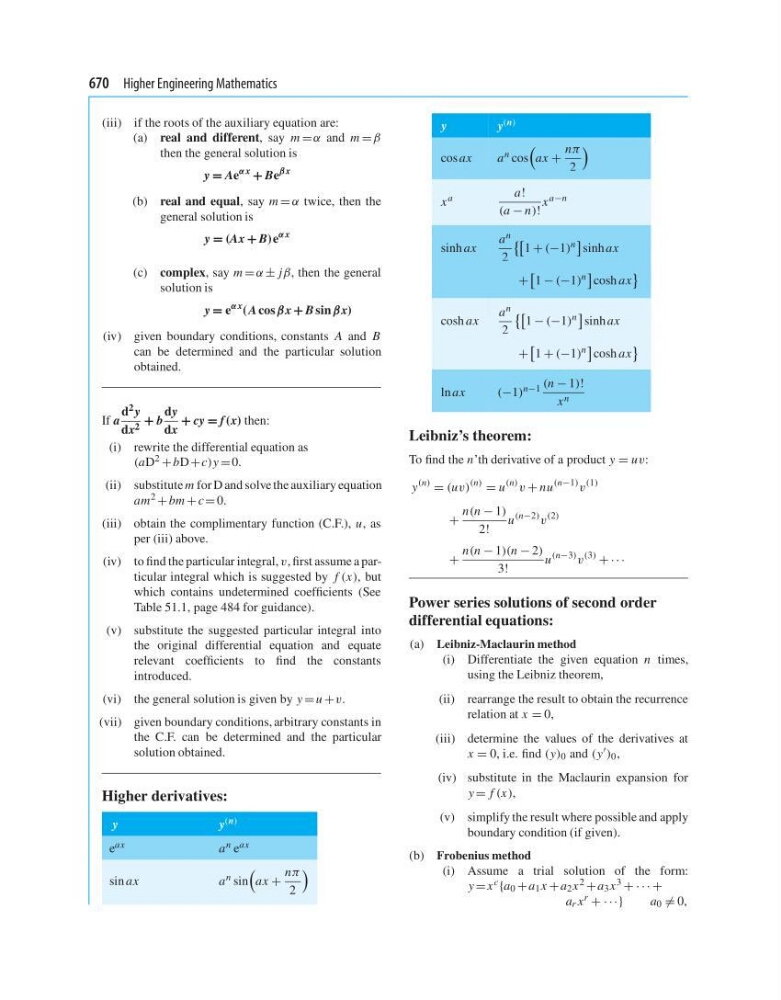
Higher derivatives:
y
y (n)
e ax
a n e ax
sin ax
a n sin
ax +
nπ
2
y
y (n)
cos ax
a n cos
ax +
nπ
2
x a
a!
(a − n)!
x a−n
sinh ax
a n
2
1 + (−1) n
sinh ax
+
1 − (−1) n
cosh ax
cosh ax
a n
2
1 − (−1) n
sinh ax
+
1 + (−1) n
cosh ax
ln ax
(−1) n−1 (n − 1)!
x n
Leibniz’s theorem:
To find the n’th derivative of a product y = uv:
y
(n)
= (uv)
(n)
= u
(n)
v + nu
(n−1)
v
(1)
+
n(n − 1)
2!
u
(n−2)
v
(2)
+
n(n − 1)(n − 2)
3!
u
(n−3)
v
(3)
+ · · ·
Power series solutions of second order
differential equations:
(a) Leibniz-Maclaurin method
(i) Differentiate the given equation n times,
using the Leibniz theorem,
(ii) rearrange the result to obtain the recurrence
relation at x = 0,
(iii) determine the values of the derivatives at
x = 0, i.e. find (y) 0 and (y
) 0 ,
(iv) substitute in the Maclaurin expansion for
y = f (x),
(v) simplify the result where possible and apply
boundary condition (if given).
(b) Frobenius method
(i) Assume a trial solution of the form:
y = x c {a 0 + a 1 x + a 2 x 2 + a 3 x 3 + · · · +
a r x r + · · ·}
a 0 = 0,