

Essential formulae 667
π
0
x
n cos x dx = I n = −nπ
n−1
− n(n − 1)I n−2
x
n sin x dx = I n = −x
n cos x + nx
n−1 sin x
−n(n − 1)I n−2
sin
n x dx = I n = −
1
n
sin
n−1 x cos x +
n − 1
n
I n−2
cos
n x dx = I n =
1
n
cos
n−1 sin x +
n − 1
n
I n−2
π/2
0
sin
n x dx =
π/2
0
cos
n x dx = I n =
n − 1
n
I n−2
tan
n x dx = I n =
tan n−1 x
n − 1
− I n−2
(ln x)
n dx = I n = x(ln x)
n
− n I n−1
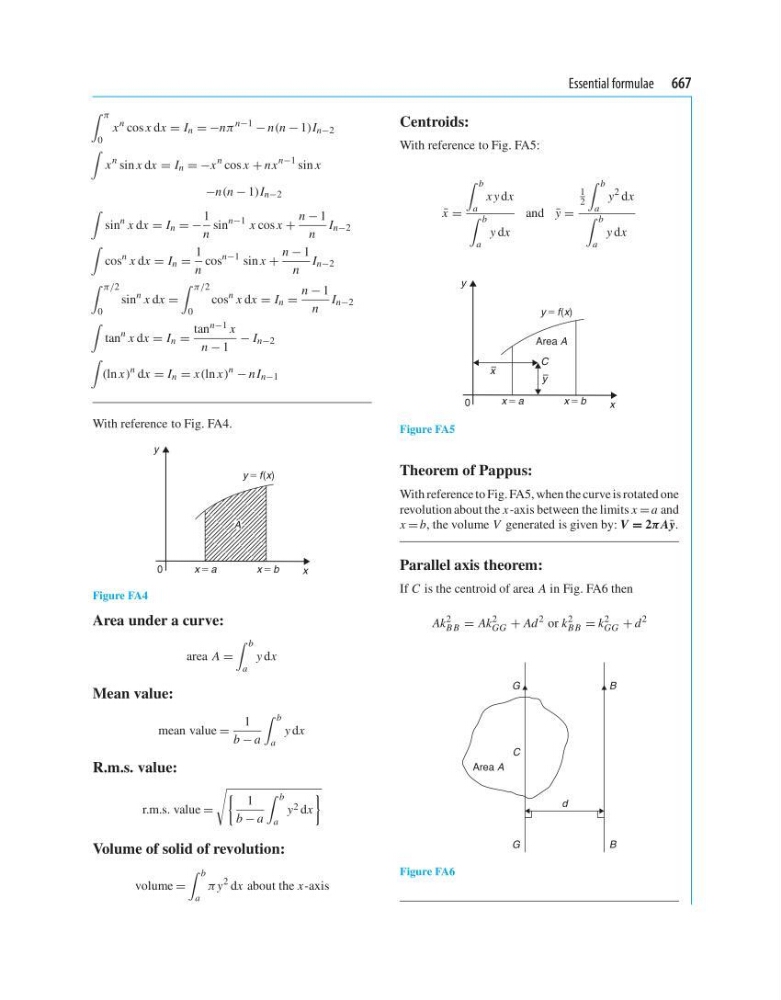
With reference to Fig. FA4.
y
y 5 f(x)
x 5 a
x 5 b
x
0
A
Figure FA4
Area under a curve:
area A =
b
a
y dx
Mean value:
mean value =
1
b − a
b
a
y dx
R.m.s. value:
r.m.s. value =
1
b − a
b
a
y 2 dx
Volume of solid of revolution:
volume =
b
a
π y
2 dx about the x-axis
Centroids:
With reference to Fig. FA5:
¯
x =
b
a
x y dx
b
a
y dx
and ¯
y =
1
2
b
a
y
2 dx
b
a
y dx
y
C
Area A
x
y
y 5 f(x)
x 5 a
x 5 b
x
0
Figure FA5
Theorem of Pappus:
With reference to Fig. FA5, when the curve is rotated one
revolution about the x-axis between the limits x = a and
x = b, the volume V generated is given by: V = 2πA¯ y.
Parallel axis theorem:
If C is the centroid of area A in Fig. FA6 then
Ak
2
B B = Ak
2
GG + Ad
2 or k
2
B B = k
2
GG + d
2
G
B
G
B
d
C
Area A
Figure FA6