

Revision Test 19
This Revision Test covers the material contained in Chapters 66 to 71. The marks for each question are shown in
brackets at the end of each question.
1. Obtain a Fourier series for the periodic function
f (x) defined as follows:
f (x) =
−1, when − π ≤ x ≤ 0
1, when
0 ≤ x ≤ π
The function is periodic outside of this range with
period 2π.
(13)
2. Obtain a Fourier series to represent f (t ) = t in the
range −π to +π.
(13)
3. Expand the function f (θ) = θ in the range
0 ≤θ ≤ π into (a) a half range cosine series, and
(b) a half range sine series.
(18)
4. (a) Sketch the waveform defined by:
f (x) =
⎧
⎨
⎩
0, when −4 ≤ x ≤ −2
3, when −2 ≤ x ≤ 2
0, when 2 ≤ x ≤ 4
and is periodic outside of this range of period 8.
(b) State whether the waveform in (a) is odd, even
or neither odd nor even.
(c) Deduce the Fourier series for the function
defined in (a).
(15)
5. Displacement y on a point on a pulley when
turned through an angle of θ degrees is given by:
θ
y
30
3.99
60
4.01
90
3.60
120
2.84
150
1.84
180
0.88
210
0.27
240
0.13
270
0.45
300
1.25
330
2.37
360
3.41
Sketch the waveform and construct a Fourier series
for the first three harmonics
(23)
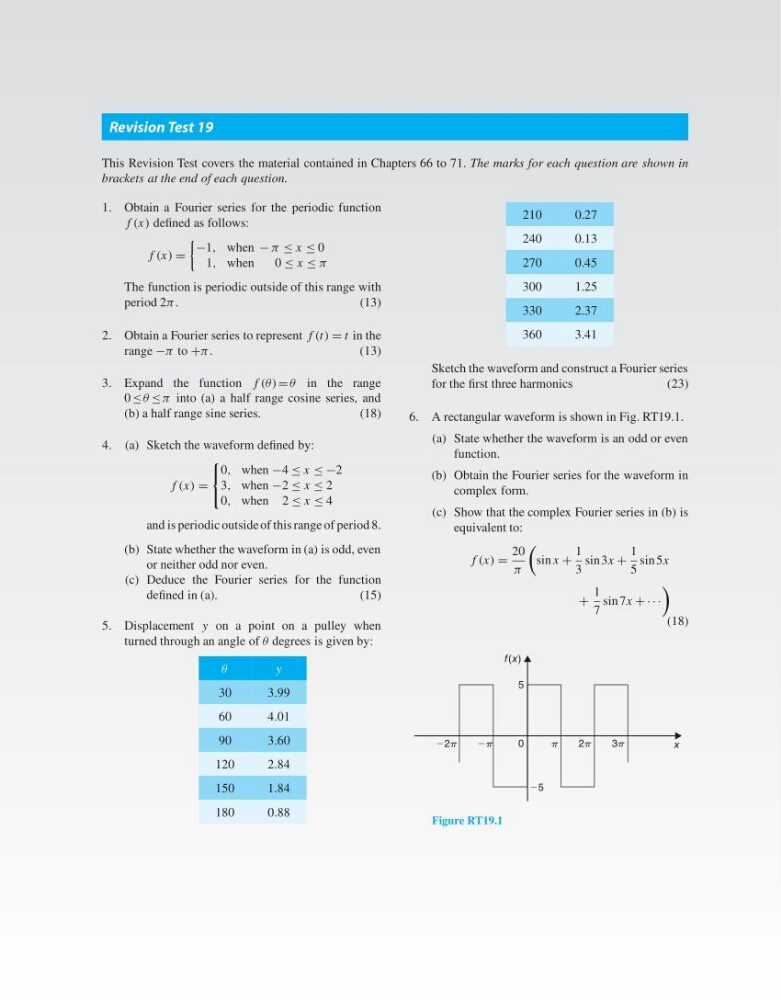
6. A rectangular waveform is shown in Fig. RT19.1.
(a) State whether the waveform is an odd or even
function.
(b) Obtain the Fourier series for the waveform in
complex form.
(c) Show that the complex Fourier series in (b) is
equivalent to:
f (x) =
20
π
sin x +
1
3
sin 3x +
1
5
sin 5x
+
1
7
sin 7x + · · ·
(18)
5
f (x )
x
0
25
2
22
2
3
Figure RT19.1