

48 Higher Engineering Mathematics
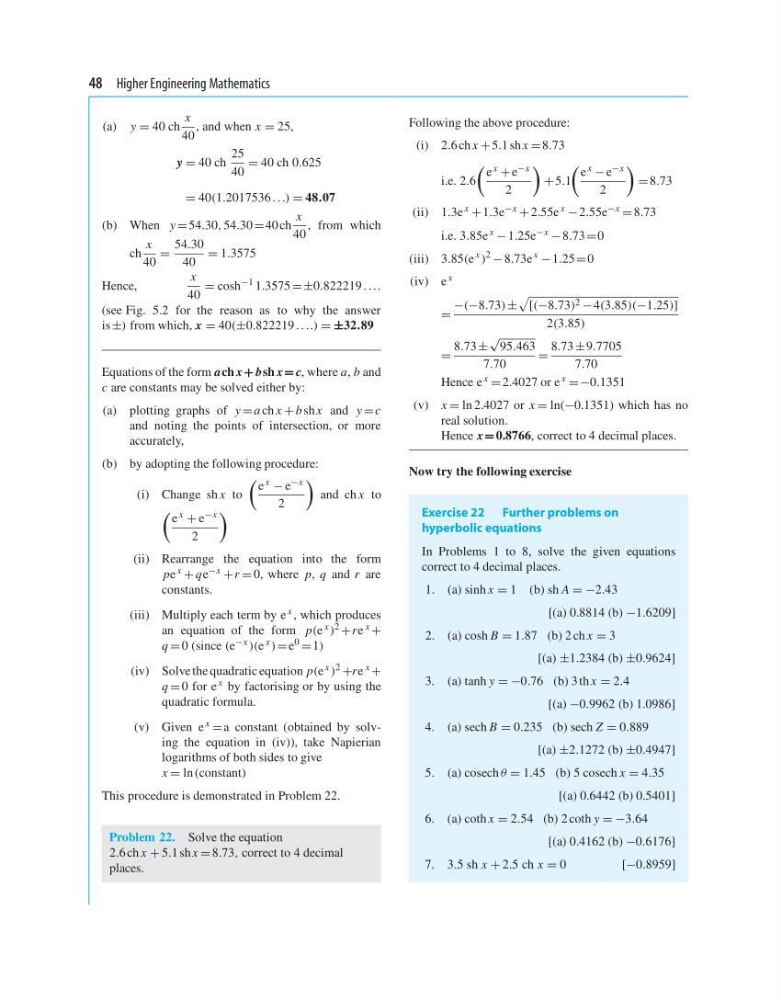
(a) y = 40 ch
x
40
, and when x = 25,
y = 40 ch
25
40
= 40 ch 0.625
= 40(1.2017536 ...) = 48.07
(b) When y = 54.30, 54.30 =40 ch
x
40
, from which
ch
x
40
=
54.30
40
= 1.3575
Hence,
x
40
= cosh
−1 1.3575 =±0.822219 ....
(see Fig. 5.2 for the reason as to why the answer
is ±) from which, x = 40(±0.822219 ....) = ±32.89
Equations of the form a ch x + b sh x = c, where a, b and
c are constants may be solved either by:
(a) plotting graphs of y = a ch x + b sh x and y = c
and noting the points of intersection, or more
accurately,
(b) by adopting the following procedure:
(i) Change sh x to
e x − e −x
2
and ch x to
e x + e −x
2
(ii) Rearrange the equation into the form
pe x + qe −x +r = 0, where p, q and r are
constants.
(iii) Multiply each term by e x , which produces
an equation of the form p(e x ) 2 +re x +
q = 0 (since (e −x )(e x ) = e 0 = 1)
(iv) Solve the quadratic equation p(e x ) 2 +re x +
q = 0 for e x by factorising or by using the
quadratic formula.
(v) Given e x = a constant (obtained by solving the equation in (iv)), take Napierian
logarithms of both sides to give
x = ln (constant)
This procedure is demonstrated in Problem 22.
Problem 22. Solve the equation
2.6 ch x + 5.1 sh x = 8.73, correct to 4 decimal
places.
Following the above procedure:
(i) 2.6 ch x + 5.1 sh x = 8.73
i.e. 2.6
e x + e −x
2
+ 5.1
e x − e −x
2
= 8.73
(ii) 1.3e x + 1.3e −x + 2.55e x − 2.55e −x = 8.73
i.e. 3.85e x − 1.25e −x − 8.73 =0
(iii) 3.85(e
x
)
2
− 8.73e
x
− 1.25 =0
(iv) e x
=
−(−8.73) ±
[(−8.73) 2 − 4(3.85)(−1.25)]
2(3.85)
=
8.73 ±
√
95.463
7.70
=
8.73 ±9.7705
7.70
Hence e x = 2.4027 or e x =−0.1351
(v) x = ln 2.4027 or x = ln(−0.1351) which has no
real solution.
Hence x = 0.8766, correct to 4 decimal places.
Now try the following exercise
Exercise 22 Further problems on
hyperbolic equations
In Problems 1 to 8, solve the given equations
correct to 4 decimal places.
1. (a) sinh x = 1 (b) sh A = −2.43
[(a) 0.8814 (b) −1.6209]
2. (a) cosh B = 1.87 (b) 2 ch x = 3
[(a) ±1.2384 (b) ±0.9624]
3. (a) tanh y = −0.76 (b) 3 th x = 2.4
[(a) −0.9962 (b) 1.0986]
4. (a) sech B = 0.235 (b) sech Z = 0.889
[(a) ±2.1272 (b) ±0.4947]
5. (a) cosech θ = 1.45 (b) 5 cosech x = 4.35
[(a) 0.6442 (b) 0.5401]
6. (a) coth x = 2.54 (b) 2 coth y = −3.64
[(a) 0.4162 (b) −0.6176]
7. 3.5 sh x + 2.5 ch x = 0
[ −0.8959]
(a) y = 40 ch
x
40
, and when x = 25,
y = 40 ch
25
40
= 40 ch 0.625
= 40(1.2017536 ...) = 48.07
(b) When y = 54.30, 54.30 =40 ch
x
40
, from which
ch
x
40
=
54.30
40
= 1.3575
Hence,
x
40
= cosh
−1 1.3575 =±0.822219 ....
(see Fig. 5.2 for the reason as to why the answer
is ±) from which, x = 40(±0.822219 ....) = ±32.89
Equations of the form a ch x + b sh x = c, where a, b and
c are constants may be solved either by:
(a) plotting graphs of y = a ch x + b sh x and y = c
and noting the points of intersection, or more
accurately,
(b) by adopting the following procedure:
(i) Change sh x to
e x − e −x
2
and ch x to
e x + e −x
2
(ii) Rearrange the equation into the form
pe x + qe −x +r = 0, where p, q and r are
constants.
(iii) Multiply each term by e x , which produces
an equation of the form p(e x ) 2 +re x +
q = 0 (since (e −x )(e x ) = e 0 = 1)
(iv) Solve the quadratic equation p(e x ) 2 +re x +
q = 0 for e x by factorising or by using the
quadratic formula.
(v) Given e x = a constant (obtained by solving the equation in (iv)), take Napierian
logarithms of both sides to give
x = ln (constant)
This procedure is demonstrated in Problem 22.
Problem 22. Solve the equation
2.6 ch x + 5.1 sh x = 8.73, correct to 4 decimal
places.
Following the above procedure:
(i) 2.6 ch x + 5.1 sh x = 8.73
i.e. 2.6
e x + e −x
2
+ 5.1
e x − e −x
2
= 8.73
(ii) 1.3e x + 1.3e −x + 2.55e x − 2.55e −x = 8.73
i.e. 3.85e x − 1.25e −x − 8.73 =0
(iii) 3.85(e
x
)
2
− 8.73e
x
− 1.25 =0
(iv) e x
=
−(−8.73) ±
[(−8.73) 2 − 4(3.85)(−1.25)]
2(3.85)
=
8.73 ±
√
95.463
7.70
=
8.73 ±9.7705
7.70
Hence e x = 2.4027 or e x =−0.1351
(v) x = ln 2.4027 or x = ln(−0.1351) which has no
real solution.
Hence x = 0.8766, correct to 4 decimal places.
Now try the following exercise
Exercise 22 Further problems on
hyperbolic equations
In Problems 1 to 8, solve the given equations
correct to 4 decimal places.
1. (a) sinh x = 1 (b) sh A = −2.43
[(a) 0.8814 (b) −1.6209]
2. (a) cosh B = 1.87 (b) 2 ch x = 3
[(a) ±1.2384 (b) ±0.9624]
3. (a) tanh y = −0.76 (b) 3 th x = 2.4
[(a) −0.9962 (b) 1.0986]
4. (a) sech B = 0.235 (b) sech Z = 0.889
[(a) ±2.1272 (b) ±0.4947]
5. (a) cosech θ = 1.45 (b) 5 cosech x = 4.35
[(a) 0.6442 (b) 0.5401]
6. (a) coth x = 2.54 (b) 2 coth y = −3.64
[(a) 0.4162 (b) −0.6176]
7. 3.5 sh x + 2.5 ch x = 0
[ −0.8959]