

The complex or exponential form of a Fourier series 649
Now try the following exercise
Exercise 236 Further problems on the
complex form of a Fourier series
1. Determine the complex Fourier series for the
function defined by:
f (t ) =
0, when −π ≤ t ≤ 0
2, when 0 ≤ t ≤ π
The function is periodic outside of this range
of period 2π.
f (t ) =
∞
n=−∞
j
nπ
(cos nπ − 1) e
jnt
= 1 − j
2
π
e
jt
+
1
3
e
j 3t
+
1
5
e
j 5t
+ · · ·
+ j
2
π
e
− jt
+
1
3
e
− j 3t
+
1
5
e
− j 5t
+ · · ·
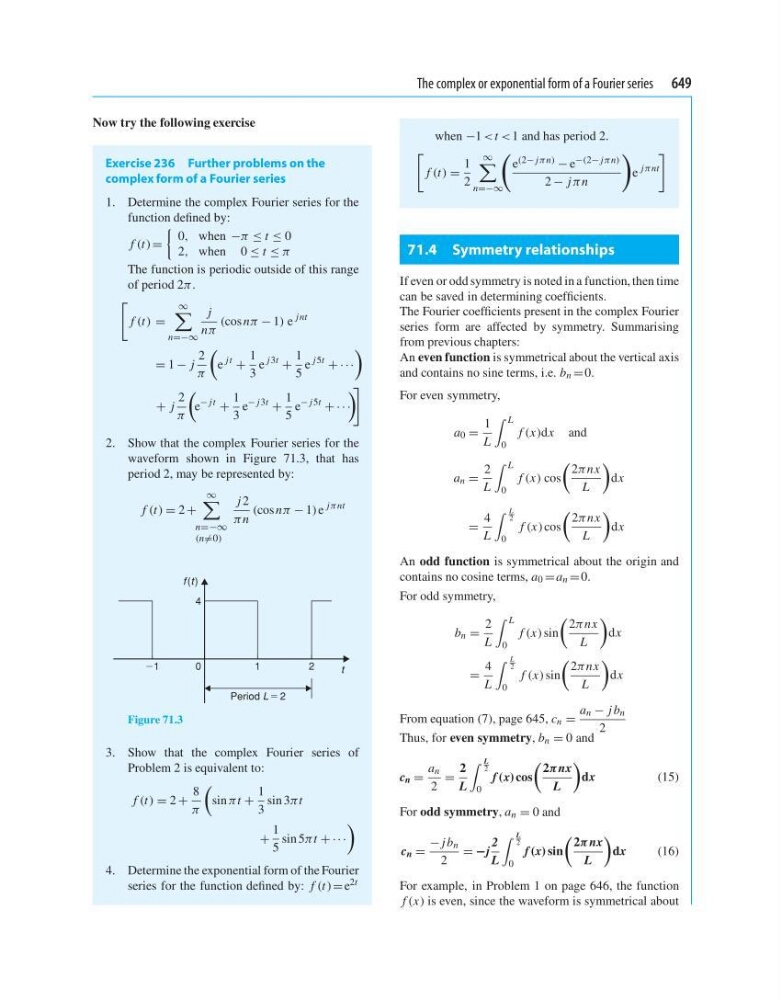
2. Show that the complex Fourier series for the
waveform shown in Figure 71.3, that has
period 2, may be represented by:
f (t ) = 2 +
∞
n=−∞
(n =0)
j 2
πn
(cos nπ − 1) e
j πnt
21
0
4
1
2
t
Period L 5 2
f (t)
Figure 71.3
3. Show that the complex Fourier series of
Problem 2 is equivalent to:
f (t ) = 2 +
8
π
sin πt +
1
3
sin 3πt
+
1
5
sin 5πt + · · ·
4. Determine the exponential form of the Fourier
series for the function defined by: f (t ) = e 2t
when −1 < t < 1 and has period 2.
f (t ) =
1
2
∞
n=−∞
e (2− j πn) − e −(2− j πn)
2 − j πn
e
j πnt
71.4 Symmetry relationships
If even or odd symmetry is noted in a function, then time
can be saved in determining coefficients.
The Fourier coefficients present in the complex Fourier
series form are affected by symmetry. Summarising
from previous chapters:
An even function is symmetrical about the vertical axis
and contains no sine terms, i.e. b n = 0.
For even symmetry,
a 0 =
1
L
L
0
f (x)dx and
a n =
2
L
L
0
f (x) cos
2πnx
L
dx
=
4
L
L
2
0
f (x) cos
2πnx
L
dx
An odd function is symmetrical about the origin and
contains no cosine terms, a 0 = a n = 0.
For odd symmetry,
b n =
2
L
L
0
f (x) sin
2πnx
L
dx
=
4
L
L
2
0
f (x) sin
2πnx
L
dx
From equation (7), page 645, c n =
a n − j b n
2
Thus, for even symmetry, b n = 0 and
c n =
a n
2
=
2
L
L
2
0
f (x) cos
2πnx
L
dx
(15)
For odd symmetry, a n = 0 and
c n =
− j b n
2
= −j
2
L
L
2
0
f (x) sin
2πnx
L
dx
(16)
For example, in Problem 1 on page 646, the function
f (x) is even, since the waveform is symmetrical about