

646 Higher Engineering Mathematics
Problem 1. Determine the complex Fourier series
for the function defined by:
f (x) =
⎧
⎨
⎩
0, when −2 ≤ x ≤ −1
5, when −1 ≤ x ≤1
0, when 1 ≤ x ≤ 2
The function is periodic outside this range of
period 4.
This is the same Problem as Problem 2 on page 631 and
we can use this to demonstrate that the two forms of
Fourier series are equivalent.
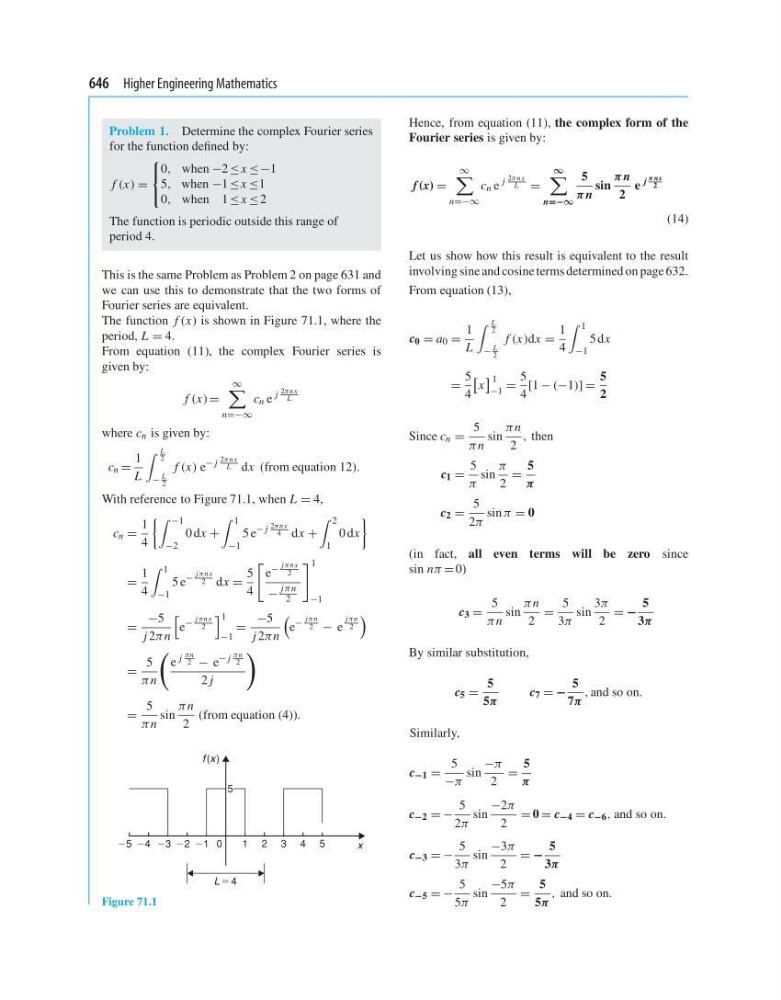
The function f (x) is shown in Figure 71.1, where the
period, L = 4.
From equation (11), the complex Fourier series is
given by:
f (x) =
∞
n=−∞
c n e
j
2πnx
L
where c n is given by:
c n =
1
L
L
2
−
L
2
f (x) e
− j
2πnx
L dx (from equation 12).
With reference to Figure 71.1, when L = 4,
c n =
1
4
−1
−2
0 dx +
1
−1
5 e
− j 2πnx
4 dx +
2
1
0 dx
=
1
4
1
−1
5 e
−
j πnx
2 dx =
5
4
e
−
j πnx
2
−
j πn
2
1
−1
=
−5
j 2πn
e
−
j πnx
2
1
−1
=
−5
j 2πn
e
−
j πn
2 − e
j πn
2
=
5
πn
e
j
πn
2 − e
− j
πn
2
2 j
=
5
πn
sin
πn
2
(from equation (4)).
1
21 0
5
2
22
3
23
4
24
5
x
L 5 4
f (x)
25
Figure 71.1
Hence, from equation (11), the complex form of the
Fourier series is given by:
f (x) =
∞
n=−∞
c n e
j 2πnx
L
=
∞
n=−∞
5
πn
sin
πn
2
e
j π nx
2
(14)
Let us show how this result is equivalent to the result
involving sine and cosine terms determined on page 632.
From equation (13),
c 0 = a 0 =
1
L
L
2
− L
2
f (x)dx =
1
4
1
−1
5 dx
=
5
4
x
1
−1
=
5
4
[1 − (−1)] =
5
2
Since c n =
5
πn
sin
πn
2
, then
c 1 =
5
π
sin
π
2
=
5
π
c 2 =
5
2π
sin π = 0
(in fact, all even terms will be zero since
sin nπ = 0)
c 3 =
5
πn
sin
πn
2
=
5
3π
sin
3π
2
= −
5
3π
By similar substitution,
c 5 =
5
5π
c 7 = −
5
7π
, and so on.
Similarly,
c −1 =
5
−π
sin
−π
2
=
5
π
c −2 = −
5
2π
sin
−2π
2
= 0 = c −4 = c −6 , and so on.
c −3 = −
5
3π
sin
−3π
2
= −
5
3π
c −5 = −
5
5π
sin
−5π
2
=
5
5π
, and so on.