

A numerical method of harmonic analysis 643
Thus the Fourier series for current i is given by:
i = 8.04 sin θ − 2.00 sin 3 θ − 0.04 sin 5 θ
Now try the following exercise
Exercise 235 Further problems on a
numerical method of harmonic analysis
1. Without performing calculations, state which
harmonics will be present in the waveforms
shown in Fig. 70.6
(a) only odd cosine terms present
(b) only even sine terms present
(a)
(b)
f(t)
t
22
2
4
0
24
4
2
x
y
2
210
0
10
2
Figure 70.6
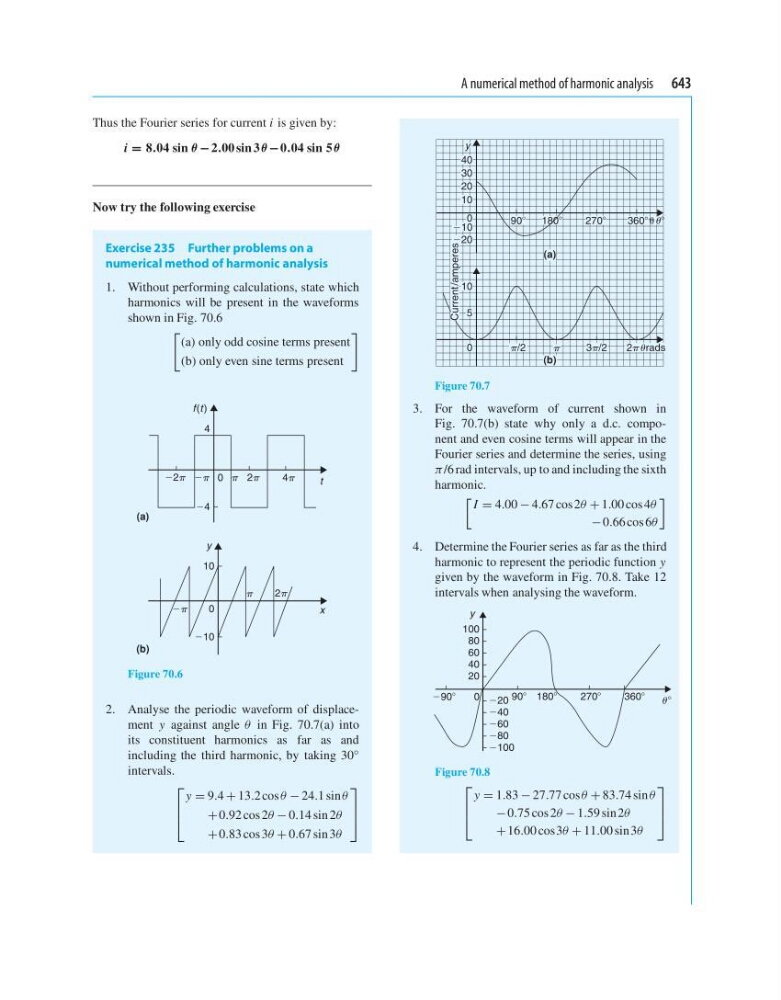
2. Analyse the periodic waveform of displacement y against angle θ in Fig. 70.7(a) into
its constituent harmonics as far as and
including the third harmonic, by taking 30 ◦
intervals.
⎡
⎢
⎣
y = 9.4 + 13.2 cos θ − 24.1 sinθ
+ 0.92 cos 2θ − 0.14 sin 2θ
+ 0.83 cos 3θ + 0.67 sin 3θ
⎤
⎥
⎦
2 rads
40
y
30
20
10
10
5
0
Ϫ10
/2
3/2
270Њ
360Њ Њ
Ϫ20
(a)
(b)
0
180Њ
90Њ
Current /amperes
Figure 70.7
3. For the waveform of current shown in
Fig. 70.7(b) state why only a d.c. component and even cosine terms will appear in the
Fourier series and determine the series, using
π/6 rad intervals, up to and including the sixth
harmonic.
I = 4.00 − 4.67 cos2θ + 1.00 cos 4θ
− 0.66 cos 6θ
4. Determine the Fourier series as far as the third
harmonic to represent the periodic function y
given by the waveform in Fig. 70.8. Take 12
intervals when analysing the waveform.
100
y
80
60
40
20
220
240
260
280
2100
2908
908 1808
2708
3608
8
0
Figure 70.8
⎡
⎢
⎣
y = 1.83 − 27.77 cosθ + 83.74 sin θ
− 0.75 cos 2θ − 1.59 sin 2θ
+ 16.00 cos3θ + 11.00 sin 3θ
⎤
⎥
⎦