

A numerical method of harmonic analysis 641
70.3 Complex waveform
considerations
It is sometimes possible to predict the harmonic content of a waveform on inspection of particular waveform
characteristics.
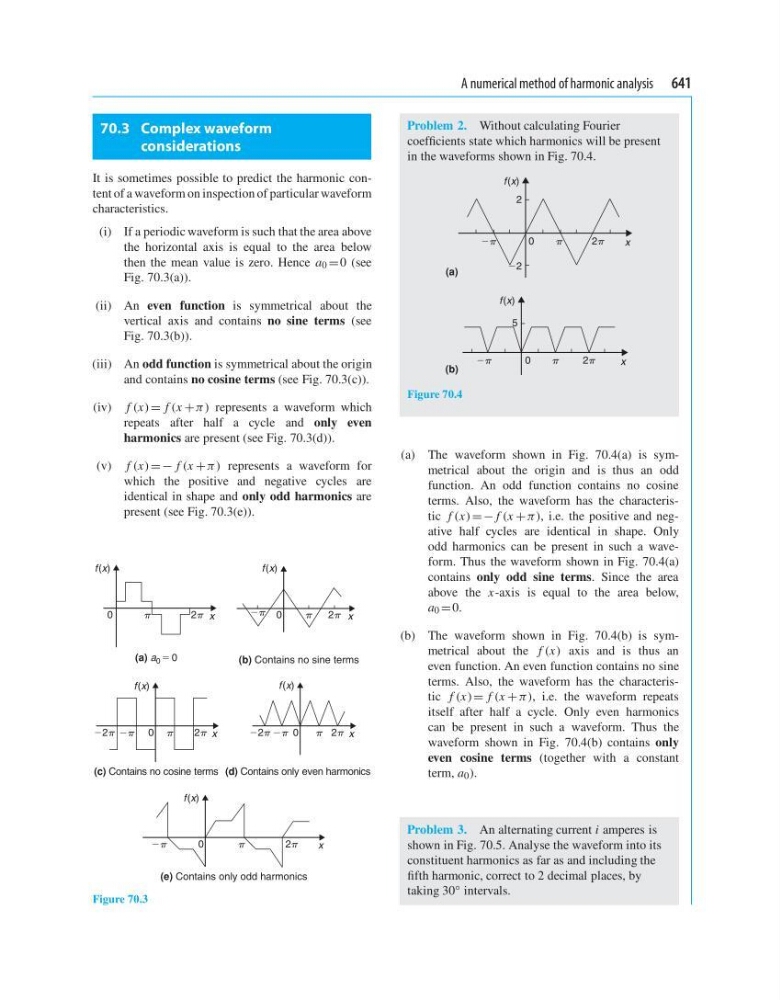
(i) If a periodic waveform is such that the area above
the horizontal axis is equal to the area below
then the mean value is zero. Hence a 0 = 0 (see
Fig. 70.3(a)).
(ii) An even function is symmetrical about the
vertical axis and contains no sine terms (see
Fig. 70.3(b)).
(iii) An odd function is symmetrical about the origin
and contains no cosine terms (see Fig. 70.3(c)).
(iv) f (x) = f (x + π) represents a waveform which
repeats after half a cycle and only even
harmonics are present (see Fig. 70.3(d)).
(v) f (x) = − f (x + π) represents a waveform for
which the positive and negative cycles are
identical in shape and only odd harmonics are
present (see Fig. 70.3(e)).
(a) a 0 5 0
(b) Contains no sine terms
(c) Contains no cosine terms (d) Contains only even harmonics
(e) Contains only odd harmonics
f (x)
x
0
2
f (x)
x
22
2
0
2
f (x)
x
22
2
0
2
f (x)
x
2
0
2
f (x)
x
0
2
2
Figure 70.3
Problem 2. Without calculating Fourier
coefficients state which harmonics will be present
in the waveforms shown in Fig. 70.4.
(a)
(b)
f(x)
2
22
2
2
0
x
f(x)
5
2
2
0
x
Figure 70.4
(a) The waveform shown in Fig. 70.4(a) is symmetrical about the origin and is thus an odd
function. An odd function contains no cosine
terms. Also, the waveform has the characteristic f (x) = − f (x + π), i.e. the positive and negative half cycles are identical in shape. Only
odd harmonics can be present in such a waveform. Thus the waveform shown in Fig. 70.4(a)
contains only odd sine terms. Since the area
above the x-axis is equal to the area below,
a 0 = 0.
(b) The waveform shown in Fig. 70.4(b) is symmetrical about the f (x) axis and is thus an
even function. An even function contains no sine
terms. Also, the waveform has the characteristic f (x) = f (x + π), i.e. the waveform repeats
itself after half a cycle. Only even harmonics
can be present in such a waveform. Thus the
waveform shown in Fig. 70.4(b) contains only
even cosine terms (together with a constant
term, a 0 ).
Problem 3. An alternating current i amperes is
shown in Fig. 70.5. Analyse the waveform into its
constituent harmonics as far as and including the
fifth harmonic, correct to 2 decimal places, by
taking 30 ◦ intervals.