

634 Higher Engineering Mathematics
4. Determine the Fourier series for the half
wave rectified sinusoidal voltage V sin ωt
defined by:
f (t ) =
⎧
⎪ ⎨
⎪ ⎩
V sin ωt, 0 < t <
π
ω
0,
π
ω
< t <
2π
ω
which is periodic of period
2π
ω
⎡
⎢
⎢
⎢
⎢
⎢
⎢
⎣
f (t ) =
V
π
+
V
2
sin ωt
−
2V
π
cos 2ωt
(1)(3)
+
cos 4ωt
(3)(5)
+
cos 6ωt
(5)(7)
+ · · ·
⎤
⎥
⎥
⎥
⎥
⎥
⎥
⎦
69.2 Half-range Fourier series for
functions defined over range L
(a) By making the substitution u =
π x
L
(see
Section 69.1), the range x = 0 to x = L corresponds to the range u = 0 to u = π. Hence a
function may be expanded in a series of either
cosine terms or sine terms only, i.e. a half-range
Fourier series.
(b) A half-range cosine series in the range 0 to L can
be expanded as:
where
f (x) = a 0 +
∞
n=1
a n cos
nπ x
L
a 0 =
1
L
L
0
f (x)dx and
a n =
2
L
L
0
f (x)cos
nπ x
L
dx
(c) A half-range sine series in the range 0 to L can
be expanded as:
f (x)=
∞
n=1
b n sin
nπx
L
where b n =
2
L
L
0
f (x)sin
nπ x
L
dx
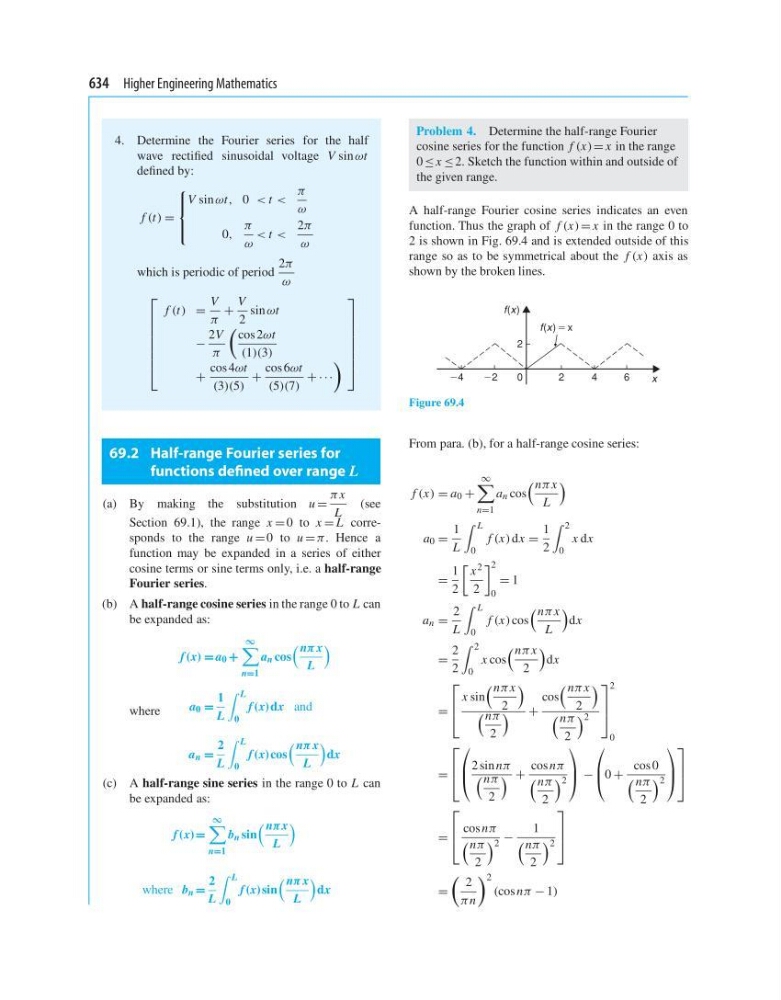
Problem 4. Determine the half-range Fourier
cosine series for the function f (x) = x in the range
0 ≤ x ≤ 2. Sketch the function within and outside of
the given range.
A half-range Fourier cosine series indicates an even
function. Thus the graph of f (x) = x in the range 0 to
2 is shown in Fig. 69.4 and is extended outside of this
range so as to be symmetrical about the f (x) axis as
shown by the broken lines.
f (x )
f (x ) 5 x
x
22
24
2
4
2
0
6
Figure 69.4
From para. (b), for a half-range cosine series:
f (x) = a 0 +
∞
n=1
a n cos
nπ x
L
a 0 =
1
L
L
0
f (x) dx =
1
2
2
0
x dx
=
1
2
x 2
2
2
0
= 1
a n =
2
L
L
0
f (x) cos
nπ x
L
dx
=
2
2
2
0
x cos
nπ x
2
dx
=
⎡
⎢
⎣
x sin
nπ x
2
nπ
2
+
cos
nπ x
2
nπ
2
2
⎤
⎥
⎦
2
0
=
⎡
⎢
⎣
⎛
⎜
⎝
2 sinnπ
nπ
2
+
cos nπ
nπ
2
2
⎞
⎟
⎠ −
⎛
⎜
⎝0 +
cos 0
nπ
2
2
⎞
⎟
⎠
⎤
⎥
⎦
=
⎡
⎢
⎣
cos nπ
nπ
2
2 −
1
nπ
2
2
⎤
⎥
⎦
=
2
πn
2
(cos nπ − 1)