

628 Higher Engineering Mathematics
Problem 7. Find the half-range Fourier sine
series to represent the function f (x) = 3x in the
range 0 ≤ x ≤ π.
From para. (c), for a half-range sine series:
f (x) =
∞
n=1
b n sin nx
When f (x) = 3x,
b n =
2
π
π
0
f (x) sin nx dx =
2
π
π
0
3x sin nx dx
=
6
π
−x cos nx
n
+
sin nx
n 2
π
0
by parts
=
6
π
−π cos nπ
n
+
sin nπ
n 2
− (0 + 0)
= −
6
n
cos nπ
When n is odd, b n =
6
n
Hence b 1 =
6
1
, b 3 =
6
3
, b 5 =
6
5
and so on.
When n is even, b n =−
6
n
Hence b 2 =−
6
2
, b 4 =−
6
4
, b 6 =−
6
6
and so on.
Hence the half-range Fourier sine series is given by:
f (x) = 3x = 6
sin x −
1
2
sin 2x +
1
3
sin 3x
−
1
4
sin 4x +
1
5
sin 5x −· · ·
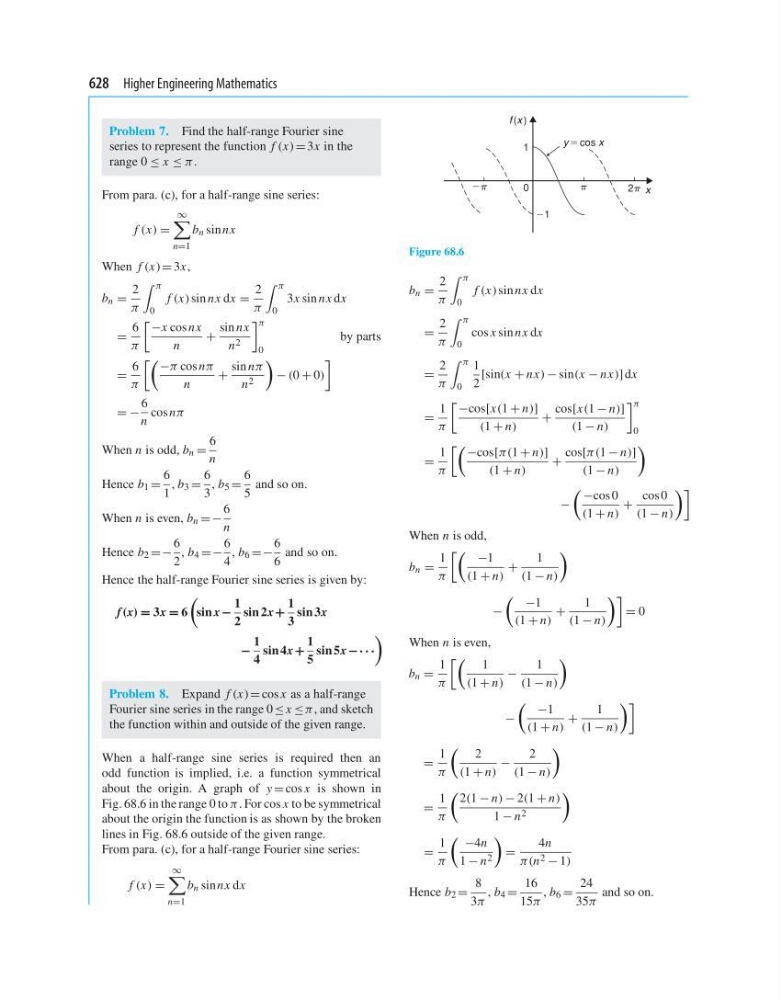
Problem 8. Expand f (x) = cos x as a half-range
Fourier sine series in the range 0 ≤ x ≤ π, and sketch
the function within and outside of the given range.
When a half-range sine series is required then an
odd function is implied, i.e. a function symmetrical
about the origin. A graph of y = cos x is shown in
Fig. 68.6 in the range 0 to π. For cos x to be symmetrical
about the origin the function is as shown by the broken
lines in Fig. 68.6 outside of the given range.
From para. (c), for a half-range Fourier sine series:
f (x) =
∞
n=1
b n sin nx dx
2
21
2
0
x
y 5 cos x
1
f (x )
Figure 68.6
b n =
2
π
π
0
f (x) sin nx dx
=
2
π
π
0
cos x sin nx dx
=
2
π
π
0
1
2
[sin(x + nx) − sin(x − nx)] dx
=
1
π
−cos[x(1 + n)]
(1 + n)
+
cos[x(1 − n)]
(1 − n)
π
0
=
1
π
−cos[π(1 + n)]
(1 + n)
+
cos[π(1 − n)]
(1 − n)
−
−cos 0
(1 + n)
+
cos 0
(1 − n)
When n is odd,
b n =
1
π
−1
(1 + n)
+
1
(1 − n)
−
−1
(1 + n)
+
1
(1 − n)
= 0
When n is even,
b n =
1
π
1
(1 + n)
−
1
(1 − n)
−
−1
(1 + n)
+
1
(1 − n)
=
1
π
2
(1 + n)
−
2
(1 − n)
=
1
π
2(1 − n) − 2(1 + n)
1 − n 2
=
1
π
−4n
1 − n 2
=
4n
π(n 2 − 1)
Hence b 2 =
8
3π
, b 4 =
16
15π
, b 6 =
24
35π
and so on.