

624 Higher Engineering Mathematics
Problem 1. Determine the Fourier series for the
periodic function defined by:
f (x) =
⎧
⎪ ⎪ ⎪ ⎪ ⎪ ⎨
⎪ ⎪ ⎪ ⎪ ⎪ ⎩
−2,
when −π < x < −
π
2
2,
when −
π
2
< x <
π
2
−2,
when
π
2
< x <π.
and has a period of 2π.
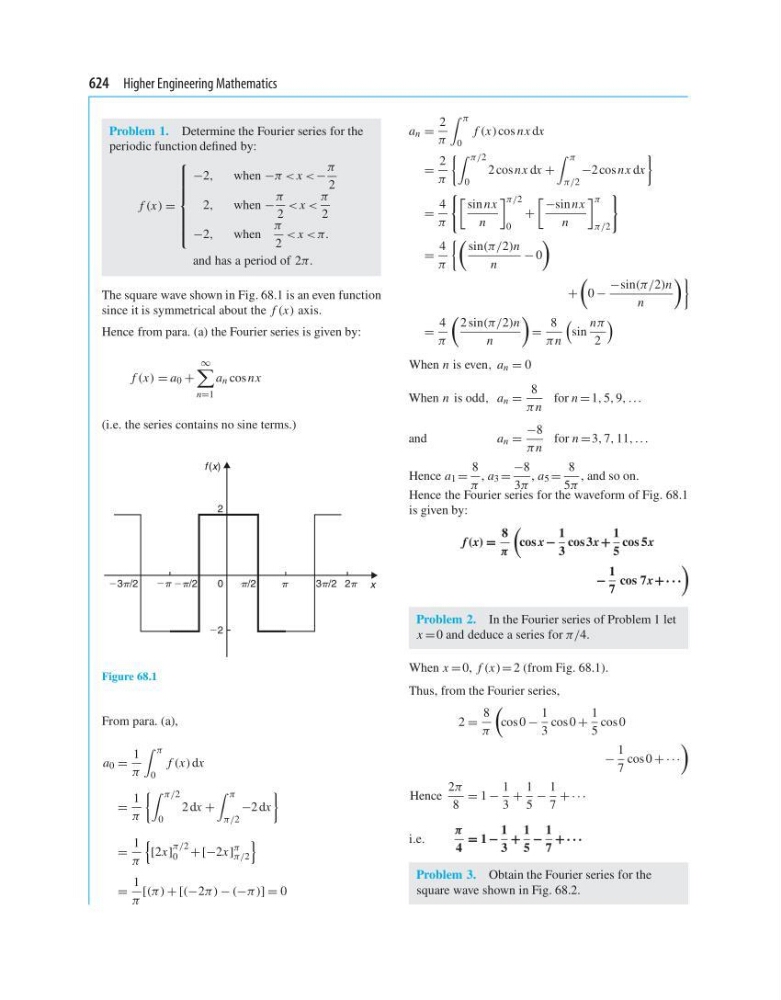
The square wave shown in Fig. 68.1 is an even function
since it is symmetrical about the f (x) axis.
Hence from para. (a) the Fourier series is given by:
f (x) = a 0 +
∞
n=1
a n cos nx
(i.e. the series contains no sine terms.)
2
f (x)
Ϫ2
Ϫ3/2
3/2 2 x
Ϫ Ϫ/2
/2
0
Figure 68.1
From para. (a),
a 0 =
1
π
π
0
f (x) dx
=
1
π
π/2
0
2 dx +
π
π/2
−2 dx
=
1
π
[2x]
π/2
0 + [−2x]
π
π/2
=
1
π
[(π) + [(−2π) − (−π)] = 0
a n =
2
π
π
0
f (x) cos nx dx
=
2
π
π/2
0
2 cos nx dx +
π
π/2
−2 cos nx dx
=
4
π
sin nx
n
π/2
0
+
−sin nx
n
π
π/2
=
4
π
sin(π/2)n
n
− 0
+
0 −
−sin(π/2)n
n
=
4
π
2 sin(π/2)n
n
=
8
πn
sin
nπ
2
When n is even, a n = 0
When n is odd, a n =
8
πn
for n = 1, 5, 9, ...
and
a n =
−8
πn
for n =3, 7, 11, ...
Hence a 1 =
8
π
, a 3 =
−8
3π
, a 5 =
8
5π
, and so on.
Hence the Fourier series for the waveform of Fig. 68.1
is given by:
f (x) =
8
π
cos x −
1
3
cos 3x +
1
5
cos 5x
−
1
7
cos 7x +· · ·
Problem 2. In the Fourier series of Problem 1 let
x = 0 and deduce a series for π/4.
When x = 0, f (x) = 2 (from Fig. 68.1).
Thus, from the Fourier series,
2 =
8
π
cos 0 −
1
3
cos 0 +
1
5
cos 0
−
1
7
cos 0 + · · ·
Hence
2π
8
= 1 −
1
3
+
1
5
−
1
7
+ · · ·
i.e.
π
4
= 1 −
1
3
+
1
5
−
1
7
+· · ·
Problem 3. Obtain the Fourier series for the
square wave shown in Fig. 68.2.