

614 Higher Engineering Mathematics
x
f (x)
f (x)
P 1
0
(a)
(b)
(c)
4
24
2/2
2
2
/2
x
f (x)
f (x)
4/3 sin 3x
0
2/2
2
2
/2
x
f (x)
f (x)
4/5 sin 5x
P 2
P 2
P 1
P 3
0
2/2
2
2
/2
Figure 66.4
When x =
π
2
, f (x) = 1,
sin x = sin
π
2
= 1,
sin 3x = sin
3π
2
= −1,
sin 5x = sin
5π
2
= 1, and so on.
Hence 1 =
4
π
1 +
1
3
(−1) +
1
5
(1) +
1
7
(−1) + · · ·
i.e.
π
4
= 1 −
1
3
+
1
5
−
1
7
+ · · ·
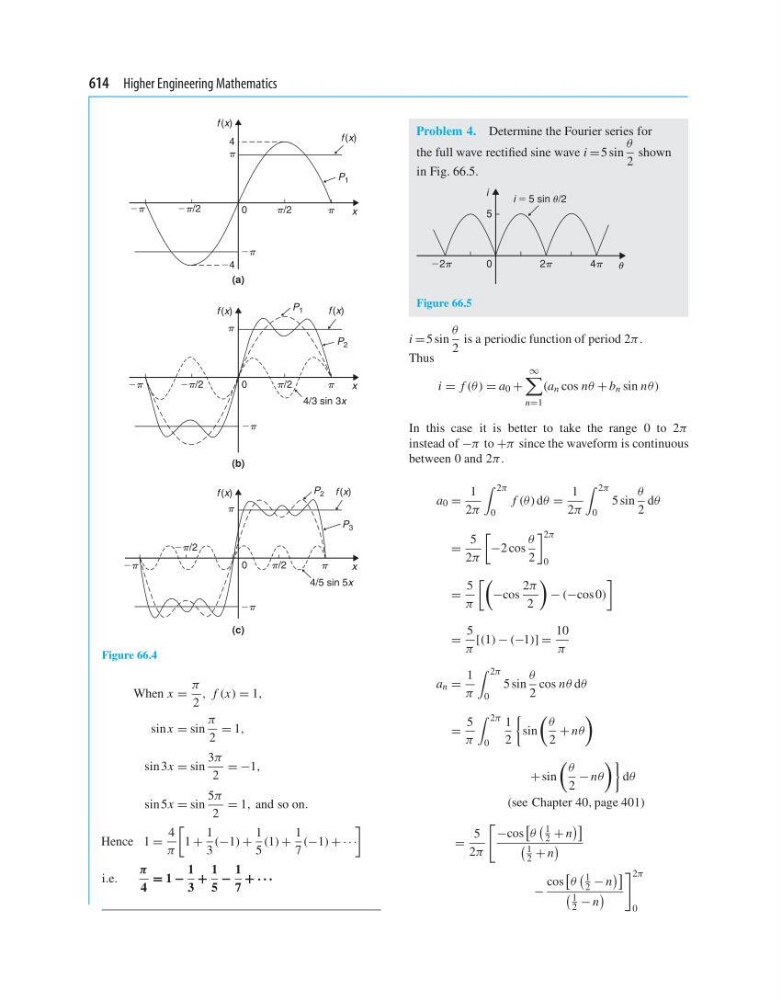
Problem 4. Determine the Fourier series for
the full wave rectified sine wave i = 5 sin
θ
2
shown
in Fig. 66.5.
0
5
22
2
4
i 5 5 sin /2
i
Figure 66.5
i = 5 sin
θ
2
is a periodic function of period 2π.
Thus
i = f (θ) = a 0 +
∞
n=1
(a n cos nθ + b n sin nθ)
In this case it is better to take the range 0 to 2π
instead of −π to +π since the waveform is continuous
between 0 and 2π.
a 0 =
1
2π
2π
0
f (θ) dθ =
1
2π
2π
0
5 sin
θ
2
dθ
=
5
2π
−2 cos
θ
2
2π
0
=
5
π
−cos
2π
2
− (−cos 0)
=
5
π
[(1) − (−1)] =
10
π
a n =
1
π
2π
0
5 sin
θ
2
cos nθ dθ
=
5
π
2π
0
1
2
sin
θ
2
+ nθ
+ sin
θ
2
− nθ
dθ
(see Chapter 40, page 401)
=
5
2π
−cos
θ
1
2 + n
1
2 + n
−
cos
θ
1
2 − n
1
2 − n
2π
0
x
f (x)
f (x)
P 1
0
(a)
(b)
(c)
4
24
2/2
2
2
/2
x
f (x)
f (x)
4/3 sin 3x
0
2/2
2
2
/2
x
f (x)
f (x)
4/5 sin 5x
P 2
P 2
P 1
P 3
0
2/2
2
2
/2
Figure 66.4
When x =
π
2
, f (x) = 1,
sin x = sin
π
2
= 1,
sin 3x = sin
3π
2
= −1,
sin 5x = sin
5π
2
= 1, and so on.
Hence 1 =
4
π
1 +
1
3
(−1) +
1
5
(1) +
1
7
(−1) + · · ·
i.e.
π
4
= 1 −
1
3
+
1
5
−
1
7
+ · · ·
Problem 4. Determine the Fourier series for
the full wave rectified sine wave i = 5 sin
θ
2
shown
in Fig. 66.5.
0
5
22
2
4
i 5 5 sin /2
i
Figure 66.5
i = 5 sin
θ
2
is a periodic function of period 2π.
Thus
i = f (θ) = a 0 +
∞
n=1
(a n cos nθ + b n sin nθ)
In this case it is better to take the range 0 to 2π
instead of −π to +π since the waveform is continuous
between 0 and 2π.
a 0 =
1
2π
2π
0
f (θ) dθ =
1
2π
2π
0
5 sin
θ
2
dθ
=
5
2π
−2 cos
θ
2
2π
0
=
5
π
−cos
2π
2
− (−cos 0)
=
5
π
[(1) − (−1)] =
10
π
a n =
1
π
2π
0
5 sin
θ
2
cos nθ dθ
=
5
π
2π
0
1
2
sin
θ
2
+ nθ
+ sin
θ
2
− nθ
dθ
(see Chapter 40, page 401)
=
5
2π
−cos
θ
1
2 + n
1
2 + n
−
cos
θ
1
2 − n
1
2 − n
2π
0