

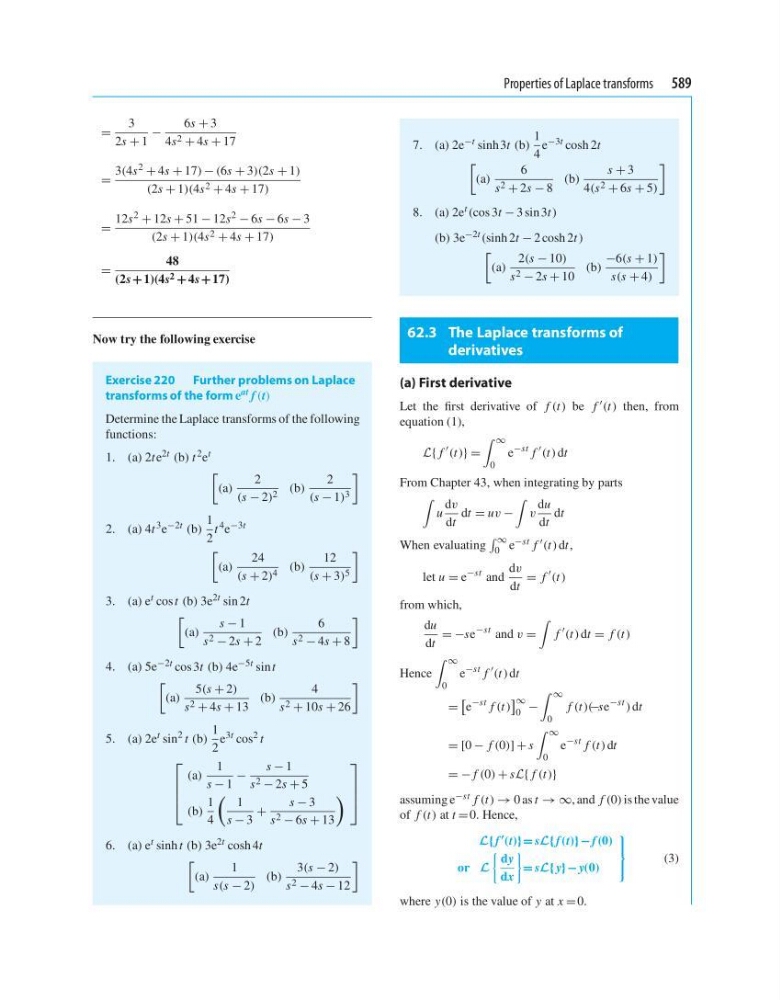
Properties of Laplace transforms 589
=
3
2s + 1
−
6s + 3
4s 2 + 4s + 17
=
3(4s 2 + 4s + 17) − (6s + 3)(2s + 1)
(2s + 1)(4s 2 + 4s + 17)
=
12s 2 + 12s + 51 − 12s 2 − 6s − 6s − 3
(2s + 1)(4s 2 + 4s + 17)
=
48
(2s + 1)(4s 2 + 4s + 17)
Now try the following exercise
Exercise 220 Further problems on Laplace
transforms of the form e at f (t)
Determine the Laplace transforms of the following
functions:
1. (a) 2t e 2t (b) t 2 e t
(a)
2
(s − 2) 2 (b)
2
(s − 1) 3
2. (a) 4t 3 e −2t (b)
1
2
t 4 e −3t
(a)
24
(s + 2) 4 (b)
12
(s + 3) 5
3. (a) e t cos t (b) 3e 2t sin 2t
(a)
s − 1
s 2 − 2s + 2
(b)
6
s 2 − 4s + 8
4. (a) 5e −2t cos 3t (b) 4e −5t sin t
(a)
5(s + 2)
s 2 + 4s + 13
(b)
4
s 2 + 10s + 26
5. (a) 2e t sin
2 t (b)
1
2
e 3t cos 2 t
⎡
⎢
⎢
⎣
(a)
1
s − 1
−
s − 1
s 2 − 2s + 5
(b)
1
4
1
s − 3
+
s − 3
s 2 − 6s + 13
⎤
⎥
⎥
⎦
6. (a) e t sinh t (b) 3e 2t cosh 4t
(a)
1
s(s − 2)
(b)
3(s − 2)
s 2 − 4s − 12
7. (a) 2e −t sinh 3t (b)
1
4
e −3t cosh 2t
(a)
6
s 2 + 2s − 8
(b)
s + 3
4(s 2 + 6s + 5)
8. (a) 2e t (cos 3t − 3 sin3t )
(b) 3e −2t (sinh 2t − 2 cosh 2t )
(a)
2(s − 10)
s 2 − 2s + 10
(b)
−6(s + 1)
s(s + 4)
62.3 The Laplace transforms of
derivatives
(a) First derivative
Let the first derivative of f (t ) be f (t ) then, from
equation (1),
L{ f
(t )} =
∞
0
e
−st f
(t ) dt
From Chapter 43, when integrating by parts
u
dv
dt
dt = uv −
v
du
dt
dt
When evaluating
∞
0 e −st f (t ) dt ,
let u = e
−st and
dv
dt
= f
(t )
from which,
du
dt
= −se
−st and v =
f
(t ) dt = f (t )
Hence
∞
0
e
−st f
(t ) dt
=
e
−st f (t )
∞
0
−
∞
0
f (t )(−se
−st
) dt
= [0 − f (0)] + s
∞
0
e
−st f (t ) dt
= − f (0) + sL{ f (t )}
assuming e −st f (t ) → 0 as t → ∞, and f (0) is the value
of f (t ) at t = 0. Hence,
L{ f (t)} =sL{ f (t)} −f (0)
or L
dy
dx
= sL{ y} −y(0)
⎫
⎬
⎭
(3)
where y(0) is the value of y at x = 0.
=
3
2s + 1
−
6s + 3
4s 2 + 4s + 17
=
3(4s 2 + 4s + 17) − (6s + 3)(2s + 1)
(2s + 1)(4s 2 + 4s + 17)
=
12s 2 + 12s + 51 − 12s 2 − 6s − 6s − 3
(2s + 1)(4s 2 + 4s + 17)
=
48
(2s + 1)(4s 2 + 4s + 17)
Now try the following exercise
Exercise 220 Further problems on Laplace
transforms of the form e at f (t)
Determine the Laplace transforms of the following
functions:
1. (a) 2t e 2t (b) t 2 e t
(a)
2
(s − 2) 2 (b)
2
(s − 1) 3
2. (a) 4t 3 e −2t (b)
1
2
t 4 e −3t
(a)
24
(s + 2) 4 (b)
12
(s + 3) 5
3. (a) e t cos t (b) 3e 2t sin 2t
(a)
s − 1
s 2 − 2s + 2
(b)
6
s 2 − 4s + 8
4. (a) 5e −2t cos 3t (b) 4e −5t sin t
(a)
5(s + 2)
s 2 + 4s + 13
(b)
4
s 2 + 10s + 26
5. (a) 2e t sin
2 t (b)
1
2
e 3t cos 2 t
⎡
⎢
⎢
⎣
(a)
1
s − 1
−
s − 1
s 2 − 2s + 5
(b)
1
4
1
s − 3
+
s − 3
s 2 − 6s + 13
⎤
⎥
⎥
⎦
6. (a) e t sinh t (b) 3e 2t cosh 4t
(a)
1
s(s − 2)
(b)
3(s − 2)
s 2 − 4s − 12
7. (a) 2e −t sinh 3t (b)
1
4
e −3t cosh 2t
(a)
6
s 2 + 2s − 8
(b)
s + 3
4(s 2 + 6s + 5)
8. (a) 2e t (cos 3t − 3 sin3t )
(b) 3e −2t (sinh 2t − 2 cosh 2t )
(a)
2(s − 10)
s 2 − 2s + 10
(b)
−6(s + 1)
s(s + 4)
62.3 The Laplace transforms of
derivatives
(a) First derivative
Let the first derivative of f (t ) be f (t ) then, from
equation (1),
L{ f
(t )} =
∞
0
e
−st f
(t ) dt
From Chapter 43, when integrating by parts
u
dv
dt
dt = uv −
v
du
dt
dt
When evaluating
∞
0 e −st f (t ) dt ,
let u = e
−st and
dv
dt
= f
(t )
from which,
du
dt
= −se
−st and v =
f
(t ) dt = f (t )
Hence
∞
0
e
−st f
(t ) dt
=
e
−st f (t )
∞
0
−
∞
0
f (t )(−se
−st
) dt
= [0 − f (0)] + s
∞
0
e
−st f (t ) dt
= − f (0) + sL{ f (t )}
assuming e −st f (t ) → 0 as t → ∞, and f (0) is the value
of f (t ) at t = 0. Hence,
L{ f (t)} =sL{ f (t)} −f (0)
or L
dy
dx
= sL{ y} −y(0)
⎫
⎬
⎭
(3)
where y(0) is the value of y at x = 0.