

Revision Test 17
This Revision Test covers the material contained in chapters 57 to 60. The marks for each question are shown in
brackets at the end of each question.
1. A machine produces 15% defective components.
In a sample of 5, drawn at random, calculate,
using the binomial distribution, the probability
that:
(a) there will be 4 defective items,
(b) there will be not more than 3 defective items,
(c) all the items will be non-defective.
Draw a histogram showing the probabilities of 0, 1,
2, ..., 5 defective items.
(20)
2. 2% of the light bulbs produced by a company are
defective. Determine, using the Poisson distribution, the probability that in a sample of 80 bulbs:
(a) 3 bulbs will be defective, (b) not more than
3 bulbs will be defective, (c) at least 2 bulbs will be
defective.
(13)
3. Some engineering components have a mean length
of 20 mm and a standard deviation of 0.25 mm.
Assume that the data on the lengths of the components is normally distributed.
In a batch of 500 components, determine the
number of components likely to:
(a) have a length of less than 19.95 mm,
(b) be between 19.95 mm and 20.15 mm,
(c) be longer than 20.54 mm.
(15)
4. In a factory, cans are packed with an average of
1.0 kg of a compound and the masses are normally
distributed about the average value. The standard
deviation of a sample of the contents of the cans
is 12 g. Determine the percentage of cans containing (a) less than 985 g, (b) more than 1030 g,
(c) between 985 g and 1030 g.
(10)
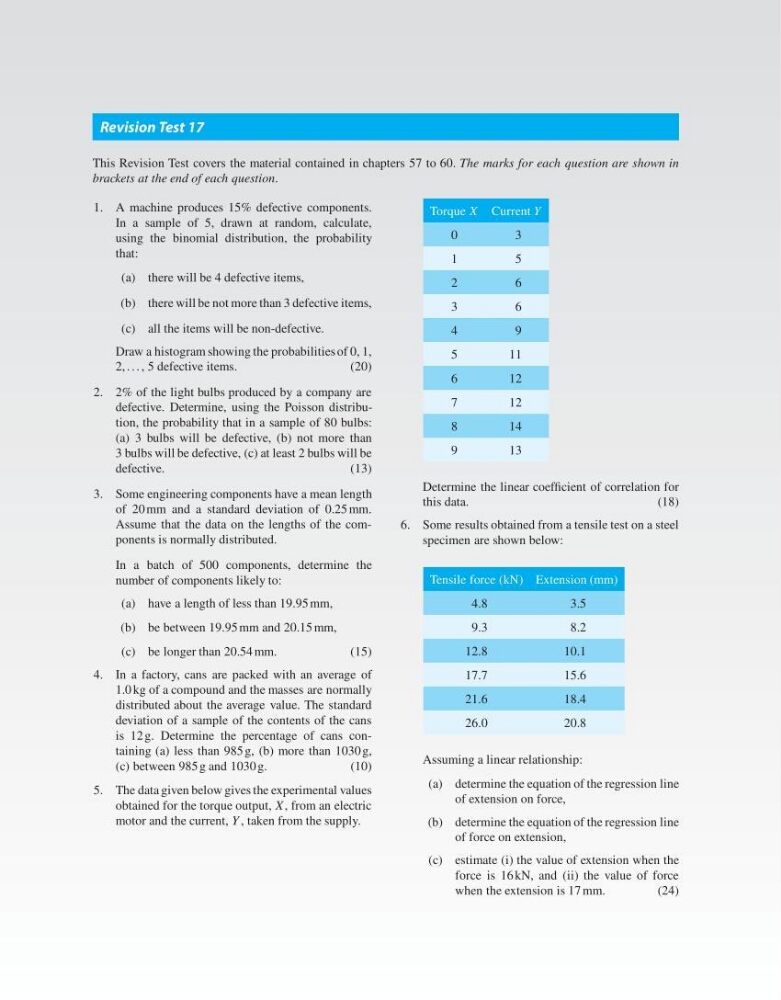
5. The data given below gives the experimental values
obtained for the torque output, X , from an electric
motor and the current, Y , taken from the supply.
Torque X Current Y
0
3
1
5
2
6
3
6
4
9
5
11
6
12
7
12
8
14
9
13
Determine the linear coefficient of correlation for
this data.
(18)
6. Some results obtained from a tensile test on a steel
specimen are shown below:
Tensile force (kN) Extension (mm)
4.8
3.5
9.3
8.2
12.8
10.1
17.7
15.6
21.6
18.4
26.0
20.8
Assuming a linear relationship:
(a) determine the equation of the regression line
of extension on force,
(b) determine the equation of the regression line
of force on extension,
(c) estimate (i) the value of extension when the
force is 16 kN, and (ii) the value of force
when the extension is 17 mm.
(24)
This Revision Test covers the material contained in chapters 57 to 60. The marks for each question are shown in
brackets at the end of each question.
1. A machine produces 15% defective components.
In a sample of 5, drawn at random, calculate,
using the binomial distribution, the probability
that:
(a) there will be 4 defective items,
(b) there will be not more than 3 defective items,
(c) all the items will be non-defective.
Draw a histogram showing the probabilities of 0, 1,
2, ..., 5 defective items.
(20)
2. 2% of the light bulbs produced by a company are
defective. Determine, using the Poisson distribution, the probability that in a sample of 80 bulbs:
(a) 3 bulbs will be defective, (b) not more than
3 bulbs will be defective, (c) at least 2 bulbs will be
defective.
(13)
3. Some engineering components have a mean length
of 20 mm and a standard deviation of 0.25 mm.
Assume that the data on the lengths of the components is normally distributed.
In a batch of 500 components, determine the
number of components likely to:
(a) have a length of less than 19.95 mm,
(b) be between 19.95 mm and 20.15 mm,
(c) be longer than 20.54 mm.
(15)
4. In a factory, cans are packed with an average of
1.0 kg of a compound and the masses are normally
distributed about the average value. The standard
deviation of a sample of the contents of the cans
is 12 g. Determine the percentage of cans containing (a) less than 985 g, (b) more than 1030 g,
(c) between 985 g and 1030 g.
(10)
5. The data given below gives the experimental values
obtained for the torque output, X , from an electric
motor and the current, Y , taken from the supply.
Torque X Current Y
0
3
1
5
2
6
3
6
4
9
5
11
6
12
7
12
8
14
9
13
Determine the linear coefficient of correlation for
this data.
(18)
6. Some results obtained from a tensile test on a steel
specimen are shown below:
Tensile force (kN) Extension (mm)
4.8
3.5
9.3
8.2
12.8
10.1
17.7
15.6
21.6
18.4
26.0
20.8
Assuming a linear relationship:
(a) determine the equation of the regression line
of extension on force,
(b) determine the equation of the regression line
of force on extension,
(c) estimate (i) the value of extension when the
force is 16 kN, and (ii) the value of force
when the extension is 17 mm.
(24)