

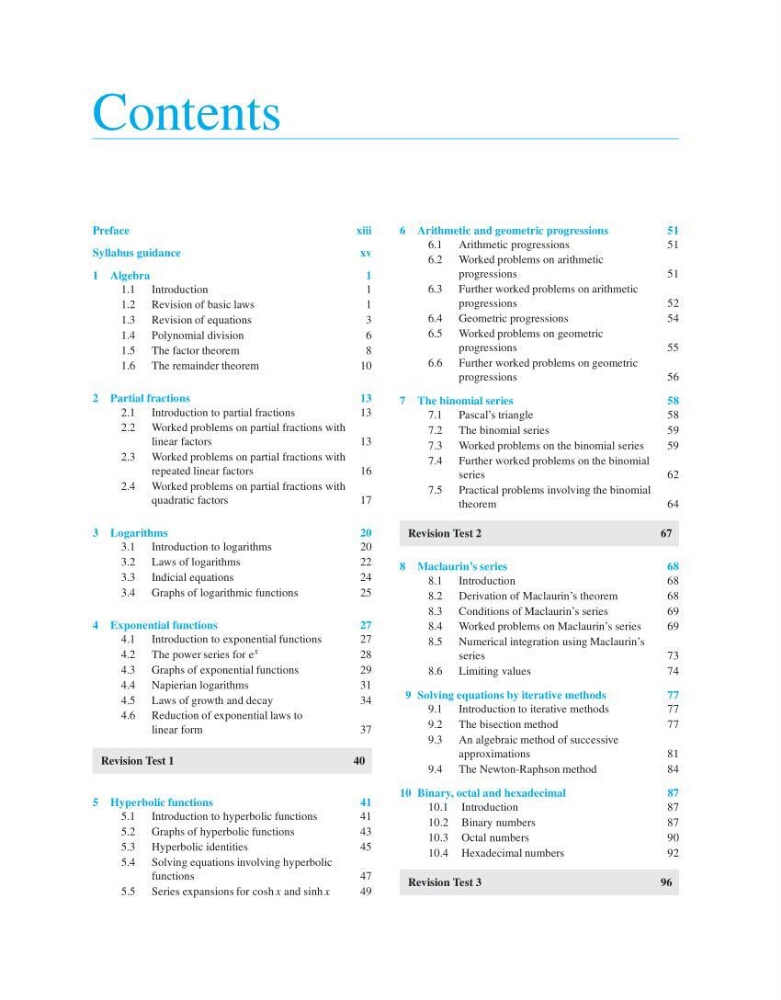
Contents
Preface
xiii
Syllabus guidance
xv
1 Algebra
1
1.1 Introduction
1
1.2 Revision of basic laws
1
1.3 Revision of equations
3
1.4 Polynomial division
6
1.5 The factor theorem
8
1.6 The remainder theorem
10
2 Partial fractions
13
2.1 Introduction to partial fractions
13
2.2 Worked problems on partial fractions with
linear factors
13
2.3 Worked problems on partial fractions with
repeated linear factors
16
2.4 Worked problems on partial fractions with
quadratic factors
17
3 Logarithms
20
3.1 Introduction to logarithms
20
3.2 Laws of logarithms
22
3.3 Indicial equations
24
3.4 Graphs of logarithmic functions
25
4 Exponential functions
27
4.1 Introduction to exponential functions
27
4.2 The power series for e x
28
4.3 Graphs of exponential functions
29
4.4 Napierian logarithms
31
4.5 Laws of growth and decay
34
4.6 Reduction of exponential laws to
linear form
37
Revision Test 1
40
5 Hyperbolic functions
41
5.1 Introduction to hyperbolic functions
41
5.2 Graphs of hyperbolic functions
43
5.3 Hyperbolic identities
45
5.4 Solving equations involving hyperbolic
functions
47
5.5 Series expansions for cosh x and sinh x
49
6 Arithmetic and geometric progressions
51
6.1 Arithmetic progressions
51
6.2 Worked problems on arithmetic
progressions
51
6.3 Further worked problems on arithmetic
progressions
52
6.4 Geometric progressions
54
6.5 Worked problems on geometric
progressions
55
6.6 Further worked problems on geometric
progressions
56
7 The binomial series
58
7.1 Pascal’s triangle
58
7.2 The binomial series
59
7.3 Worked problems on the binomial series
59
7.4 Further worked problems on the binomial
series
62
7.5 Practical problems involving the binomial
theorem
64
Revision Test 2
67
8 Maclaurin’s series
68
8.1 Introduction
68
8.2 Derivation of Maclaurin’s theorem
68
8.3 Conditions of Maclaurin’s series
69
8.4 Worked problems on Maclaurin’s series
69
8.5 Numerical integration using Maclaurin’s
series
73
8.6 Limiting values
74
9 Solving equations by iterative methods
77
9.1 Introduction to iterative methods
77
9.2 The bisection method
77
9.3 An algebraic method of successive
approximations
81
9.4 The Newton-Raphson method
84
10 Binary, octal and hexadecimal
87
10.1 Introduction
87
10.2 Binary numbers
87
10.3 Octal numbers
90
10.4 Hexadecimal numbers
92
Revision Test 3
96
Preface
xiii
Syllabus guidance
xv
1 Algebra
1
1.1 Introduction
1
1.2 Revision of basic laws
1
1.3 Revision of equations
3
1.4 Polynomial division
6
1.5 The factor theorem
8
1.6 The remainder theorem
10
2 Partial fractions
13
2.1 Introduction to partial fractions
13
2.2 Worked problems on partial fractions with
linear factors
13
2.3 Worked problems on partial fractions with
repeated linear factors
16
2.4 Worked problems on partial fractions with
quadratic factors
17
3 Logarithms
20
3.1 Introduction to logarithms
20
3.2 Laws of logarithms
22
3.3 Indicial equations
24
3.4 Graphs of logarithmic functions
25
4 Exponential functions
27
4.1 Introduction to exponential functions
27
4.2 The power series for e x
28
4.3 Graphs of exponential functions
29
4.4 Napierian logarithms
31
4.5 Laws of growth and decay
34
4.6 Reduction of exponential laws to
linear form
37
Revision Test 1
40
5 Hyperbolic functions
41
5.1 Introduction to hyperbolic functions
41
5.2 Graphs of hyperbolic functions
43
5.3 Hyperbolic identities
45
5.4 Solving equations involving hyperbolic
functions
47
5.5 Series expansions for cosh x and sinh x
49
6 Arithmetic and geometric progressions
51
6.1 Arithmetic progressions
51
6.2 Worked problems on arithmetic
progressions
51
6.3 Further worked problems on arithmetic
progressions
52
6.4 Geometric progressions
54
6.5 Worked problems on geometric
progressions
55
6.6 Further worked problems on geometric
progressions
56
7 The binomial series
58
7.1 Pascal’s triangle
58
7.2 The binomial series
59
7.3 Worked problems on the binomial series
59
7.4 Further worked problems on the binomial
series
62
7.5 Practical problems involving the binomial
theorem
64
Revision Test 2
67
8 Maclaurin’s series
68
8.1 Introduction
68
8.2 Derivation of Maclaurin’s theorem
68
8.3 Conditions of Maclaurin’s series
69
8.4 Worked problems on Maclaurin’s series
69
8.5 Numerical integration using Maclaurin’s
series
73
8.6 Limiting values
74
9 Solving equations by iterative methods
77
9.1 Introduction to iterative methods
77
9.2 The bisection method
77
9.3 An algebraic method of successive
approximations
81
9.4 The Newton-Raphson method
84
10 Binary, octal and hexadecimal
87
10.1 Introduction
87
10.2 Binary numbers
87
10.3 Octal numbers
90
10.4 Hexadecimal numbers
92
Revision Test 3
96