

Revision Test 1
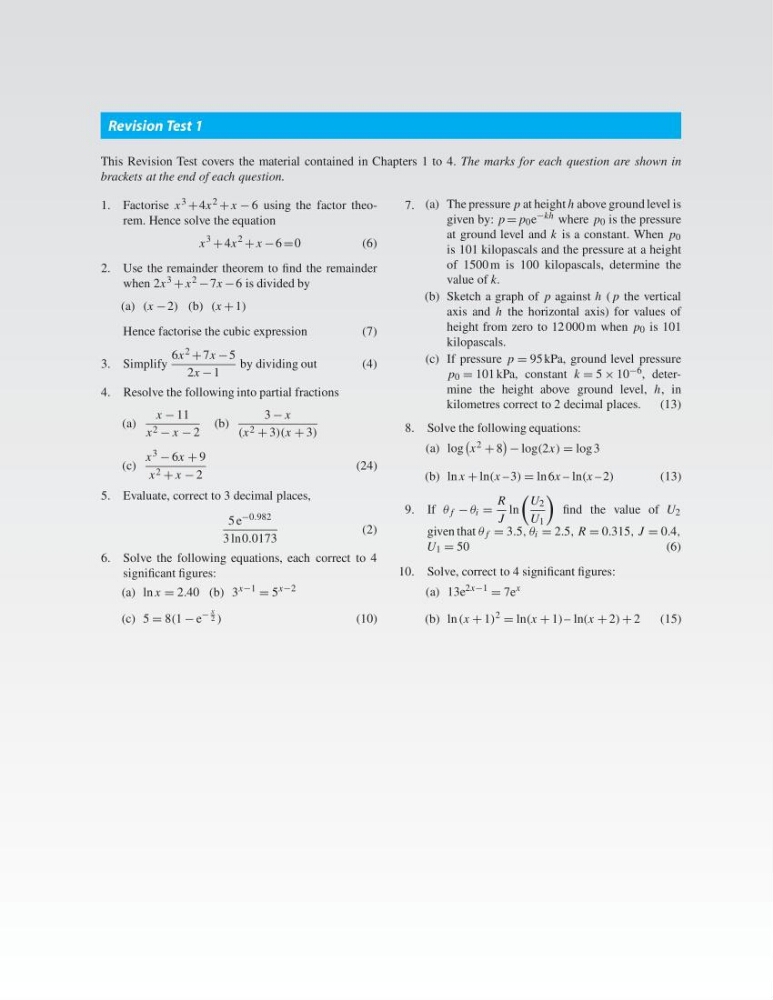
This Revision Test covers the material contained in Chapters 1 to 4. The marks for each question are shown in
brackets at the end of each question.
1. Factorise x 3 + 4x 2 + x − 6 using the factor theorem. Hence solve the equation
x
3
+ 4x
2
+ x − 6 =0
( 6 )
2. Use the remainder theorem to find the remainder
when 2x 3 + x 2 − 7x − 6 is divided by
(a) (x − 2) (b) (x + 1)
Hence factorise the cubic expression
(7)
3. Simplify
6x 2 + 7x − 5
2x − 1
by dividing out
(4)
4. Resolve the following into partial fractions
(a)
x − 11
x 2 − x − 2
(b)
3 − x
(x 2 + 3)(x + 3)
(c)
x 3 − 6x + 9
x 2 + x − 2
(24)
5. Evaluate, correct to 3 decimal places,
5 e
−0.982
3 ln0.0173
(2)
6. Solve the following equations, each correct to 4
significant figures:
(a) ln x = 2.40 (b) 3
x−1
= 5
x−2
(c) 5 = 8(1 − e
−
x
2 )
(10)
7. (a) The pressure p at height h above ground level is
given by: p = p 0 e −kh where p 0 is the pressure
at ground level and k is a constant. When p 0
is 101 kilopascals and the pressure at a height
of 1500 m is 100 kilopascals, determine the
value of k.
(b) Sketch a graph of p against h ( p the vertical
axis and h the horizontal axis) for values of
height from zero to 12 000 m when p 0 is 101
kilopascals.
(c) If pressure p = 95 kPa, ground level pressure
p 0 = 101 kPa, constant k = 5 × 10 −6 , determine the height above ground level, h, in
kilometres correct to 2 decimal places.
(13)
8. Solve the following equations:
(a) log
x 2 + 8
− log(2x) = log 3
(b) ln x + ln(x – 3) = ln 6x – ln(x – 2)
(13)
9. If θ f − θ i =
R
J
ln
U 2
U 1
find the value of U 2
given that θ f = 3.5, θ i = 2.5, R = 0.315, J = 0.4,
U 1 = 50
(6)
10. Solve, correct to 4 significant figures:
(a) 13e
2x−1
= 7e
x
(b) ln (x + 1)
2
= ln(x + 1) – ln(x + 2) + 2
(15)
This Revision Test covers the material contained in Chapters 1 to 4. The marks for each question are shown in
brackets at the end of each question.
1. Factorise x 3 + 4x 2 + x − 6 using the factor theorem. Hence solve the equation
x
3
+ 4x
2
+ x − 6 =0
( 6 )
2. Use the remainder theorem to find the remainder
when 2x 3 + x 2 − 7x − 6 is divided by
(a) (x − 2) (b) (x + 1)
Hence factorise the cubic expression
(7)
3. Simplify
6x 2 + 7x − 5
2x − 1
by dividing out
(4)
4. Resolve the following into partial fractions
(a)
x − 11
x 2 − x − 2
(b)
3 − x
(x 2 + 3)(x + 3)
(c)
x 3 − 6x + 9
x 2 + x − 2
(24)
5. Evaluate, correct to 3 decimal places,
5 e
−0.982
3 ln0.0173
(2)
6. Solve the following equations, each correct to 4
significant figures:
(a) ln x = 2.40 (b) 3
x−1
= 5
x−2
(c) 5 = 8(1 − e
−
x
2 )
(10)
7. (a) The pressure p at height h above ground level is
given by: p = p 0 e −kh where p 0 is the pressure
at ground level and k is a constant. When p 0
is 101 kilopascals and the pressure at a height
of 1500 m is 100 kilopascals, determine the
value of k.
(b) Sketch a graph of p against h ( p the vertical
axis and h the horizontal axis) for values of
height from zero to 12 000 m when p 0 is 101
kilopascals.
(c) If pressure p = 95 kPa, ground level pressure
p 0 = 101 kPa, constant k = 5 × 10 −6 , determine the height above ground level, h, in
kilometres correct to 2 decimal places.
(13)
8. Solve the following equations:
(a) log
x 2 + 8
− log(2x) = log 3
(b) ln x + ln(x – 3) = ln 6x – ln(x – 2)
(13)
9. If θ f − θ i =
R
J
ln
U 2
U 1
find the value of U 2
given that θ f = 3.5, θ i = 2.5, R = 0.315, J = 0.4,
U 1 = 50
(6)
10. Solve, correct to 4 significant figures:
(a) 13e
2x−1
= 7e
x
(b) ln (x + 1)
2
= ln(x + 1) – ln(x + 2) + 2
(15)