

The normal distribution 565
0
0
20.56
20.56
(a)
z-value
z-value
(b)
Figure 58.4
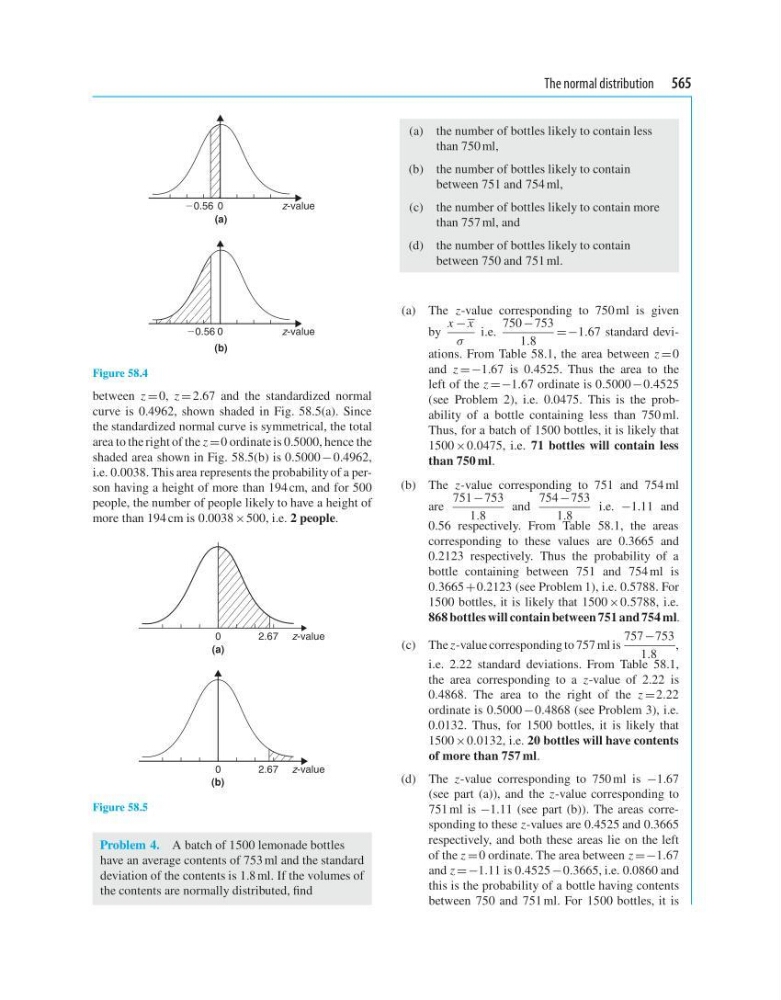
between z = 0, z = 2.67 and the standardized normal
curve is 0.4962, shown shaded in Fig. 58.5(a). Since
the standardized normal curve is symmetrical, the total
area to the right of the z =0 ordinate is 0.5000, hence the
shaded area shown in Fig. 58.5(b) is 0.5000 − 0.4962,
i.e. 0.0038. This area represents the probability of a person having a height of more than 194 cm, and for 500
people, the number of people likely to have a height of
more than 194 cm is 0.0038 ×500, i.e. 2 people.
0
z-value
z-value
2.67
(a)
0
2.67
(b)
Figure 58.5
Problem 4. A batch of 1500 lemonade bottles
have an average contents of 753 ml and the standard
deviation of the contents is 1.8 ml. If the volumes of
the contents are normally distributed, find
(a) the number of bottles likely to contain less
than 750 ml,
(b) the number of bottles likely to contain
between 751 and 754 ml,
(c) the number of bottles likely to contain more
than 757 ml, and
(d) the number of bottles likely to contain
between 750 and 751 ml.
(a) The z-value corresponding to 750 ml is given
by
x − x
σ
i.e.
750 −753
1.8
=−1.67 standard deviations. From Table 58.1, the area between z = 0
and z =−1.67 is 0.4525. Thus the area to the
left of the z =−1.67 ordinate is 0.5000 −0.4525
(see Problem 2), i.e. 0.0475. This is the probability of a bottle containing less than 750 ml.
Thus, for a batch of 1500 bottles, it is likely that
1500 ×0.0475, i.e. 71 bottles will contain less
than 750 ml.
(b) The z-value corresponding to 751 and 754 ml
are
751 −753
1.8
and
754 −753
1.8
i.e. −1.11 and
0.56 respectively. From Table 58.1, the areas
corresponding to these values are 0.3665 and
0.2123 respectively. Thus the probability of a
bottle containing between 751 and 754 ml is
0.3665 +0.2123 (see Problem 1), i.e. 0.5788. For
1500 bottles, it is likely that 1500 ×0.5788, i.e.
868 bottles will contain between 751 and 754 ml.
(c) The z-value corresponding to 757 ml is
757 −753
1.8
,
i.e. 2.22 standard deviations. From Table 58.1,
the area corresponding to a z-value of 2.22 is
0.4868. The area to the right of the z =2.22
ordinate is 0.5000 −0.4868 (see Problem 3), i.e.
0.0132. Thus, for 1500 bottles, it is likely that
1500 ×0.0132, i.e. 20 bottles will have contents
of more than 757 ml.
(d) The z-value corresponding to 750 ml is −1.67
(see part (a)), and the z-value corresponding to
751 ml is −1.11 (see part (b)). The areas corresponding to these z-values are 0.4525 and 0.3665
respectively, and both these areas lie on the left
of the z = 0 ordinate. The area between z =−1.67
and z =−1.11 is 0.4525 −0.3665, i.e. 0.0860 and
this is the probability of a bottle having contents
between 750 and 751 ml. For 1500 bottles, it is
0
0
20.56
20.56
(a)
z-value
z-value
(b)
Figure 58.4
between z = 0, z = 2.67 and the standardized normal
curve is 0.4962, shown shaded in Fig. 58.5(a). Since
the standardized normal curve is symmetrical, the total
area to the right of the z =0 ordinate is 0.5000, hence the
shaded area shown in Fig. 58.5(b) is 0.5000 − 0.4962,
i.e. 0.0038. This area represents the probability of a person having a height of more than 194 cm, and for 500
people, the number of people likely to have a height of
more than 194 cm is 0.0038 ×500, i.e. 2 people.
0
z-value
z-value
2.67
(a)
0
2.67
(b)
Figure 58.5
Problem 4. A batch of 1500 lemonade bottles
have an average contents of 753 ml and the standard
deviation of the contents is 1.8 ml. If the volumes of
the contents are normally distributed, find
(a) the number of bottles likely to contain less
than 750 ml,
(b) the number of bottles likely to contain
between 751 and 754 ml,
(c) the number of bottles likely to contain more
than 757 ml, and
(d) the number of bottles likely to contain
between 750 and 751 ml.
(a) The z-value corresponding to 750 ml is given
by
x − x
σ
i.e.
750 −753
1.8
=−1.67 standard deviations. From Table 58.1, the area between z = 0
and z =−1.67 is 0.4525. Thus the area to the
left of the z =−1.67 ordinate is 0.5000 −0.4525
(see Problem 2), i.e. 0.0475. This is the probability of a bottle containing less than 750 ml.
Thus, for a batch of 1500 bottles, it is likely that
1500 ×0.0475, i.e. 71 bottles will contain less
than 750 ml.
(b) The z-value corresponding to 751 and 754 ml
are
751 −753
1.8
and
754 −753
1.8
i.e. −1.11 and
0.56 respectively. From Table 58.1, the areas
corresponding to these values are 0.3665 and
0.2123 respectively. Thus the probability of a
bottle containing between 751 and 754 ml is
0.3665 +0.2123 (see Problem 1), i.e. 0.5788. For
1500 bottles, it is likely that 1500 ×0.5788, i.e.
868 bottles will contain between 751 and 754 ml.
(c) The z-value corresponding to 757 ml is
757 −753
1.8
,
i.e. 2.22 standard deviations. From Table 58.1,
the area corresponding to a z-value of 2.22 is
0.4868. The area to the right of the z =2.22
ordinate is 0.5000 −0.4868 (see Problem 3), i.e.
0.0132. Thus, for 1500 bottles, it is likely that
1500 ×0.0132, i.e. 20 bottles will have contents
of more than 757 ml.
(d) The z-value corresponding to 750 ml is −1.67
(see part (a)), and the z-value corresponding to
751 ml is −1.11 (see part (b)). The areas corresponding to these z-values are 0.4525 and 0.3665
respectively, and both these areas lie on the left
of the z = 0 ordinate. The area between z =−1.67
and z =−1.11 is 0.4525 −0.3665, i.e. 0.0860 and
this is the probability of a bottle having contents
between 750 and 751 ml. For 1500 bottles, it is