

Probability 553
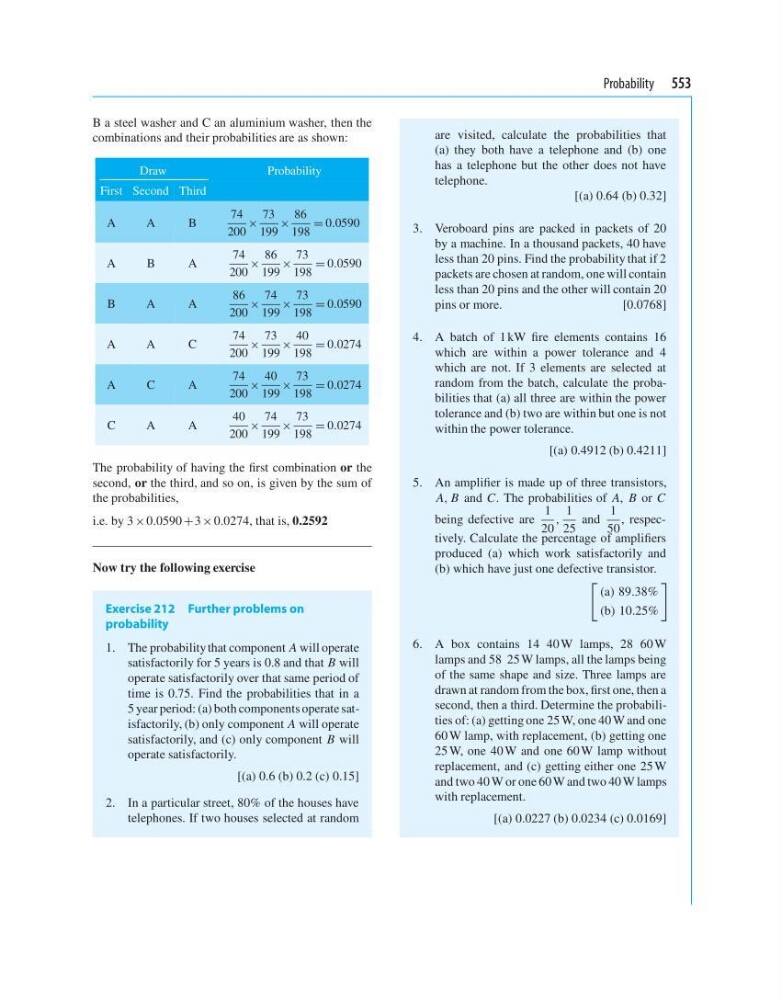
B a steel washer and C an aluminium washer, then the
combinations and their probabilities are as shown:
Draw
Probability
First Second Third
A
A
B
74
200
×
73
199
×
86
198
= 0.0590
A
B
A
74
200
×
86
199
×
73
198
= 0.0590
B
A
A
86
200
×
74
199
×
73
198
= 0.0590
A
A
C
74
200
×
73
199
×
40
198
= 0.0274
A
C
A
74
200
×
40
199
×
73
198
= 0.0274
C
A
A
40
200
×
74
199
×
73
198
= 0.0274
The probability of having the first combination or the
second, or the third, and so on, is given by the sum of
the probabilities,
i.e. by 3 × 0.0590 +3 × 0.0274, that is, 0.2592
Now try the following exercise
Exercise 212 Further problems on
probability
1. The probability that component A will operate
satisfactorily for 5 years is 0.8 and that B will
operate satisfactorily over that same period of
time is 0.75. Find the probabilities that in a
5 year period: (a) both components operate satisfactorily, (b) only component A will operate
satisfactorily, and (c) only component B will
operate satisfactorily.
[(a) 0.6 (b) 0.2 (c) 0.15]
2. In a particular street, 80% of the houses have
telephones. If two houses selected at random
are visited, calculate the probabilities that
(a) they both have a telephone and (b) one
has a telephone but the other does not have
telephone.
[(a) 0.64 (b) 0.32]
3. Veroboard pins are packed in packets of 20
by a machine. In a thousand packets, 40 have
less than 20 pins. Find the probability that if 2
packets are chosen at random, one will contain
less than 20 pins and the other will contain 20
pins or more.
[0.0768]
4. A batch of 1 kW fire elements contains 16
which are within a power tolerance and 4
which are not. If 3 elements are selected at
random from the batch, calculate the probabilities that (a) all three are within the power
tolerance and (b) two are within but one is not
within the power tolerance.
[(a) 0.4912 (b) 0.4211]
5. An amplifier is made up of three transistors,
A, B and C. The probabilities of A, B or C
being defective are
1
20
,
1
25
and
1
50
, respectively. Calculate the percentage of amplifiers
produced (a) which work satisfactorily and
(b) which have just one defective transistor.
(a) 89.38%
(b) 10.25%
6. A box contains 14 40 W lamps, 28 60 W
lamps and 58 25 W lamps, all the lamps being
of the same shape and size. Three lamps are
drawn at random from the box, first one, then a
second, then a third. Determine the probabilities of: (a) getting one 25 W, one 40 W and one
60 W lamp, with replacement, (b) getting one
25 W, one 40 W and one 60 W lamp without
replacement, and (c) getting either one 25 W
and two 40 W or one 60 W and two 40 W lamps
with replacement.
[(a) 0.0227 (b) 0.0234 (c) 0.0169]
B a steel washer and C an aluminium washer, then the
combinations and their probabilities are as shown:
Draw
Probability
First Second Third
A
A
B
74
200
×
73
199
×
86
198
= 0.0590
A
B
A
74
200
×
86
199
×
73
198
= 0.0590
B
A
A
86
200
×
74
199
×
73
198
= 0.0590
A
A
C
74
200
×
73
199
×
40
198
= 0.0274
A
C
A
74
200
×
40
199
×
73
198
= 0.0274
C
A
A
40
200
×
74
199
×
73
198
= 0.0274
The probability of having the first combination or the
second, or the third, and so on, is given by the sum of
the probabilities,
i.e. by 3 × 0.0590 +3 × 0.0274, that is, 0.2592
Now try the following exercise
Exercise 212 Further problems on
probability
1. The probability that component A will operate
satisfactorily for 5 years is 0.8 and that B will
operate satisfactorily over that same period of
time is 0.75. Find the probabilities that in a
5 year period: (a) both components operate satisfactorily, (b) only component A will operate
satisfactorily, and (c) only component B will
operate satisfactorily.
[(a) 0.6 (b) 0.2 (c) 0.15]
2. In a particular street, 80% of the houses have
telephones. If two houses selected at random
are visited, calculate the probabilities that
(a) they both have a telephone and (b) one
has a telephone but the other does not have
telephone.
[(a) 0.64 (b) 0.32]
3. Veroboard pins are packed in packets of 20
by a machine. In a thousand packets, 40 have
less than 20 pins. Find the probability that if 2
packets are chosen at random, one will contain
less than 20 pins and the other will contain 20
pins or more.
[0.0768]
4. A batch of 1 kW fire elements contains 16
which are within a power tolerance and 4
which are not. If 3 elements are selected at
random from the batch, calculate the probabilities that (a) all three are within the power
tolerance and (b) two are within but one is not
within the power tolerance.
[(a) 0.4912 (b) 0.4211]
5. An amplifier is made up of three transistors,
A, B and C. The probabilities of A, B or C
being defective are
1
20
,
1
25
and
1
50
, respectively. Calculate the percentage of amplifiers
produced (a) which work satisfactorily and
(b) which have just one defective transistor.
(a) 89.38%
(b) 10.25%
6. A box contains 14 40 W lamps, 28 60 W
lamps and 58 25 W lamps, all the lamps being
of the same shape and size. Three lamps are
drawn at random from the box, first one, then a
second, then a third. Determine the probabilities of: (a) getting one 25 W, one 40 W and one
60 W lamp, with replacement, (b) getting one
25 W, one 40 W and one 60 W lamp without
replacement, and (c) getting either one 25 W
and two 40 W or one 60 W and two 40 W lamps
with replacement.
[(a) 0.0227 (b) 0.0234 (c) 0.0169]