

Revision Test 15
This Revision Test covers the material contained in Chapters 50 to 53. The marks for each question are shown in
brackets at the end of each question.
1. Find the particular solution of the following differential equations:
(a) 12
d 2 y
dt 2 − 3y = 0 given that when t = 0, y = 3
and
d y
dt
=
1
2
(b)
d 2 y
dx 2 + 2
d y
dx
+ 2y = 10e x given that when x = 0,
y = 0 and
d y
dx
= 1.
(20)
2. In a galvanometer the deflection θ satisfies the
differential equation:
d 2 θ
dt 2 + 2
dθ
dt
+ θ = 4
Solve the equation for θ given that when t = 0,
θ = 0 and
dθ
dt
= 0.
(12)
3. Determine y (n) when y = 2x 3 e 4x .
(10)
4. Determine the power series solution of the differential equation:
d 2 y
dx 2 + 2x
d y
dx
+ y = 0 using LeibnizMaclaurin’s method, given the boundary conditions
that at x = 0, y = 2 and
d y
dx
= 1.
(20)
5. Use the Frobenius method to determine the general power series solution of the differential
equation:
d 2 y
dx 2 + 4y = 0.
(21)
20
0
1
40 x (cm)
u (x,0)
Figure RT15.1
6. Determine the general power series solution of
Bessel’s equation:
x
2 d 2 y
dx 2 + x
d y
dx
+ (x
2
− v
2
)y = 0
and hence state the series up to and including the
term in x 6 when v =+3.
(26)
7. Determine the general solution of
∂u
∂x
= 5x y
(2)
8. Solve the differential equation
∂ 2 u
∂x 2 = x 2 (y − 3)
given the boundary conditions that at x = 0,
∂u
∂x
= sin y and u =cos y.
( 6 )
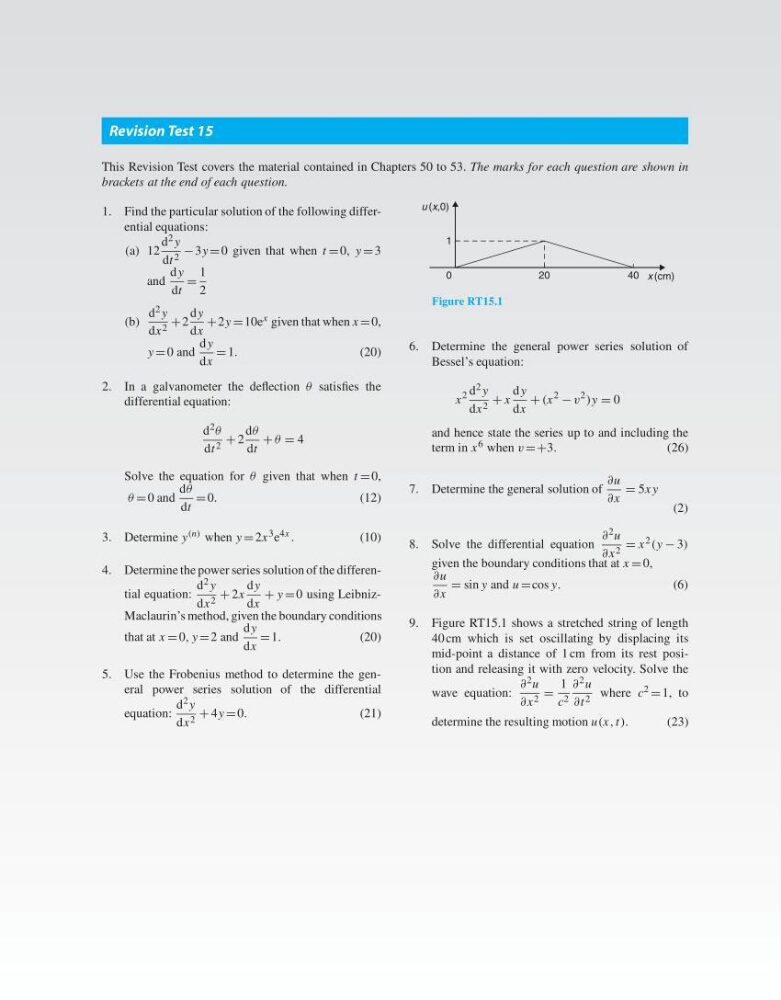
9. Figure RT15.1 shows a stretched string of length
40 cm which is set oscillating by displacing its
mid-point a distance of 1 cm from its rest position and releasing it with zero velocity. Solve the
wave equation:
∂ 2 u
∂x 2 =
1
c 2
∂ 2 u
∂t 2 where c 2 = 1, to
determine the resulting motion u(x, t ).
(23)
This Revision Test covers the material contained in Chapters 50 to 53. The marks for each question are shown in
brackets at the end of each question.
1. Find the particular solution of the following differential equations:
(a) 12
d 2 y
dt 2 − 3y = 0 given that when t = 0, y = 3
and
d y
dt
=
1
2
(b)
d 2 y
dx 2 + 2
d y
dx
+ 2y = 10e x given that when x = 0,
y = 0 and
d y
dx
= 1.
(20)
2. In a galvanometer the deflection θ satisfies the
differential equation:
d 2 θ
dt 2 + 2
dθ
dt
+ θ = 4
Solve the equation for θ given that when t = 0,
θ = 0 and
dθ
dt
= 0.
(12)
3. Determine y (n) when y = 2x 3 e 4x .
(10)
4. Determine the power series solution of the differential equation:
d 2 y
dx 2 + 2x
d y
dx
+ y = 0 using LeibnizMaclaurin’s method, given the boundary conditions
that at x = 0, y = 2 and
d y
dx
= 1.
(20)
5. Use the Frobenius method to determine the general power series solution of the differential
equation:
d 2 y
dx 2 + 4y = 0.
(21)
20
0
1
40 x (cm)
u (x,0)
Figure RT15.1
6. Determine the general power series solution of
Bessel’s equation:
x
2 d 2 y
dx 2 + x
d y
dx
+ (x
2
− v
2
)y = 0
and hence state the series up to and including the
term in x 6 when v =+3.
(26)
7. Determine the general solution of
∂u
∂x
= 5x y
(2)
8. Solve the differential equation
∂ 2 u
∂x 2 = x 2 (y − 3)
given the boundary conditions that at x = 0,
∂u
∂x
= sin y and u =cos y.
( 6 )
9. Figure RT15.1 shows a stretched string of length
40 cm which is set oscillating by displacing its
mid-point a distance of 1 cm from its rest position and releasing it with zero velocity. Solve the
wave equation:
∂ 2 u
∂x 2 =
1
c 2
∂ 2 u
∂t 2 where c 2 = 1, to
determine the resulting motion u(x, t ).
(23)