

34 Higher Engineering Mathematics
11. 5 = 8
1 − e
−x
2
[1.962]
12. ln(x + 3) − ln x = ln(x − 1)
[3]
13. ln(x − 1) 2 − ln 3 = ln(x − 1)
[4]
14. ln(x + 3) + 2 = 12 − ln(x − 2)
[147.9]
15. e (x+1) = 3e (2x−5)
[4.901]
16. ln(x + 1) 2 = 1.5 − ln(x − 2)
+ ln(x + 1)
[3.095]
17. Transpose: b = ln t − a ln D to make t the
subject.
[t = e b+a ln D = e b e a ln D = e b e ln D a
i.e. t = e b D a ]
18. If
P
Q
= 10 log 10
R 1
R 2
find the value of R 1
when P = 160, Q = 8 and R 2 = 5.
[500]
19. If U 2 = U 1 e
W
P V
make W the subject of the
formula.
W = PV ln
U 2
U 1
20. The work done in an isothermal expansion of
a gas from pressure p 1 to p 2 is given by:
w = w 0 ln
p 1
p 2
If the initial pressure p 1 = 7.0 kPa, calculate
the final pressure p 2 if w = 3 w 0 .
[ p 2 = 348.5 Pa]
4.5 Laws of growth and decay
The laws of exponential growth and decay are of the
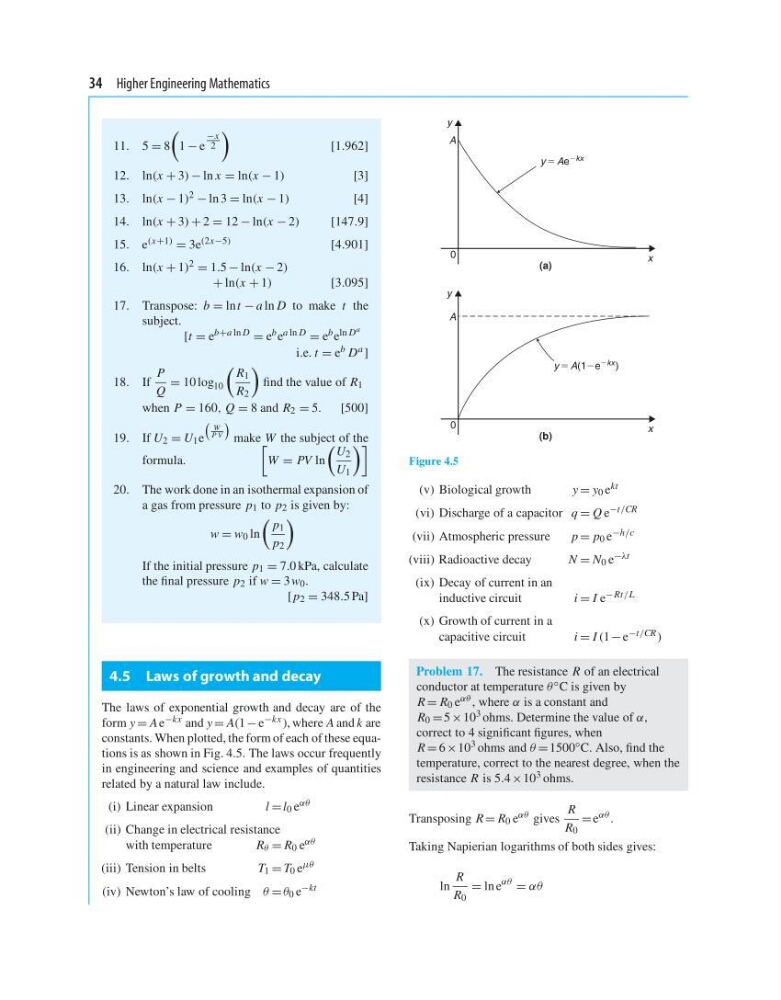
form y = A e −kx and y = A(1 − e −kx ), where A and k are
constants. When plotted, the form of each of these equations is as shown in Fig. 4.5. The laws occur frequently
in engineering and science and examples of quantities
related by a natural law include.
(i) Linear expansion
l = l 0 e αθ
(ii) Change in electrical resistance
with temperature
R θ = R 0 e αθ
(iii) Tension in belts
T 1 = T 0 e μθ
(iv) Newton’s law of cooling θ = θ 0 e
−kt
(a)
y
x
A
0
y 5 Ae
2kx
(b)
y
x
A
0
y 5 A(12e 2kx )
Figure 4.5
(v) Biological growth
y = y 0 e kt
(vi) Discharge of a capacitor q = Q e −t/CR
(vii) Atmospheric pressure
p = p 0 e −h/c
(viii) Radioactive decay
N = N 0 e −λt
(ix) Decay of current in an
inductive circuit
i = I e − Rt/L
(x) Growth of current in a
capacitive circuit
i = I (1 − e −t/CR )
Problem 17. The resistance R of an electrical
conductor at temperature θ ◦ C is given by
R = R 0 e αθ , where α is a constant and
R 0 = 5 × 10 3 ohms. Determine the value of α,
correct to 4 significant figures, when
R = 6 ×10 3 ohms and θ = 1500 ◦ C. Also, find the
temperature, correct to the nearest degree, when the
resistance R is 5.4 ×10 3 ohms.
Transposing R = R 0 e αθ gives
R
R 0
= e αθ .
Taking Napierian logarithms of both sides gives:
ln
R
R 0
= ln e
αθ
= αθ
11. 5 = 8
1 − e
−x
2
[1.962]
12. ln(x + 3) − ln x = ln(x − 1)
[3]
13. ln(x − 1) 2 − ln 3 = ln(x − 1)
[4]
14. ln(x + 3) + 2 = 12 − ln(x − 2)
[147.9]
15. e (x+1) = 3e (2x−5)
[4.901]
16. ln(x + 1) 2 = 1.5 − ln(x − 2)
+ ln(x + 1)
[3.095]
17. Transpose: b = ln t − a ln D to make t the
subject.
[t = e b+a ln D = e b e a ln D = e b e ln D a
i.e. t = e b D a ]
18. If
P
Q
= 10 log 10
R 1
R 2
find the value of R 1
when P = 160, Q = 8 and R 2 = 5.
[500]
19. If U 2 = U 1 e
W
P V
make W the subject of the
formula.
W = PV ln
U 2
U 1
20. The work done in an isothermal expansion of
a gas from pressure p 1 to p 2 is given by:
w = w 0 ln
p 1
p 2
If the initial pressure p 1 = 7.0 kPa, calculate
the final pressure p 2 if w = 3 w 0 .
[ p 2 = 348.5 Pa]
4.5 Laws of growth and decay
The laws of exponential growth and decay are of the
form y = A e −kx and y = A(1 − e −kx ), where A and k are
constants. When plotted, the form of each of these equations is as shown in Fig. 4.5. The laws occur frequently
in engineering and science and examples of quantities
related by a natural law include.
(i) Linear expansion
l = l 0 e αθ
(ii) Change in electrical resistance
with temperature
R θ = R 0 e αθ
(iii) Tension in belts
T 1 = T 0 e μθ
(iv) Newton’s law of cooling θ = θ 0 e
−kt
(a)
y
x
A
0
y 5 Ae
2kx
(b)
y
x
A
0
y 5 A(12e 2kx )
Figure 4.5
(v) Biological growth
y = y 0 e kt
(vi) Discharge of a capacitor q = Q e −t/CR
(vii) Atmospheric pressure
p = p 0 e −h/c
(viii) Radioactive decay
N = N 0 e −λt
(ix) Decay of current in an
inductive circuit
i = I e − Rt/L
(x) Growth of current in a
capacitive circuit
i = I (1 − e −t/CR )
Problem 17. The resistance R of an electrical
conductor at temperature θ ◦ C is given by
R = R 0 e αθ , where α is a constant and
R 0 = 5 × 10 3 ohms. Determine the value of α,
correct to 4 significant figures, when
R = 6 ×10 3 ohms and θ = 1500 ◦ C. Also, find the
temperature, correct to the nearest degree, when the
resistance R is 5.4 ×10 3 ohms.
Transposing R = R 0 e αθ gives
R
R 0
= e αθ .
Taking Napierian logarithms of both sides gives:
ln
R
R 0
= ln e
αθ
= αθ