

506 Higher Engineering Mathematics
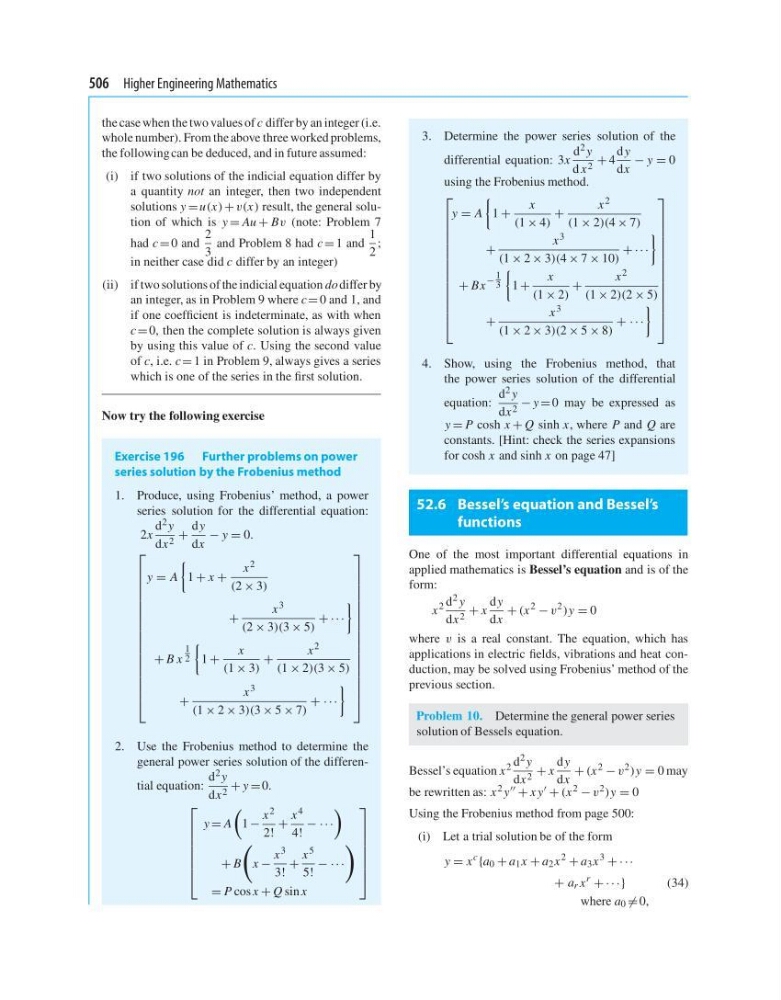
the case when the two values of c differ by an integer (i.e.
whole number). From the above three worked problems,
the following can be deduced, and in future assumed:
(i) if two solutions of the indicial equation differ by
a quantity not an integer, then two independent
solutions y = u(x) + v(x) result, the general solution of which is y = Au + Bv (note: Problem 7
had c = 0 and
2
3
and Problem 8 had c = 1 and
1
2
;
in neither case did c differ by an integer)
(ii) if two solutions of the indicial equation do differ by
an integer, as in Problem 9 where c = 0 and 1, and
if one coefficient is indeterminate, as with when
c = 0, then the complete solution is always given
by using this value of c. Using the second value
of c, i.e. c = 1 in Problem 9, always gives a series
which is one of the series in the first solution.
Now try the following exercise
Exercise 196 Further problems on power
series solution by the Frobenius method
1. Produce, using Frobenius’ method, a power
series solution for the differential equation:
2x
d 2 y
dx 2 +
d y
dx
− y = 0.
⎡
⎢
⎢
⎢
⎢
⎢
⎢
⎢
⎢
⎢
⎢
⎢
⎢
⎢
⎢
⎢
⎢
⎣
y = A
1 + x +
x 2
(2 × 3)
+
x 3
(2 × 3)(3 × 5)
+ · · ·
+ B x
1
2
1 +
x
(1 × 3)
+
x
2
(1 × 2)(3 × 5)
+
x 3
(1 × 2 × 3)(3 × 5 × 7)
+ · · ·
⎤
⎥
⎥
⎥
⎥
⎥
⎥
⎥
⎥
⎥
⎥
⎥
⎥
⎥
⎥
⎥
⎥
⎦
2. Use the Frobenius method to determine the
general power series solution of the differential equation:
d 2 y
dx 2 + y = 0.
⎡
⎢
⎢
⎢
⎢
⎢
⎢
⎣
y = A
1 −
x 2
2!
+
x 4
4!
− · · ·
+ B
x −
x
3
3!
+
x
5
5!
− · · ·
= P cos x + Q sin x
⎤
⎥
⎥
⎥
⎥
⎥
⎥
⎦
3. Determine the power series solution of the
differential equation: 3x
d 2 y
d x 2 + 4
d y
dx
− y = 0
using the Frobenius method.
⎡
⎢
⎢
⎢
⎢
⎢
⎢
⎢
⎢
⎢
⎢
⎢
⎢
⎢
⎣
y = A
1 +
x
(1 × 4)
+
x 2
(1 × 2)(4 × 7)
+
x 3
(1 × 2 × 3)(4 × 7 × 10)
+ · · ·
+ Bx
−
1
3
1 +
x
(1 × 2)
+
x 2
(1 × 2)(2 × 5)
+
x 3
(1 × 2 × 3)(2 × 5 × 8)
+ · · ·
⎤
⎥
⎥
⎥
⎥
⎥
⎥
⎥
⎥
⎥
⎥
⎥
⎥
⎥
⎦
4. Show, using the Frobenius method, that
the power series solution of the differential
equation:
d 2 y
dx 2 − y = 0 may be expressed as
y = P cosh x + Q sinh x, where P and Q are
constants. [Hint: check the series expansions
for cosh x and sinh x on page 47]
52.6 Bessel’s equation and Bessel’s
functions
One of the most important differential equations in
applied mathematics is Bessel’s equation and is of the
form:
x
2 d 2 y
dx 2 + x
d y
dx
+ (x
2
− v
2
)y = 0
where v is a real constant. The equation, which has
applications in electric fields, vibrations and heat conduction, may be solved using Frobenius’ method of the
previous section.
Problem 10. Determine the general power series
solution of Bessels equation.
Bessel’s equation x 2 d
2 y
dx 2 + x
d y
dx
+ (x 2 − v 2 )y = 0 may
be rewritten as: x 2 y + x y + (x 2 − v 2 )y = 0
Using the Frobenius method from page 500:
(i) Let a trial solution be of the form
y = x
c
{a 0 + a 1 x + a 2 x
2
+ a 3 x
3
+ · · ·
+ a r x
r
+ · · ·}
(34)
where a 0 = 0,
the case when the two values of c differ by an integer (i.e.
whole number). From the above three worked problems,
the following can be deduced, and in future assumed:
(i) if two solutions of the indicial equation differ by
a quantity not an integer, then two independent
solutions y = u(x) + v(x) result, the general solution of which is y = Au + Bv (note: Problem 7
had c = 0 and
2
3
and Problem 8 had c = 1 and
1
2
;
in neither case did c differ by an integer)
(ii) if two solutions of the indicial equation do differ by
an integer, as in Problem 9 where c = 0 and 1, and
if one coefficient is indeterminate, as with when
c = 0, then the complete solution is always given
by using this value of c. Using the second value
of c, i.e. c = 1 in Problem 9, always gives a series
which is one of the series in the first solution.
Now try the following exercise
Exercise 196 Further problems on power
series solution by the Frobenius method
1. Produce, using Frobenius’ method, a power
series solution for the differential equation:
2x
d 2 y
dx 2 +
d y
dx
− y = 0.
⎡
⎢
⎢
⎢
⎢
⎢
⎢
⎢
⎢
⎢
⎢
⎢
⎢
⎢
⎢
⎢
⎢
⎣
y = A
1 + x +
x 2
(2 × 3)
+
x 3
(2 × 3)(3 × 5)
+ · · ·
+ B x
1
2
1 +
x
(1 × 3)
+
x
2
(1 × 2)(3 × 5)
+
x 3
(1 × 2 × 3)(3 × 5 × 7)
+ · · ·
⎤
⎥
⎥
⎥
⎥
⎥
⎥
⎥
⎥
⎥
⎥
⎥
⎥
⎥
⎥
⎥
⎥
⎦
2. Use the Frobenius method to determine the
general power series solution of the differential equation:
d 2 y
dx 2 + y = 0.
⎡
⎢
⎢
⎢
⎢
⎢
⎢
⎣
y = A
1 −
x 2
2!
+
x 4
4!
− · · ·
+ B
x −
x
3
3!
+
x
5
5!
− · · ·
= P cos x + Q sin x
⎤
⎥
⎥
⎥
⎥
⎥
⎥
⎦
3. Determine the power series solution of the
differential equation: 3x
d 2 y
d x 2 + 4
d y
dx
− y = 0
using the Frobenius method.
⎡
⎢
⎢
⎢
⎢
⎢
⎢
⎢
⎢
⎢
⎢
⎢
⎢
⎢
⎣
y = A
1 +
x
(1 × 4)
+
x 2
(1 × 2)(4 × 7)
+
x 3
(1 × 2 × 3)(4 × 7 × 10)
+ · · ·
+ Bx
−
1
3
1 +
x
(1 × 2)
+
x 2
(1 × 2)(2 × 5)
+
x 3
(1 × 2 × 3)(2 × 5 × 8)
+ · · ·
⎤
⎥
⎥
⎥
⎥
⎥
⎥
⎥
⎥
⎥
⎥
⎥
⎥
⎥
⎦
4. Show, using the Frobenius method, that
the power series solution of the differential
equation:
d 2 y
dx 2 − y = 0 may be expressed as
y = P cosh x + Q sinh x, where P and Q are
constants. [Hint: check the series expansions
for cosh x and sinh x on page 47]
52.6 Bessel’s equation and Bessel’s
functions
One of the most important differential equations in
applied mathematics is Bessel’s equation and is of the
form:
x
2 d 2 y
dx 2 + x
d y
dx
+ (x
2
− v
2
)y = 0
where v is a real constant. The equation, which has
applications in electric fields, vibrations and heat conduction, may be solved using Frobenius’ method of the
previous section.
Problem 10. Determine the general power series
solution of Bessels equation.
Bessel’s equation x 2 d
2 y
dx 2 + x
d y
dx
+ (x 2 − v 2 )y = 0 may
be rewritten as: x 2 y + x y + (x 2 − v 2 )y = 0
Using the Frobenius method from page 500:
(i) Let a trial solution be of the form
y = x
c
{a 0 + a 1 x + a 2 x
2
+ a 3 x
3
+ · · ·
+ a r x
r
+ · · ·}
(34)
where a 0 = 0,