

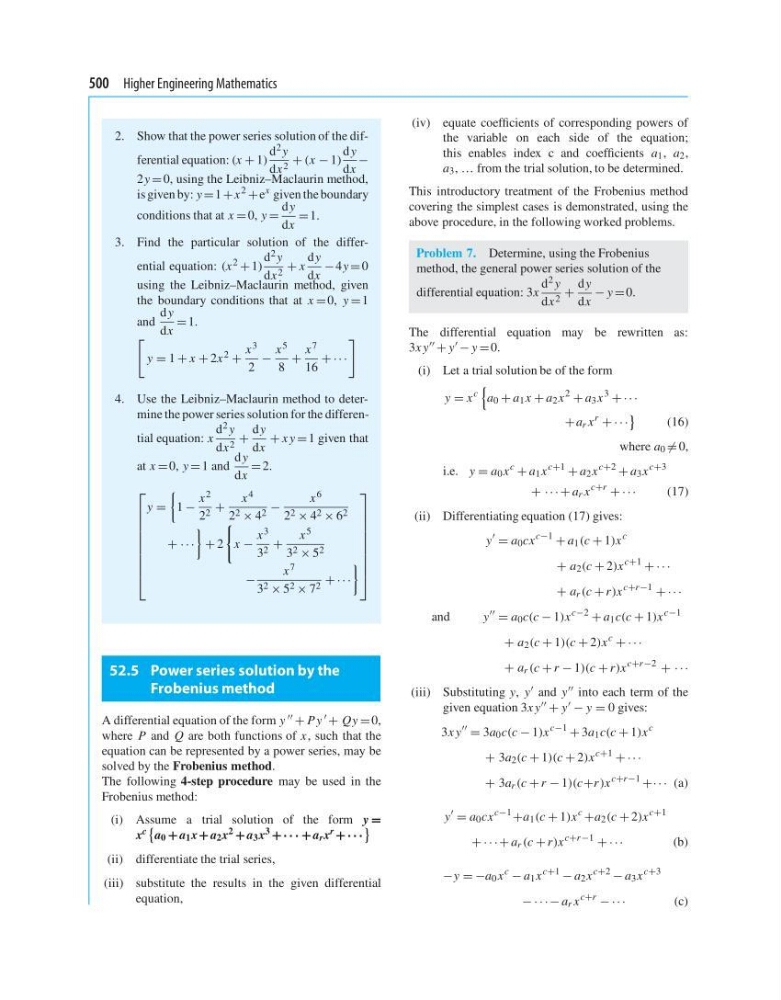
500 Higher Engineering Mathematics
2. Show that the power series solution of the differential equation: (x + 1)
d 2 y
dx 2 + (x − 1)
d y
dx
−
2y = 0, using the Leibniz–Maclaurin method,
is given by: y = 1 + x
2
+ e
x given the boundary
conditions that at x = 0, y =
d y
dx
= 1.
3. Find the particular solution of the differential equation: (x 2 + 1)
d 2 y
dx 2 + x
d y
dx
− 4y = 0
using the Leibniz–Maclaurin method, given
the boundary conditions that at x = 0, y = 1
and
d y
dx
= 1.
y = 1 + x + 2x 2 +
x 3
2
−
x 5
8
+
x 7
16
+ · · ·
4. Use the Leibniz–Maclaurin method to determine the power series solution for the differential equation: x
d 2 y
dx 2 +
d y
dx
+ x y = 1 given that
at x = 0, y = 1 and
d y
dx
= 2.
⎡
⎢
⎢
⎢
⎢
⎢
⎢
⎢
⎢
⎣
y =
1 −
x 2
2 2 +
x 4
2 2 × 4 2 −
x 6
2 2 × 4 2 × 6 2
+ · · ·
+ 2
x −
x 3
3 2 +
x 5
3 2 × 5 2
−
x 7
3 2 × 5 2 × 7 2 + · · ·
⎤
⎥
⎥
⎥
⎥
⎥
⎥
⎥
⎥
⎦
52.5 Power series solution by the
Frobenius method
A differential equation of the form y + P y + Qy = 0,
where P and Q are both functions of x, such that the
equation can be represented by a power series, may be
solved by the Frobenius method.
The following 4-step procedure may be used in the
Frobenius method:
(i) Assume a trial solution of the form y =
x c
a 0 + a 1 x + a 2 x 2 + a 3 x 3 +· · · +a r x r +· · ·
(ii) differentiate the trial series,
(iii) substitute the results in the given differential
equation,
(iv) equate coefficients of corresponding powers of
the variable on each side of the equation;
this enables index c and coefficients a 1 , a 2 ,
a 3 , … from the trial solution, to be determined.
This introductory treatment of the Frobenius method
covering the simplest cases is demonstrated, using the
above procedure, in the following worked problems.
Problem 7. Determine, using the Frobenius
method, the general power series solution of the
differential equation: 3x
d 2 y
dx 2 +
d y
dx
− y = 0.
The differential equation may be rewritten as:
3x y + y − y = 0.
(i) Let a trial solution be of the form
y = x
c
a 0 + a 1 x + a 2 x
2
+ a 3 x
3
+ · · ·
+ a r x
r
+ · · ·
(16)
where a 0 = 0,
i.e. y = a 0 x
c
+ a 1 x
c+1
+ a 2 x
c+2
+ a 3 x
c+3
+ · · · + a r x
c+r
+ · · ·
(17)
(ii) Differentiating equation (17) gives:
y
= a 0 cx
c−1
+ a 1 (c + 1)x
c
+ a 2 (c + 2)x
c+1
+ · · ·
+ a r (c + r)x
c+r−1
+ · · ·
and
y
= a 0 c(c − 1)x
c−2
+ a 1 c(c + 1)x
c−1
+ a 2 (c + 1)(c + 2)x
c
+ · · ·
+ a r (c + r − 1)(c + r)x
c+r−2
+ · · ·
(iii) Substituting y, y and y into each term of the
given equation 3x y + y − y = 0 gives:
3x y
= 3a 0 c(c − 1)x
c−1
+ 3a 1 c(c + 1)x
c
+ 3a 2 (c + 1)(c + 2)x
c+1
+ · · ·
+ 3a r (c + r − 1)(c+r)x
c+r−1
+· · · (a)
y
= a 0 cx
c−1
+a 1 (c + 1)x
c
+a 2 (c + 2)x
c+1
+ · · · + a r (c + r)x
c+r−1
+ · · ·
(b)
−y = −a 0 x
c
− a 1 x
c+1
− a 2 x
c+2
− a 3 x
c+3
− · · · − a r x
c+r
− · · ·
(c)
2. Show that the power series solution of the differential equation: (x + 1)
d 2 y
dx 2 + (x − 1)
d y
dx
−
2y = 0, using the Leibniz–Maclaurin method,
is given by: y = 1 + x
2
+ e
x given the boundary
conditions that at x = 0, y =
d y
dx
= 1.
3. Find the particular solution of the differential equation: (x 2 + 1)
d 2 y
dx 2 + x
d y
dx
− 4y = 0
using the Leibniz–Maclaurin method, given
the boundary conditions that at x = 0, y = 1
and
d y
dx
= 1.
y = 1 + x + 2x 2 +
x 3
2
−
x 5
8
+
x 7
16
+ · · ·
4. Use the Leibniz–Maclaurin method to determine the power series solution for the differential equation: x
d 2 y
dx 2 +
d y
dx
+ x y = 1 given that
at x = 0, y = 1 and
d y
dx
= 2.
⎡
⎢
⎢
⎢
⎢
⎢
⎢
⎢
⎢
⎣
y =
1 −
x 2
2 2 +
x 4
2 2 × 4 2 −
x 6
2 2 × 4 2 × 6 2
+ · · ·
+ 2
x −
x 3
3 2 +
x 5
3 2 × 5 2
−
x 7
3 2 × 5 2 × 7 2 + · · ·
⎤
⎥
⎥
⎥
⎥
⎥
⎥
⎥
⎥
⎦
52.5 Power series solution by the
Frobenius method
A differential equation of the form y + P y + Qy = 0,
where P and Q are both functions of x, such that the
equation can be represented by a power series, may be
solved by the Frobenius method.
The following 4-step procedure may be used in the
Frobenius method:
(i) Assume a trial solution of the form y =
x c
a 0 + a 1 x + a 2 x 2 + a 3 x 3 +· · · +a r x r +· · ·
(ii) differentiate the trial series,
(iii) substitute the results in the given differential
equation,
(iv) equate coefficients of corresponding powers of
the variable on each side of the equation;
this enables index c and coefficients a 1 , a 2 ,
a 3 , … from the trial solution, to be determined.
This introductory treatment of the Frobenius method
covering the simplest cases is demonstrated, using the
above procedure, in the following worked problems.
Problem 7. Determine, using the Frobenius
method, the general power series solution of the
differential equation: 3x
d 2 y
dx 2 +
d y
dx
− y = 0.
The differential equation may be rewritten as:
3x y + y − y = 0.
(i) Let a trial solution be of the form
y = x
c
a 0 + a 1 x + a 2 x
2
+ a 3 x
3
+ · · ·
+ a r x
r
+ · · ·
(16)
where a 0 = 0,
i.e. y = a 0 x
c
+ a 1 x
c+1
+ a 2 x
c+2
+ a 3 x
c+3
+ · · · + a r x
c+r
+ · · ·
(17)
(ii) Differentiating equation (17) gives:
y
= a 0 cx
c−1
+ a 1 (c + 1)x
c
+ a 2 (c + 2)x
c+1
+ · · ·
+ a r (c + r)x
c+r−1
+ · · ·
and
y
= a 0 c(c − 1)x
c−2
+ a 1 c(c + 1)x
c−1
+ a 2 (c + 1)(c + 2)x
c
+ · · ·
+ a r (c + r − 1)(c + r)x
c+r−2
+ · · ·
(iii) Substituting y, y and y into each term of the
given equation 3x y + y − y = 0 gives:
3x y
= 3a 0 c(c − 1)x
c−1
+ 3a 1 c(c + 1)x
c
+ 3a 2 (c + 1)(c + 2)x
c+1
+ · · ·
+ 3a r (c + r − 1)(c+r)x
c+r−1
+· · · (a)
y
= a 0 cx
c−1
+a 1 (c + 1)x
c
+a 2 (c + 2)x
c+1
+ · · · + a r (c + r)x
c+r−1
+ · · ·
(b)
−y = −a 0 x
c
− a 1 x
c+1
− a 2 x
c+2
− a 3 x
c+3
− · · · − a r x
c+r
− · · ·
(c)