

498 Higher Engineering Mathematics
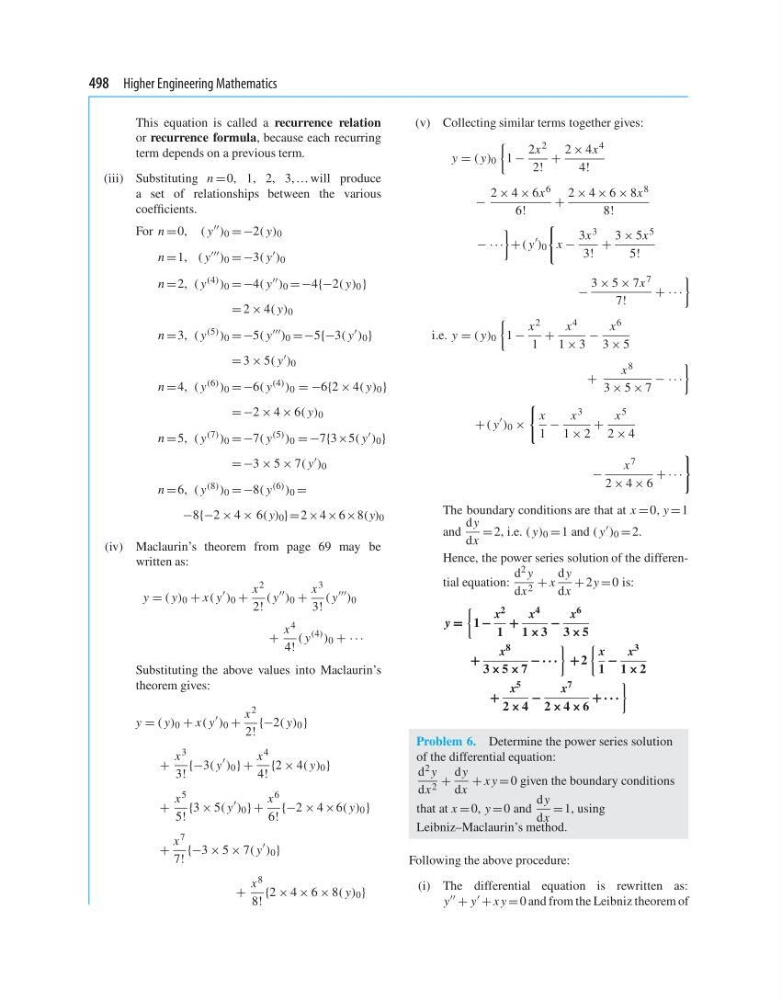
This equation is called a recurrence relation
or recurrence formula, because each recurring
term depends on a previous term.
(iii) Substituting n =0, 1, 2, 3, … will produce
a set of relationships between the various
coefficients.
For n =0, ( y ) 0 = −2( y) 0
n =1, ( y ) 0 = −3( y ) 0
n =2, ( y (4) ) 0 = −4( y ) 0 =−4{−2( y) 0 }
= 2 × 4( y) 0
n =3, ( y (5) ) 0 = −5( y ) 0 =−5{−3( y ) 0 }
= 3 × 5( y ) 0
n =4, ( y (6) ) 0 = −6( y (4) ) 0 = −6{2 × 4( y) 0 }
= −2 × 4 × 6( y) 0
n =5, ( y (7) ) 0 = −7( y (5) ) 0 = −7{3×5( y ) 0 }
= −3 × 5 × 7( y ) 0
n =6, ( y (8) ) 0 = −8( y (6) ) 0 =
−8{−2 × 4 × 6( y) 0 }= 2 × 4 × 6×8(y) 0
(iv) Maclaurin’s theorem from page 69 may be
written as:
y = ( y) 0 + x( y
) 0 +
x 2
2!
( y
) 0 +
x 3
3!
( y
) 0
+
x 4
4!
( y
(4)
) 0 + · · ·
Substituting the above values into Maclaurin’s
theorem gives:
y = ( y) 0 + x( y
) 0 +
x 2
2!
{−2( y) 0 }
+
x 3
3!
{−3( y
) 0 } +
x 4
4!
{2 × 4( y) 0 }
+
x 5
5!
{3 × 5( y
) 0 } +
x 6
6!
{−2 × 4 ×6( y) 0 }
+
x
7
7!
{−3 × 5 × 7( y
) 0 }
+
x 8
8!
{2 × 4 × 6 × 8( y) 0 }
(v) Collecting similar terms together gives:
y = ( y) 0
1 −
2x 2
2!
+
2 × 4x 4
4!
−
2 × 4 × 6x 6
6!
+
2 × 4 × 6 × 8x 8
8!
− · · ·
+ ( y
) 0
x −
3x 3
3!
+
3 × 5x 5
5!
−
3 × 5 × 7x 7
7!
+ · · ·
i.e. y = ( y) 0
1 −
x 2
1
+
x 4
1 × 3
−
x 6
3 × 5
+
x 8
3 × 5 × 7
− · · ·
+ ( y
) 0 ×
x
1
−
x 3
1 × 2
+
x 5
2 × 4
−
x 7
2 × 4 × 6
+ · · ·
The boundary conditions are that at x = 0, y = 1
and
d y
dx
= 2, i.e. ( y) 0 = 1 and ( y ) 0 = 2.
Hence, the power series solution of the differential equation:
d 2 y
dx 2 + x
d y
dx
+ 2y = 0 is:
y =
1 −
x 2
1
+
x 4
1 ×3
−
x 6
3 ×5
+
x 8
3 ×5 × 7
−· · ·
+ 2
x
1
−
x 3
1 × 2
+
x 5
2 × 4
−
x 7
2 × 4 × 6
+· · ·
Problem 6. Determine the power series solution
of the differential equation:
d 2 y
dx 2 +
d y
dx
+ x y = 0 given the boundary conditions
that at x = 0, y = 0 and
d y
dx
= 1, using
Leibniz–Maclaurin’s method.
Following the above procedure:
(i) The differential equation is rewritten as:
y + y + x y = 0 and from the Leibniz theorem of
This equation is called a recurrence relation
or recurrence formula, because each recurring
term depends on a previous term.
(iii) Substituting n =0, 1, 2, 3, … will produce
a set of relationships between the various
coefficients.
For n =0, ( y ) 0 = −2( y) 0
n =1, ( y ) 0 = −3( y ) 0
n =2, ( y (4) ) 0 = −4( y ) 0 =−4{−2( y) 0 }
= 2 × 4( y) 0
n =3, ( y (5) ) 0 = −5( y ) 0 =−5{−3( y ) 0 }
= 3 × 5( y ) 0
n =4, ( y (6) ) 0 = −6( y (4) ) 0 = −6{2 × 4( y) 0 }
= −2 × 4 × 6( y) 0
n =5, ( y (7) ) 0 = −7( y (5) ) 0 = −7{3×5( y ) 0 }
= −3 × 5 × 7( y ) 0
n =6, ( y (8) ) 0 = −8( y (6) ) 0 =
−8{−2 × 4 × 6( y) 0 }= 2 × 4 × 6×8(y) 0
(iv) Maclaurin’s theorem from page 69 may be
written as:
y = ( y) 0 + x( y
) 0 +
x 2
2!
( y
) 0 +
x 3
3!
( y
) 0
+
x 4
4!
( y
(4)
) 0 + · · ·
Substituting the above values into Maclaurin’s
theorem gives:
y = ( y) 0 + x( y
) 0 +
x 2
2!
{−2( y) 0 }
+
x 3
3!
{−3( y
) 0 } +
x 4
4!
{2 × 4( y) 0 }
+
x 5
5!
{3 × 5( y
) 0 } +
x 6
6!
{−2 × 4 ×6( y) 0 }
+
x
7
7!
{−3 × 5 × 7( y
) 0 }
+
x 8
8!
{2 × 4 × 6 × 8( y) 0 }
(v) Collecting similar terms together gives:
y = ( y) 0
1 −
2x 2
2!
+
2 × 4x 4
4!
−
2 × 4 × 6x 6
6!
+
2 × 4 × 6 × 8x 8
8!
− · · ·
+ ( y
) 0
x −
3x 3
3!
+
3 × 5x 5
5!
−
3 × 5 × 7x 7
7!
+ · · ·
i.e. y = ( y) 0
1 −
x 2
1
+
x 4
1 × 3
−
x 6
3 × 5
+
x 8
3 × 5 × 7
− · · ·
+ ( y
) 0 ×
x
1
−
x 3
1 × 2
+
x 5
2 × 4
−
x 7
2 × 4 × 6
+ · · ·
The boundary conditions are that at x = 0, y = 1
and
d y
dx
= 2, i.e. ( y) 0 = 1 and ( y ) 0 = 2.
Hence, the power series solution of the differential equation:
d 2 y
dx 2 + x
d y
dx
+ 2y = 0 is:
y =
1 −
x 2
1
+
x 4
1 ×3
−
x 6
3 ×5
+
x 8
3 ×5 × 7
−· · ·
+ 2
x
1
−
x 3
1 × 2
+
x 5
2 × 4
−
x 7
2 × 4 × 6
+· · ·
Problem 6. Determine the power series solution
of the differential equation:
d 2 y
dx 2 +
d y
dx
+ x y = 0 given the boundary conditions
that at x = 0, y = 0 and
d y
dx
= 1, using
Leibniz–Maclaurin’s method.
Following the above procedure:
(i) The differential equation is rewritten as:
y + y + x y = 0 and from the Leibniz theorem of