

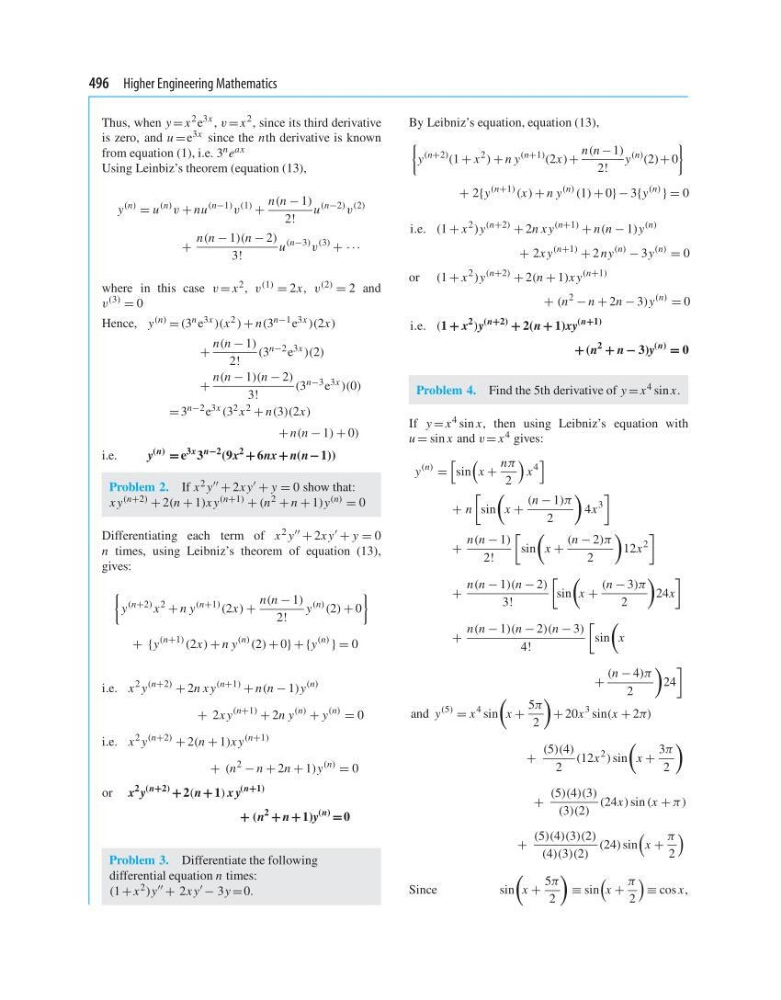
496 Higher Engineering Mathematics
Thus, when y = x
2 e
3x , v = x
2 , since its third derivative
is zero, and u = e 3x since the nth derivative is known
from equation (1), i.e. 3 n e ax
Using Leinbiz’s theorem (equation (13),
y
(n)
= u
(n)
v + nu
(n−1)
v
(1)
+
n(n − 1)
2!
u
(n−2)
v
(2)
+
n(n − 1)(n − 2)
3!
u
(n−3)
v
(3)
+ · · ·
where in this case v = x 2 , v (1) = 2x, v (2) = 2 and
v
(3)
= 0
Hence, y (n) = (3 n e 3x )(x 2 ) + n(3 n−1 e 3x )(2x)
+
n(n − 1)
2!
(3 n−2 e 3x )(2)
+
n(n − 1)(n − 2)
3!
(3 n−3 e 3x )(0)
= 3 n−2 e 3x (3 2 x 2 + n(3)(2x)
+ n(n − 1) + 0)
i.e.
y
(n)
= e
3x 3
n−2 (9x
2
+ 6nx + n(n− 1))
Problem 2. If x 2 y + 2x y + y = 0 show that:
x y (n+2) + 2(n + 1)x y (n+1) + (n 2 + n + 1)y (n) = 0
Differentiating each term of x 2 y + 2x y + y = 0
n times, using Leibniz’s theorem of equation (13),
gives:
y
(n+2) x
2
+ n y
(n+1)
(2x) +
n(n − 1)
2!
y
(n)
(2) + 0
+ {y
(n+1)
(2x) + n y
(n)
(2) + 0} + {y
(n)
} = 0
i.e. x
2 y
(n+2)
+ 2n x y
(n+1)
+ n(n − 1)y
(n)
+ 2x y
(n+1)
+ 2n y
(n)
+ y
(n)
= 0
i.e. x
2 y
(n+2)
+ 2(n + 1)x y
(n+1)
+ (n
2
− n + 2n + 1)y
(n)
= 0
or x
2 y
(n+2)
+ 2(n + 1) x y
(n+1)
+ (n
2
+ n + 1)y
(n)
= 0
Problem 3. Differentiate the following
differential equation n times:
(1 + x 2 )y + 2x y − 3y = 0.
By Leibniz’s equation, equation (13),
y
(n+2)
(1 + x
2
) + n y
(n+1)
(2x)+
n(n − 1)
2!
y
(n)
(2)+ 0
+ 2{y
(n+1)
(x) + n y
(n)
(1) + 0} − 3{y
(n)
} = 0
i.e. (1 + x
2
)y
(n+2)
+ 2n x y
(n+1)
+ n(n − 1)y
(n)
+ 2x y
(n+1)
+ 2 ny
(n)
− 3y
(n)
= 0
or (1 + x
2
)y
(n+2)
+ 2(n + 1)x y
(n+1)
+ (n
2
− n + 2n − 3)y
(n)
= 0
i.e. (1 + x
2
)y
(n+2)
+ 2(n + 1)xy
(n+1)
+ (n
2
+ n − 3)y
(n)
= 0
Problem 4. Find the 5th derivative of y = x 4 sin x.
If y = x 4 sin x, then using Leibniz’s equation with
u = sin x and v = x 4 gives:
y
(n)
=
sin
x +
nπ
2
x
4
+ n
sin
x +
(n − 1)π
2
4x
3
+
n(n − 1)
2!
sin
x +
(n − 2)π
2
12x
2
+
n(n − 1)(n − 2)
3!
sin
x +
(n − 3)π
2
24x
+
n(n − 1)(n − 2)(n − 3)
4!
sin
x
+
(n − 4)π
2
24
and y
(5)
= x
4 sin
x +
5π
2
+ 20x
3 sin(x + 2π)
+
(5)(4)
2
(12x
2
) sin
x +
3π
2
+
(5)(4)(3)
(3)(2)
(24x) sin (x + π)
+
(5)(4)(3)(2)
(4)(3)(2)
(24) sin
x +
π
2
Since
sin
x +
5π
2
≡ sin
x +
π
2
≡ cos x,
Thus, when y = x
2 e
3x , v = x
2 , since its third derivative
is zero, and u = e 3x since the nth derivative is known
from equation (1), i.e. 3 n e ax
Using Leinbiz’s theorem (equation (13),
y
(n)
= u
(n)
v + nu
(n−1)
v
(1)
+
n(n − 1)
2!
u
(n−2)
v
(2)
+
n(n − 1)(n − 2)
3!
u
(n−3)
v
(3)
+ · · ·
where in this case v = x 2 , v (1) = 2x, v (2) = 2 and
v
(3)
= 0
Hence, y (n) = (3 n e 3x )(x 2 ) + n(3 n−1 e 3x )(2x)
+
n(n − 1)
2!
(3 n−2 e 3x )(2)
+
n(n − 1)(n − 2)
3!
(3 n−3 e 3x )(0)
= 3 n−2 e 3x (3 2 x 2 + n(3)(2x)
+ n(n − 1) + 0)
i.e.
y
(n)
= e
3x 3
n−2 (9x
2
+ 6nx + n(n− 1))
Problem 2. If x 2 y + 2x y + y = 0 show that:
x y (n+2) + 2(n + 1)x y (n+1) + (n 2 + n + 1)y (n) = 0
Differentiating each term of x 2 y + 2x y + y = 0
n times, using Leibniz’s theorem of equation (13),
gives:
y
(n+2) x
2
+ n y
(n+1)
(2x) +
n(n − 1)
2!
y
(n)
(2) + 0
+ {y
(n+1)
(2x) + n y
(n)
(2) + 0} + {y
(n)
} = 0
i.e. x
2 y
(n+2)
+ 2n x y
(n+1)
+ n(n − 1)y
(n)
+ 2x y
(n+1)
+ 2n y
(n)
+ y
(n)
= 0
i.e. x
2 y
(n+2)
+ 2(n + 1)x y
(n+1)
+ (n
2
− n + 2n + 1)y
(n)
= 0
or x
2 y
(n+2)
+ 2(n + 1) x y
(n+1)
+ (n
2
+ n + 1)y
(n)
= 0
Problem 3. Differentiate the following
differential equation n times:
(1 + x 2 )y + 2x y − 3y = 0.
By Leibniz’s equation, equation (13),
y
(n+2)
(1 + x
2
) + n y
(n+1)
(2x)+
n(n − 1)
2!
y
(n)
(2)+ 0
+ 2{y
(n+1)
(x) + n y
(n)
(1) + 0} − 3{y
(n)
} = 0
i.e. (1 + x
2
)y
(n+2)
+ 2n x y
(n+1)
+ n(n − 1)y
(n)
+ 2x y
(n+1)
+ 2 ny
(n)
− 3y
(n)
= 0
or (1 + x
2
)y
(n+2)
+ 2(n + 1)x y
(n+1)
+ (n
2
− n + 2n − 3)y
(n)
= 0
i.e. (1 + x
2
)y
(n+2)
+ 2(n + 1)xy
(n+1)
+ (n
2
+ n − 3)y
(n)
= 0
Problem 4. Find the 5th derivative of y = x 4 sin x.
If y = x 4 sin x, then using Leibniz’s equation with
u = sin x and v = x 4 gives:
y
(n)
=
sin
x +
nπ
2
x
4
+ n
sin
x +
(n − 1)π
2
4x
3
+
n(n − 1)
2!
sin
x +
(n − 2)π
2
12x
2
+
n(n − 1)(n − 2)
3!
sin
x +
(n − 3)π
2
24x
+
n(n − 1)(n − 2)(n − 3)
4!
sin
x
+
(n − 4)π
2
24
and y
(5)
= x
4 sin
x +
5π
2
+ 20x
3 sin(x + 2π)
+
(5)(4)
2
(12x
2
) sin
x +
3π
2
+
(5)(4)(3)
(3)(2)
(24x) sin (x + π)
+
(5)(4)(3)(2)
(4)(3)(2)
(24) sin
x +
π
2
Since
sin
x +
5π
2
≡ sin
x +
π
2
≡ cos x,