

484 Higher Engineering Mathematics
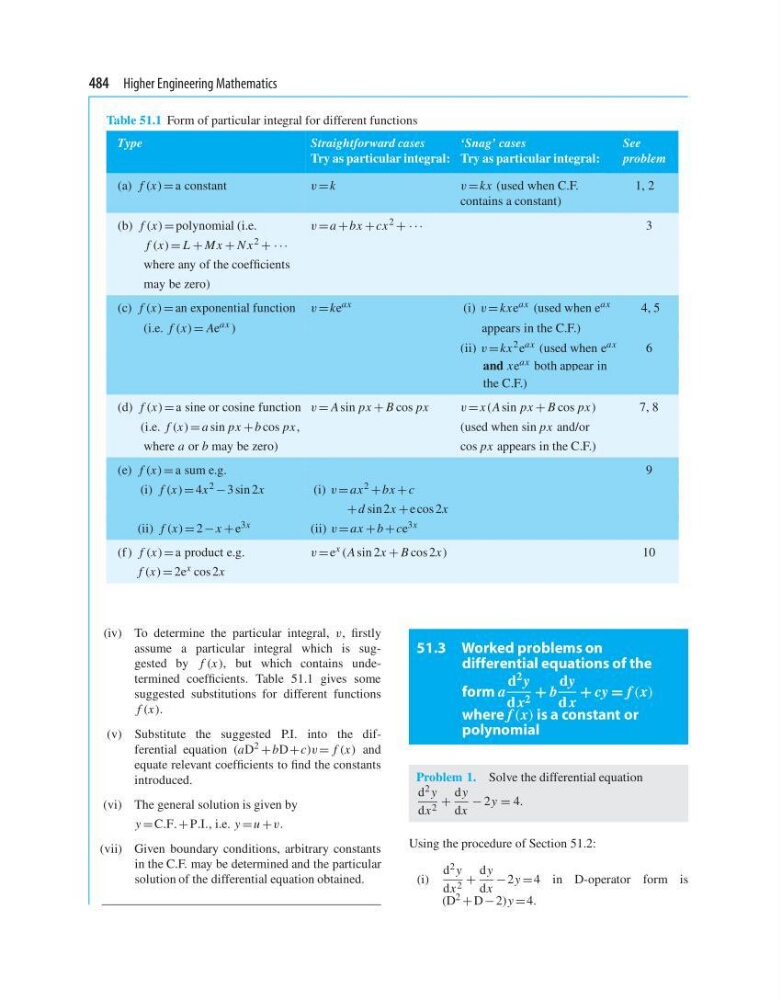
Table 51.1 Form of particular integral for different functions
Type
Straightforward cases
Try as particular integral:
‘Snag’ cases
Try as particular integral:
See
problem
(a) f (x) = a constant
v = k
v = kx (used when C.F.
contains a constant)
1, 2
(b) f (x) = polynomial (i.e.
v = a + bx + cx 2 + · · ·
3
f (x) = L + Mx + N x 2 + · · ·
where any of the coefficients
may be zero)
(c) f (x) = an exponential function v = ke ax
(i) v = kxe ax (used when e ax
4, 5
(i.e. f (x) = Ae ax )
appears in the C.F.)
(ii) v = kx 2 e ax (used when e ax
6
and xe ax both appear in
the C.F.)
(d) f (x) = a sine or cosine function v = A sin px + B cos px
v = x(A sin px + B cos px)
7, 8
(i.e. f (x) = a sin px + b cos px,
(used when sin px and/or
where a or b may be zero)
cos px appears in the C.F.)
(e) f (x) = a sum e.g.
9
(i) f (x) = 4x 2 − 3 sin 2x
(i) v = ax 2 + bx + c
+ d sin 2x + ecos 2x
(ii) f (x) = 2 − x + e 3x
(ii) v = ax + b + ce 3x
(f ) f (x) = a product e.g.
v = e x (A sin 2x + B cos 2x)
10
f (x) = 2e x cos 2x
(iv) To determine the particular integral, v, firstly
assume a particular integral which is suggested by f (x), but which contains undetermined coefficients. Table 51.1 gives some
suggested substitutions for different functions
f (x).
(v) Substitute the suggested P.I. into the differential equation (aD 2 + bD +c)v = f (x) and
equate relevant coefficients to find the constants
introduced.
(vi) The general solution is given by
y = C.F. + P.I., i.e. y = u +v.
(vii) Given boundary conditions, arbitrary constants
in the C.F. may be determined and the particular
solution of the differential equation obtained.
51.3 Worked problems on
differential equations of the
form a
d 2 y
d x 2 + b
dy
d x
+ cy = f (x)
where f (x) is a constant or
polynomial
Problem 1. Solve the differential equation
d 2 y
dx 2 +
d y
dx
− 2y = 4.
Using the procedure of Section 51.2:
(i)
d 2 y
dx 2 +
d y
dx
− 2y = 4 in D-operator form is
(D 2 + D − 2)y = 4.
Table 51.1 Form of particular integral for different functions
Type
Straightforward cases
Try as particular integral:
‘Snag’ cases
Try as particular integral:
See
problem
(a) f (x) = a constant
v = k
v = kx (used when C.F.
contains a constant)
1, 2
(b) f (x) = polynomial (i.e.
v = a + bx + cx 2 + · · ·
3
f (x) = L + Mx + N x 2 + · · ·
where any of the coefficients
may be zero)
(c) f (x) = an exponential function v = ke ax
(i) v = kxe ax (used when e ax
4, 5
(i.e. f (x) = Ae ax )
appears in the C.F.)
(ii) v = kx 2 e ax (used when e ax
6
and xe ax both appear in
the C.F.)
(d) f (x) = a sine or cosine function v = A sin px + B cos px
v = x(A sin px + B cos px)
7, 8
(i.e. f (x) = a sin px + b cos px,
(used when sin px and/or
where a or b may be zero)
cos px appears in the C.F.)
(e) f (x) = a sum e.g.
9
(i) f (x) = 4x 2 − 3 sin 2x
(i) v = ax 2 + bx + c
+ d sin 2x + ecos 2x
(ii) f (x) = 2 − x + e 3x
(ii) v = ax + b + ce 3x
(f ) f (x) = a product e.g.
v = e x (A sin 2x + B cos 2x)
10
f (x) = 2e x cos 2x
(iv) To determine the particular integral, v, firstly
assume a particular integral which is suggested by f (x), but which contains undetermined coefficients. Table 51.1 gives some
suggested substitutions for different functions
f (x).
(v) Substitute the suggested P.I. into the differential equation (aD 2 + bD +c)v = f (x) and
equate relevant coefficients to find the constants
introduced.
(vi) The general solution is given by
y = C.F. + P.I., i.e. y = u +v.
(vii) Given boundary conditions, arbitrary constants
in the C.F. may be determined and the particular
solution of the differential equation obtained.
51.3 Worked problems on
differential equations of the
form a
d 2 y
d x 2 + b
dy
d x
+ cy = f (x)
where f (x) is a constant or
polynomial
Problem 1. Solve the differential equation
d 2 y
dx 2 +
d y
dx
− 2y = 4.
Using the procedure of Section 51.2:
(i)
d 2 y
dx 2 +
d y
dx
− 2y = 4 in D-operator form is
(D 2 + D − 2)y = 4.