

Second order differential equations of the form a
d 2 y
dx 2 + b
dy
dx + cy = 0 479
(d) When t = 0, y = 3 hence 3 = (0 + B)e
0 , i.e. B = 3.
Since y = (At + B)e
4
3 t
then
d y
dt
= (At + B)
4
3
e
4
3 t
+ Ae
4
3 t , by the
product rule.
When t = 0,
d y
dt
= 3
thus 3= (0 + B)
4
3
e
0
+ Ae
0
i.e. 3 =
4
3
B + A from which, A = −1, since
B = 3.
Hence the particular solution is
y = (−t + 3)e
4
3 t or y = (3 − t)e
4
3 t
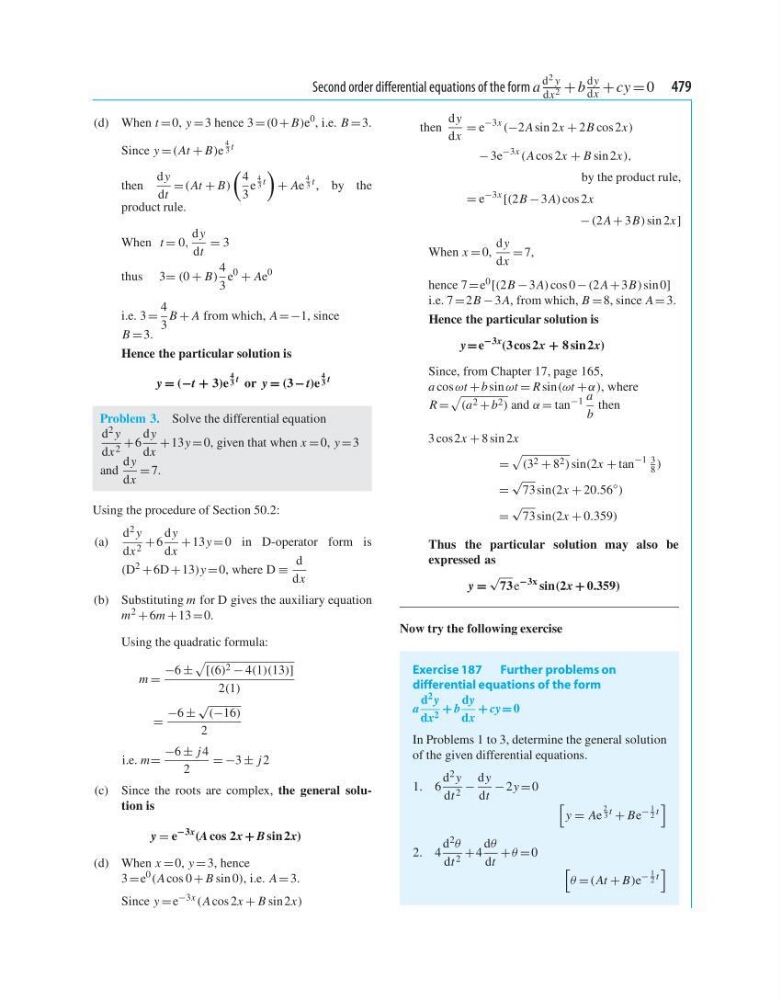
Problem 3. Solve the differential equation
d 2 y
dx 2 + 6
d y
dx
+ 13y = 0, given that when x = 0, y = 3
and
d y
dx
= 7.
Using the procedure of Section 50.2:
(a)
d 2 y
dx 2 + 6
d y
dx
+ 13y = 0 in D-operator form is
(D 2 + 6D + 13)y = 0, where D ≡
d
dx
(b) Substituting m for D gives the auxiliary equation
m 2 + 6m + 13 =0.
Using the quadratic formula:
m =
−6 ±
[(6) 2 − 4(1)(13)]
2(1)
=
−6 ±
√ (−16)
2
i.e. m=
−6 ± j 4
2
= −3 ± j 2
(c) Since the roots are complex, the general solution is
y = e
−3x (A cos 2x + B sin 2x)
(d) When x = 0, y = 3, hence
3 =e
0
(A cos 0 + B sin 0), i.e. A = 3.
Since y = e −3x (A cos 2x + B sin 2x)
then
d y
dx
= e
−3x
(−2 A sin 2x + 2B cos 2x)
− 3e
−3x
(A cos 2x + B sin 2x),
by the product rule,
= e
−3x [(2B − 3 A) cos 2x
− (2 A + 3B) sin 2x]
When x = 0,
d y
dx
= 7,
hence 7 =e 0 [(2B − 3 A) cos 0 − (2 A + 3B) sin 0]
i.e. 7 =2B − 3 A, from which, B = 8, since A = 3.
Hence the particular solution is
y = e
−3x (3 cos 2x + 8 sin 2x)
Since, from Chapter 17, page 165,
a cos ωt + b sin ωt = R sin(ωt + α), where
R =
(a 2 + b 2 ) and α = tan −1 a
b
then
3 cos2x + 8 sin 2x
=
(3 2 + 8 2 ) sin(2x + tan
−1 3
8 )
=
√
73 sin(2x + 20.56
◦
)
=
√
73 sin(2x + 0.359)
Thus the particular solution may also be
expressed as
y =
√
73 e
−3x sin(2x + 0.359)
Now try the following exercise
Exercise 187 Further problems on
differential equations of the form
a
d 2 y
dx 2 + b
dy
dx
+ cy = 0
In Problems 1 to 3, determine the general solution
of the given differential equations.
1. 6
d 2 y
dt 2 −
d y
dt
− 2y = 0
y = Ae
2
3 t
+ Be
− 1
2 t
2. 4
d 2 θ
dt 2 + 4
dθ
dt
+ θ = 0
θ = (At + B)e
−
1
2 t
d 2 y
dx 2 + b
dy
dx + cy = 0 479
(d) When t = 0, y = 3 hence 3 = (0 + B)e
0 , i.e. B = 3.
Since y = (At + B)e
4
3 t
then
d y
dt
= (At + B)
4
3
e
4
3 t
+ Ae
4
3 t , by the
product rule.
When t = 0,
d y
dt
= 3
thus 3= (0 + B)
4
3
e
0
+ Ae
0
i.e. 3 =
4
3
B + A from which, A = −1, since
B = 3.
Hence the particular solution is
y = (−t + 3)e
4
3 t or y = (3 − t)e
4
3 t
Problem 3. Solve the differential equation
d 2 y
dx 2 + 6
d y
dx
+ 13y = 0, given that when x = 0, y = 3
and
d y
dx
= 7.
Using the procedure of Section 50.2:
(a)
d 2 y
dx 2 + 6
d y
dx
+ 13y = 0 in D-operator form is
(D 2 + 6D + 13)y = 0, where D ≡
d
dx
(b) Substituting m for D gives the auxiliary equation
m 2 + 6m + 13 =0.
Using the quadratic formula:
m =
−6 ±
[(6) 2 − 4(1)(13)]
2(1)
=
−6 ±
√ (−16)
2
i.e. m=
−6 ± j 4
2
= −3 ± j 2
(c) Since the roots are complex, the general solution is
y = e
−3x (A cos 2x + B sin 2x)
(d) When x = 0, y = 3, hence
3 =e
0
(A cos 0 + B sin 0), i.e. A = 3.
Since y = e −3x (A cos 2x + B sin 2x)
then
d y
dx
= e
−3x
(−2 A sin 2x + 2B cos 2x)
− 3e
−3x
(A cos 2x + B sin 2x),
by the product rule,
= e
−3x [(2B − 3 A) cos 2x
− (2 A + 3B) sin 2x]
When x = 0,
d y
dx
= 7,
hence 7 =e 0 [(2B − 3 A) cos 0 − (2 A + 3B) sin 0]
i.e. 7 =2B − 3 A, from which, B = 8, since A = 3.
Hence the particular solution is
y = e
−3x (3 cos 2x + 8 sin 2x)
Since, from Chapter 17, page 165,
a cos ωt + b sin ωt = R sin(ωt + α), where
R =
(a 2 + b 2 ) and α = tan −1 a
b
then
3 cos2x + 8 sin 2x
=
(3 2 + 8 2 ) sin(2x + tan
−1 3
8 )
=
√
73 sin(2x + 20.56
◦
)
=
√
73 sin(2x + 0.359)
Thus the particular solution may also be
expressed as
y =
√
73 e
−3x sin(2x + 0.359)
Now try the following exercise
Exercise 187 Further problems on
differential equations of the form
a
d 2 y
dx 2 + b
dy
dx
+ cy = 0
In Problems 1 to 3, determine the general solution
of the given differential equations.
1. 6
d 2 y
dt 2 −
d y
dt
− 2y = 0
y = Ae
2
3 t
+ Be
− 1
2 t
2. 4
d 2 θ
dt 2 + 4
dθ
dt
+ θ = 0
θ = (At + B)e
−
1
2 t